How AI Hiring Software Helps with Remote Interview Scheduling
In the modern hiring environment, remote interview scheduling has become one of the biggest operational challenges.
Although you're already using AI hiring tools for scheduling interviews, simplifying calendars across different time zones, automating hyper-personalized communications, and reminding candidates, as well as necessary stakeholders.
Here's what leading talent acquisition professionals are leveraging through the daily use of AI hiring tools in their recruitment process:
- Increase in productivity: By using AI hiring software to automate tasks like scheduling, pre-screening, and notifications, TA teams worldwide are seeing up to a 75% increase in productivity.
- Resolving hiring challenges on a global scale: HR professionals are utilizing AI hiring technology to automatically sync local time zones and provide 24/7 automated communication, ensuring consistent and responsive engagement for candidates regardless of their location.
- Seamless integration: Fully-fledged, purpose-built AI hiring tools like AiPersy are designed to seamlessly sync with everyday productivity platforms such as Google Calendar, Microsoft Outlook, Zoom, and widely used ATS software.
- Boost candidate satisfaction: By implementing AI recruiting tools, organizations can offer flexible self-scheduling of interviews, automated reminders, and seamless follow-ups with hiring managers for every job seeker.
- Stay globally compliant: The most widely used AI hiring tools are designed with encryption and global compliance standards such as GDPR and SOC 2 in mind.
But how does AI hiring software simplify remote interview scheduling? What’s the science behind it? And which features in these tools actually make remote interview scheduling easier?
We’ll address everything in this guide.
Let’s begin.
What Is Remote Interview Scheduling?
Remote interview scheduling is the process of coordinating interview times between recruiters, hiring managers, and candidates who are located in different places. It typically involves aligning calendar availability, managing time zone differences, and sending video interview links through digital communication tools.
How AI Hiring Tools Improve Remote Interview Scheduling
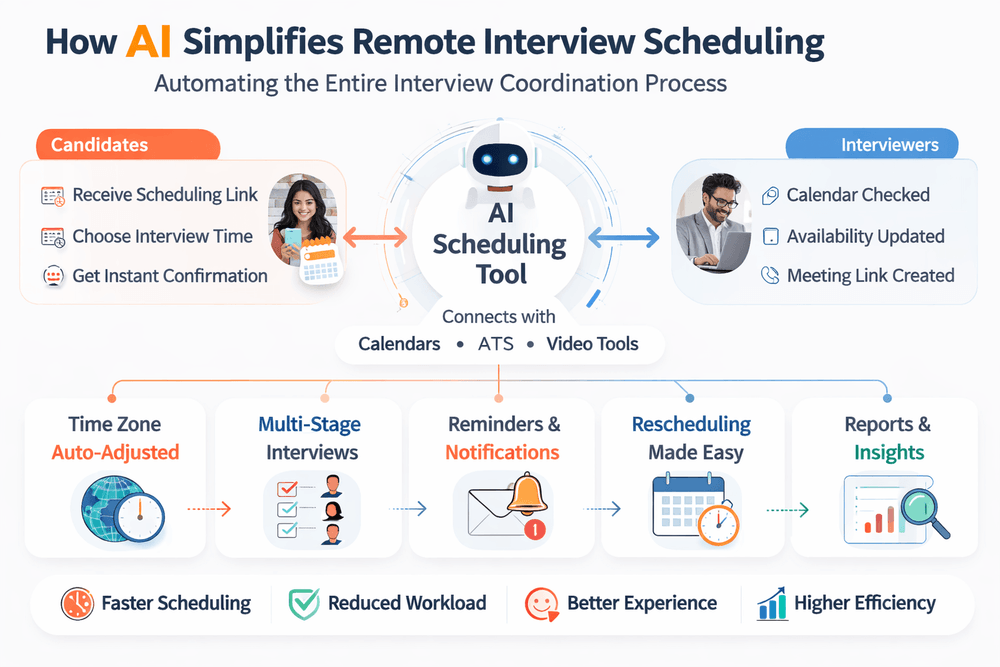
AI hiring tools improve remote interview scheduling by automatically coordinating calendars, detecting time zone differences, and generating interview slots without manual email exchanges.
Instead of recruiters juggling availability across multiple stakeholders within the process, AI scheduling tools in hiring analyze calendars and propose interview times that work for everyone.
Here's how:
Automatic calendar coordination
AI scheduling tools connect with platforms such as Google Calendar, Microsoft Outlook, and ATS systems to detect interviewer availability. This allows recruiters to instantly identify time slots without sending multiple emails.
Time-zone aware scheduling
When hiring across multiple locations, time-zone differences can easily cause scheduling mistakes.
However, AI scheduling tools automatically convert time zones and ensure interview slots appear correctly for both candidates and interviewers.Candidate self-scheduling
Many AI hiring tools provide candidates with automated scheduling links that allow them to select available interview times directly. This removes back-and-forth communication and helps interviews get scheduled faster.
Automated reminders and confirmations
AI scheduling tools in the hiring environment automatically send reminders, interview confirmations, and meeting details through email or messaging platforms to everyone.
As a result, this level of automation within recruitment significantly reduces attendance gaps in interviews.Faster coordination of multi-panel interviews
When scheduling panel interviews manually, TA teams often have to go through several rounds of coordination.
However, AI hiring scheduling tools can scan the availability of multiple interviewers simultaneously and propose the most suitable interview slots.Real-time rescheduling
If an interview needs to be rescheduled, AI-powered scheduling software in hiring can automatically identify the next available time slot and notify all stakeholders without restarting the entire scheduling process.
Why Remote Interview Scheduling Is Difficult for Hiring Teams
Remote interview scheduling becomes difficult to execute when multiple stakeholders, time zones, and interview stages are involved within the hiring pipeline.
Hence, what appears to be a piece of cake often leads to an endless chain of emails, calendar mix-ups, and delays that negatively impact the candidate’s hiring experience.
Here's how:
Time zone coordination
When candidates and interviewers are located in different regions, identifying suitable time slots becomes difficult. Recruiters often have to manually convert time zones and verify availability across calendars.Calendar conflicts
We all know that your hiring managers, recruiters, and interview panels usually have busy schedules. Hence, finding a time that works for everyone can require multiple rounds of communication.Back-and-forth communication
Manual interview scheduling typically involves several emails between recruiters, candidates, and interviewers. This slows down the process and increases the chance of miscommunication.Candidate drop-off
When confirming an interview takes too long, especially in an age where everything is accessible at the blink of an eye, candidates may lose interest or accept other offers. That's why any sort of delay in interview scheduling can directly affect hiring outcomes.
- Last-minute rescheduling
Any unexpected changes in the availability of either the interviewer or the candidate can disrupt the entire interview coordination. Hence, without AI automation in hiring, recruiters often have to restart the scheduling process manually.
AI Scheduling vs Manual Interview Scheduling
Recruiters can coordinate interviews either manually or with AI-powered interview scheduling tools.
While manual scheduling relies on email coordination and calendar checks, AI scheduling automates interview coordination by analyzing availability, proposing time slots, and confirming interviews automatically.
The following comparison highlights the differences between manual interview scheduling and AI scheduling tools.
| Factor | Manual Scheduling | AI Scheduling |
| Time to schedule interviews | 1-3 days | Minutes |
| Email exchanges | 4-8 emails | Often none |
| Time zone handling | Manual | Automatic |
| Candidate scheduling | Recruiter controlled | Candidate self-booking |
| Rescheduling | Manual coordination | Instant rescheduling |
| No-show prevention | Limited | Automated reminders |
In these situations, AI hiring tools simplify remote interview scheduling by removing bottlenecks that cause coordination delays and allow recruiters to focus on evaluating candidates instead of managing calendars iteratively.
This comparison shows why many organizations are replacing manual coordination in hiring with AI-powered interview scheduling software to speed up hiring and reduce recruiter workload.
Benefits of AI for Remote Interview Scheduling
Remote interview scheduling often requires coordinating multiple calendars, time zones, and interview stages. AI scheduling tools simplify this process by automating coordination tasks that traditionally consume recruiter time.
By automating scheduling logistics, AI hiring tools help organizations conduct interviews faster while improving the experience for both recruiters and candidates.
1. Faster interview scheduling
AI scheduling tools automatically scan recruiters' and interviewers' calendars to identify available time slots. Instead of waiting for multiple email replies, candidates can select interview times instantly.
This automation helps reduce scheduling delays and speeds up the hiring process.
According to hiring research from scheduling platforms, recruiters can spend up to 30–40% of their time coordinating interviews, making scheduling one of the most time-consuming administrative tasks in recruiting.
2. Reduced recruiter workload
Manual interview coordination requires recruiters to manage calendars, verify availability, and follow up with candidates.
AI scheduling systems automate these repetitive tasks by:
- proposing interview slots automatically
- coordinating interviewer availability
- sending confirmations and reminders
- handling rescheduling requests
This allows recruiters to focus on higher-value activities such as candidate evaluation and stakeholder communication.
3. Improved candidate experience
Interview scheduling delays can negatively impact candidate engagement. When candidates wait several days for interview confirmations, they may lose interest or accept offers from other companies.
AI scheduling tools improve candidate experience by enabling:
- self-scheduling through interview links
- instant confirmation of interview times
- automated reminders before interviews
- quick rescheduling if conflicts arise
These features create a smoother and more responsive hiring process.
4. Lower interview no-show rates
Interview no-shows are a common challenge in remote hiring processes.
AI scheduling tools help reduce missed interviews by sending automated reminders and confirmations before scheduled interviews. Candidates can also reschedule interviews easily if their availability changes.
This reduces scheduling confusion and improves interview attendance rates.
5. Better visibility into scheduling workflows
AI hiring tools often provide analytics that help recruiting teams monitor interview scheduling performance.
For example, organizations can track metrics such as:
- time to first interview
- rescheduling frequency
- interviewer workload distribution
- candidate response times
These insights help recruiting teams identify bottlenecks and improve hiring workflows.
6. Easier scaling for high-volume hiring
When organizations need to conduct large numbers of interviews, manual scheduling quickly becomes difficult to manage.
AI scheduling systems allow recruiting teams to coordinate interviews at scale without increasing administrative workload.
This is particularly useful for:
- remote hiring teams
- distributed organizations
- high-volume recruiting environments
In these situations, AI tools help companies manage remote interview scheduling efficiently while maintaining a consistent candidate experience.
What Features to Look for in Remote Interview Scheduling Software
Choosing the right remote interview scheduling software can significantly reduce the administrative burden of back-and-forth coordination in a hiring process.
The best tools, like AiPersy, automate scheduling logistics and integrate smoothly with all types of software that recruitment teams use in their daily life.
Therefore, when evaluating interview scheduling software, hiring teams should prioritize features that simplify coordination, improve candidate experience, and reduce scheduling delays.
1. Candidate self-scheduling
Self-scheduling allows candidates to choose interview times directly from available slots.
Instead of exchanging multiple emails, candidates can book interviews through scheduling links that connect with the recruiter and interviewer calendars.
This feature helps:
- eliminate scheduling back-and-forth
- speed up interview confirmations
- give candidates more flexibility when selecting interview times
2. Automated reminders and notifications
Interview scheduling tools should automatically send reminders to candidates and interviewers before scheduled interviews.
These reminders can be delivered through:
- email notifications
- SMS messages
- calendar alerts
Automated reminders in a hiring process help reduce interview no-shows and keep both candidates and interviewers informed about upcoming meetings.
3. Calendar integration
Effective scheduling tools integrate with commonly used calendar platforms such as:
- Google Calendar
- Microsoft Outlook
- Office 365
This integration allows scheduling systems to detect interviewer availability automatically and avoid conflicts when proposing interview slots.
4. Video interview integration
Since many organizations conduct remote interviews, scheduling software should automatically generate video meeting links for platforms like:
- Zoom
- Microsoft Teams
- Google Meet
This ensures candidates receive the correct meeting links along with their interview confirmations.
5. Centralized candidate records
Remote interview scheduling software should also provide a centralized view of candidate information.
Instead of managing separate spreadsheets or email threads, recruiters can access candidate profiles, resumes, and interview history within the same system.
This helps recruiting teams track interview progress more efficiently.
6. Integration with ATS platforms
Interview scheduling tools should integrate with applicant tracking systems so that candidate data and interview schedules remain synchronized.
Common ATS integrations include:
- Greenhouse
- Lever
- Workday
- SmartRecruiters
This integration helps recruiting teams maintain consistent hiring workflows without switching between multiple tools.
7. Transparent pricing and scalability
Organizations should also evaluate pricing models and scalability when selecting a scheduling software for hiring.
The right solution should:
- support growing hiring volumes
- offer flexible pricing tiers
- allow teams to upgrade features as recruiting needs evolve
Choosing scalable tools ensures the scheduling system can support future hiring growth.
When Remote Interview Scheduling with AI Hiring Tools Works Best
AI-powered scheduling tools deliver the most value when interview coordination becomes complex or time-consuming. In hiring environments where multiple calendars, time zones, and interview stages must be managed simultaneously, AI tools help automate scheduling logistics and reduce delays.
Organizations typically benefit the most from remote interview scheduling with AI hiring tools in the following scenarios.
1. High-volume hiring environments
When recruiters need to coordinate interviews for many candidates, manual scheduling quickly becomes inefficient. Sending emails, confirming availability, and rescheduling interviews can take hours each week.
AI scheduling tools automate these tasks by proposing interview slots automatically and allowing candidates to book interviews directly.
This makes them especially useful for:
- campus hiring
- seasonal hiring
- large recruitment campaigns
2. Global or distributed hiring teams
Remote hiring often involves candidates and interviewers located in different time zones.
AI scheduling tools automatically adjust interview times based on each participant’s location, preventing time zone errors and missed interviews.
This is particularly valuable for:
- global companies
- remote-first organizations
- distributed hiring teams
3. Multi-stage interview processes
Many roles require several interview rounds involving different stakeholders. Coordinating these stages manually can slow down the hiring process.
AI tools help streamline multi-stage interviews by:
- scheduling interview rounds automatically
- coordinating interviewer availability
- managing rescheduling requests efficiently
This helps organizations maintain momentum throughout the hiring process.
4. Small recruiting teams with limited resources
Small or growing companies often have limited HR staff managing multiple hiring tasks simultaneously.
AI scheduling tools reduce the administrative workload associated with interview coordination, allowing recruiters to focus on higher-impact tasks such as candidate evaluation and hiring decisions.
5. Remote-first hiring workflows
Organizations that conduct most interviews virtually rely heavily on scheduling systems to coordinate video interviews.
AI hiring tools simplify remote interview scheduling by automatically generating meeting links, sending reminders, and managing interview logistics across digital platforms.
6. Hiring processes that prioritize candidate experience
Candidates expect fast responses and flexible scheduling options during the hiring process.
AI scheduling tools enable candidates to choose interview times that work best for them, improving responsiveness and reducing scheduling delays.
This helps companies create a smoother and more professional hiring experience.
Final Words
Remote interview scheduling has become a critical part of modern hiring workflows, especially as organizations increasingly recruit candidates across locations and time zones.
However, coordinating interview availability manually often creates delays, scheduling conflicts, and unnecessary administrative work for recruiters.
AI hiring tools like AiPersy simplify remote interview scheduling by automating calendar coordination, managing time zones, sending reminders, and allowing candidates to schedule interviews directly.
These capabilities reduce scheduling bottlenecks while improving both recruiter productivity and candidate experience.
Instead of spending hours coordinating calendars, recruiting teams can focus on evaluating candidates and making hiring decisions faster.
Modern AI hiring platforms are designed to support this shift by handling the operational logistics of scheduling while keeping recruiters in control of hiring outcomes.
Tools like AiPersy are built with a human-in-the-loop approach ensure automation improves efficiency without removing human judgment from the hiring process.
As remote hiring continues to expand, organizations that adopt automated scheduling workflows will be better positioned to reduce hiring delays, maintain consistent candidate experiences, and scale recruitment operations efficiently.