AI Recruitment Software Explained for Non-Technical Teams
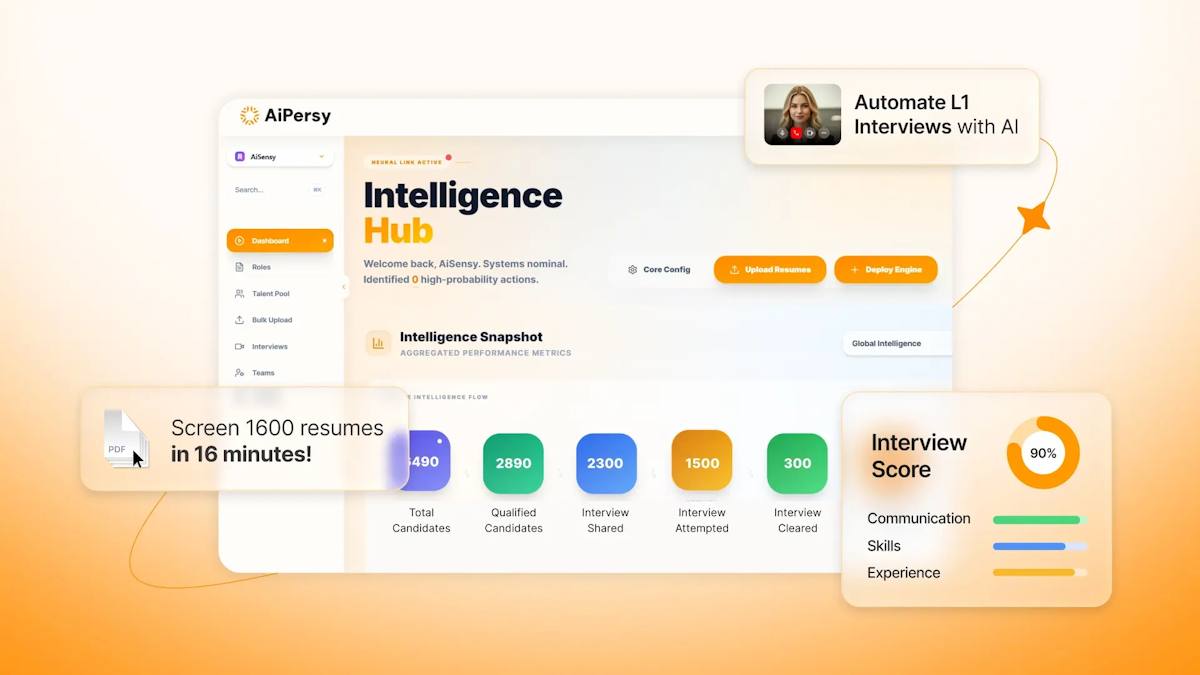
“This year 55% of companies are increasing their investment in recruitment automation.”
This stat clearly states that AI is no longer an experimental add-on in hiring.
It is becoming a standard part of how hiring teams manage growing candidate volumes, tighter timelines, longer screening hours, repetitive coordination, and everything under the sun
Yet many of the people expected to use AI recruitment software are not technical specialists.
Hiring managers, HR partners, and operations teams interact with these tools daily, often without a clear understanding of what the software actually does or where it fits in the hiring process.
As a result, expectations and outcomes do not always align.
This guide explains AI recruitment software in simple terms. It focuses on how these tools are commonly used today, what problems they are designed to solve, and where their limits are.
The goal is clarity. By the end, you should be able to understand what AI recruitment software is, how it operates day-to-day, and how to harness it as a driving force behind your recruitment funnel.
What AI recruitment software actually means
AI recruitment software is software that uses artificial intelligence to help hiring teams manage and evaluate candidates during the recruitment process.
It supports tasks like reviewing resumes, matching candidates to role requirements, handling early communication, and organizing hiring workflows at scale.
Unlike traditional hiring systems that mainly store applications or track stages, AI recruitment software actively assists with evaluation by applying predefined rules and patterns to large volumes of candidate data.
These rules are set by humans, and the software follows them consistently.
AI recruitment software does not make final hiring decisions. It is designed to support recruiters and hiring managers by reducing manual effort in early-stage hiring, while interviews, judgment, and selection remain human-led.
In simple terms, AI recruitment software helps teams process candidates more systematically, without replacing human decision-making.
How AI recruitment software is used in hiring today
We’re in an era where AI recruitment software is mainly used to support the early and operational parts of hiring.
Talent acquisition teams rely on it when they are dealing with many candidates at once and need help organizing, reviewing, and coordinating work that would otherwise be manual.
In most hiring processes, the software is used after resumes or applications are received. It helps review candidate information, compare profiles against role requirements, and surface candidates who meet predefined criteria.
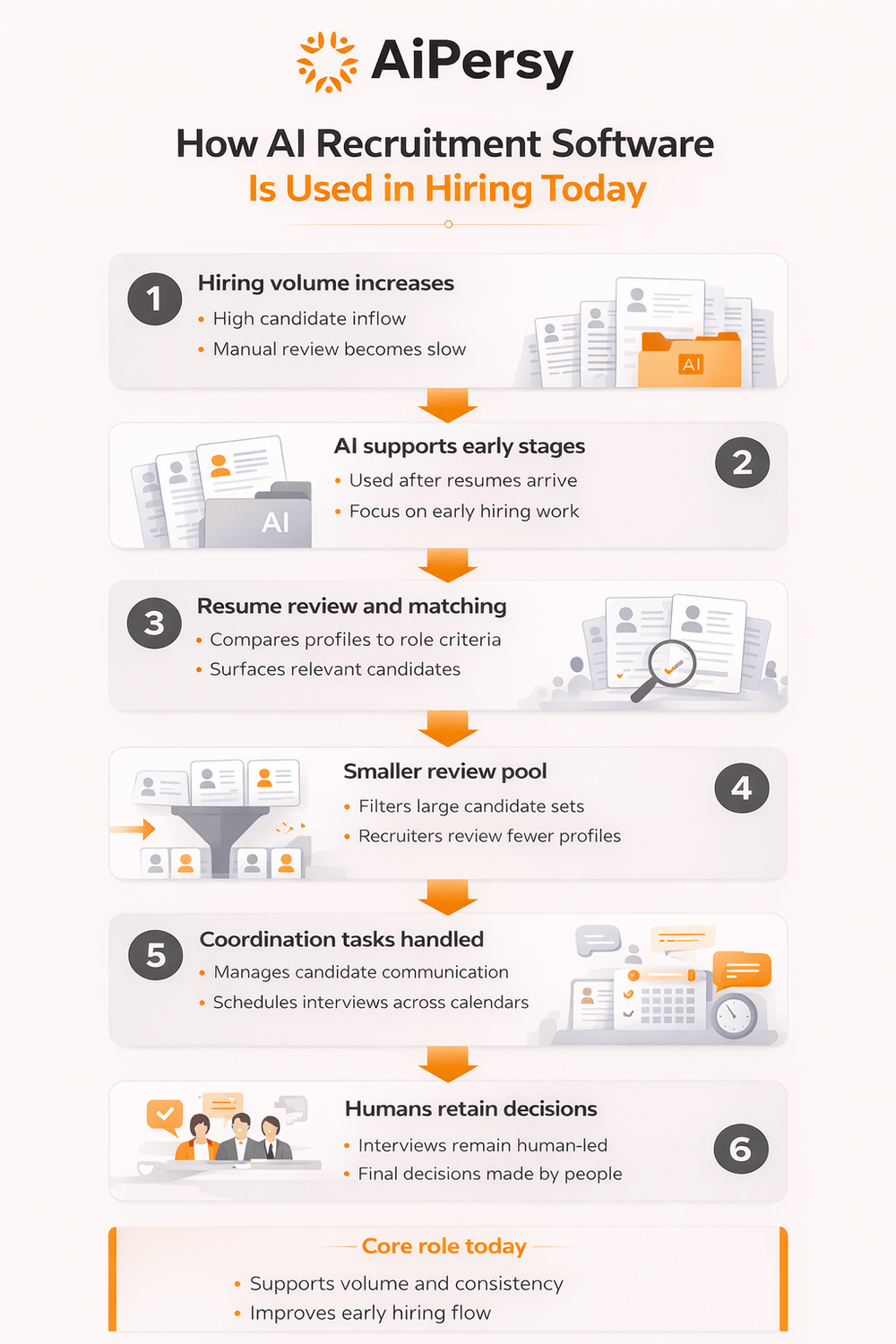
This allows recruiters and hiring managers to focus their attention on a smaller, more relevant group of candidates rather than starting from a large, unfiltered pool.
AI recruitment software is also commonly used to handle coordination tasks.
This includes managing candidate communication, answering basic questions, and scheduling interviews across different calendars.
These activities happen continuously during hiring and do not require human judgment for each step.
Importantly, AI recruitment software supports hiring teams rather than replacing them. Interviews, evaluations, and final decisions are still made by people.
The software’s role today is to assist with volume, consistency, and coordination, especially in the early stages of the hiring process.
What AI recruitment software can and cannot do
AI recruitment software is designed to assist hiring teams with structured, repeatable work.
It performs best when tasks are clearly defined and applied consistently across many candidates.
In practice, AI recruitment software can review large volumes of resumes, compare candidate information against role requirements, and surface profiles that meet predefined criteria.
It can also support sourcing, manage interview scheduling, and handle basic candidate communication. These activities reduce manual effort and help teams stay organized when hiring at scale.
However, AI recruitment software cannot make hiring decisions on its own. It does not decide who should be hired, assess cultural fit, or take responsibility for outcomes.
Final judgments remain a human responsibility because hiring decisions involve context, accountability, and legal obligations that software cannot assume.
For this reason, human oversight is a standard requirement. Hiring teams review AI-generated recommendations, validate shortlists, and intervene when results need adjustment.
Employers remain responsible for fairness, compliance, and candidate experience, regardless of how much automation is used.
In a brief, AI recruitment software supports hiring by handling routine evaluation and coordination. People remain in control of judgment, accountability, and final decisions.
How AI recruitment software fits into the hiring process
AI recruitment software does not replace the hiring process. It fits into specific stages within a recruitment funnel that is still owned and controlled by people.
In most organizations today, AI recruitment software is used after a role is defined and candidates enter the pipeline.
Once resumes or applications are received, the software helps review candidate information, compare profiles against role criteria, and organize candidates into shortlists.
This happens before interviews begin and reduces the need for manual sorting at scale.
During the interview phase, AI recruitment software often supports coordination rather than evaluation.
It manages interview scheduling, candidate updates, and workflow movement between stages.
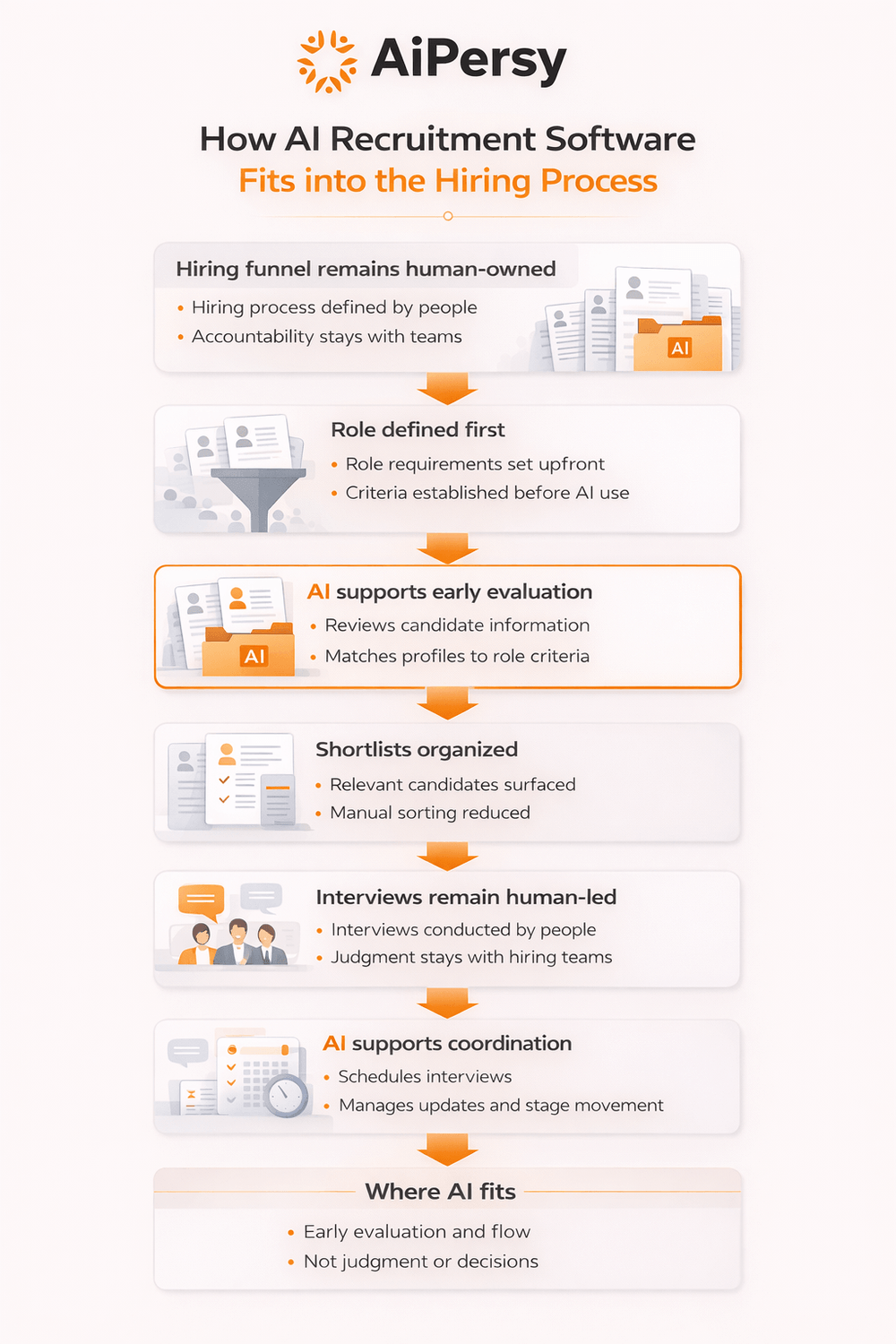
In some cases, it assists with documenting or structuring early assessments, but interviews themselves remain a human-led activity.
AI recruitment software does not sit at the end of the hiring process. Final decisions, offer approvals, and accountability stay with recruiters and hiring managers.
Although AI may surface recommendations or rankings, people validate those inputs, apply context, and take responsibility for outcomes.
In simple terms, AI recruitment software fits around early evaluation and process flow, not judgment.
It supports movement, consistency, and organization within hiring, while humans retain control over decisions and responsibility.
AI recruitment software vs traditional ATS software
AI recruitment software and applicant tracking systems (ATS) are often mentioned together, but they solve different problems in hiring.
Understanding the difference matters because many talent acquisition teams expect one tool to do the job of the other, and that mismatch is where confusion, slowdowns, and poor hiring decisions usually start.
What an ATS is designed to do
An applicant tracking system manages the hiring process.
It acts as a centralized system where teams collect applications, store resumes, move candidates through defined stages, schedule interviews, and maintain records for compliance and reporting.
In simple terms, an ATS answers operational questions like:
- Where is this candidate in the pipeline?
- Has feedback been submitted?
- Has an interview been scheduled?
- Have we documented this decision correctly?
An ATS brings structure, consistency, and visibility to hiring. It does not decide which candidates are strongest; it tracks what happens after candidates enter the system.
What AI recruitment software is designed to do
AI recruitment software focuses on evaluation and prioritization.
Instead of only storing candidates, it analyzes resumes, profiles, and interactions to help teams identify who should be reviewed first and why.
In practical use, AI recruitment software helps teams:
- Rank candidates based on skills and role fit
- Surface strong candidates who may not match keywords exactly
- Reduce manual resume screening in high-volume roles
- Highlight patterns humans miss when volume increases
AI recruitment software answers decision-oriented questions like:
- Who looks most relevant for this role?
- Which candidates should move forward next?
- Where are we likely wasting time reviewing low-fit profiles?
How they differ in the hiring workflow
The difference becomes clearer when you look at where each tool operates.
An ATS sits across the entire hiring workflow and records movement from stage to stage.
AI recruitment software operates within or alongside that workflow, influencing which candidates enter stages, move faster, or require human review.
In a nutshell:
- An ATS manages the process
- AI recruitment software supports judgment
Do they replace each other?
No. AI recruitment software does not replace an ATS, and an ATS does not replace AI recruitment software.
Most hiring teams use both together:
- The ATS acts as the system of record
- AI tools integrate into the ATS or run alongside it, feeding insights back into the system where teams track and finalize decisions
This setup allows teams to keep hiring compliant and organized while reducing manual effort in screening and shortlisting.
A simple way to remember the difference
If you strip everything down to first principles:
- An ATS tells you what is happening in the hiring pipeline
- AI recruitment software helps you decide who should be looked at next
How non-technical teams should evaluate AI recruitment software
Non-technical teams don’t need to understand how AI is built to evaluate it well.
They only need to understand where hiring slows down, where decisions feel unreliable, and where human effort gets wasted.
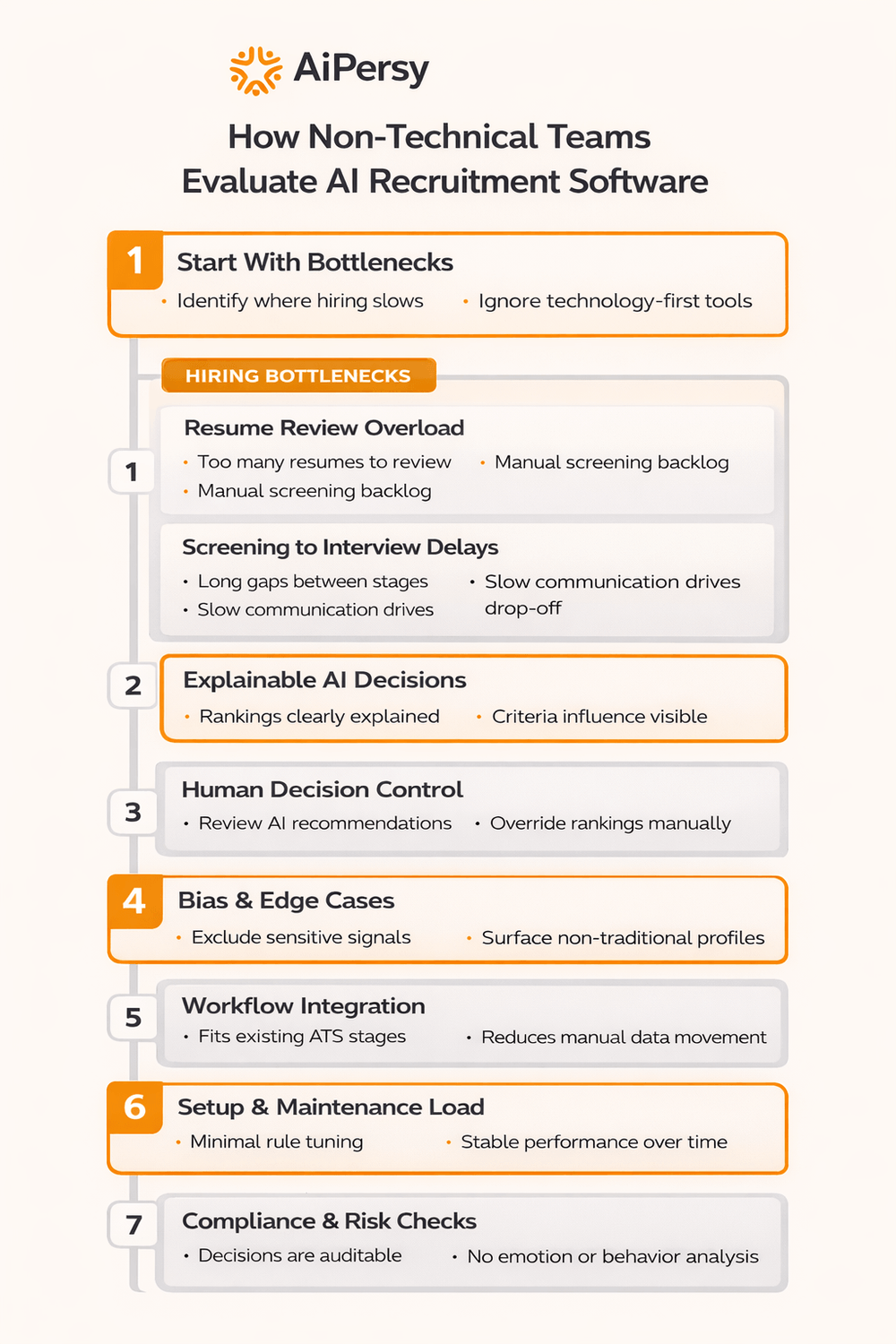
Here’s how evaluation of such tools should start:
Start with the hiring bottleneck, not the technology
Before looking at vendors, hiring teams should identify the exact problem they want to fix. Common bottlenecks include:
- Too many resumes to review
- Long delays between screening and interviews
- Inconsistent shortlisting across recruiters
- Candidates dropping off due to slow communication
Teams should assess AI recruitment software based on how directly it reduces these bottlenecks.
If the tool does not remove a real delay or decision burden, it adds complexity instead of value.
Check whether the AI recruiter can explain its decisions
HR teams should check whether the AI can clearly explain its decisions. The software should show:
- Why it ranked one candidate above another
- Which skills, experience, or criteria influenced the outcome
- What caused a candidate to move forward or drop out
If the software produces scores or rankings without explanations, teams cannot trust or defend its output.
Lack of explanation also makes audits, reviews, and internal alignment difficult.
Confirm stakeholders stay in control of decisions
TA teams should confirm that the hiring workflow keeps relevant stakeholders in control.
An AI recruiting software should support decisions, not finalize them. Recruiters and hiring managers must be able to:
- Review AI recommendations
- Override rankings when needed
- Approve or reject candidates manually
If the system automatically rejects candidates without human review, it increases legal and fairness risk instead of reducing it.
Verify how the system handles bias and edge cases
HR teams should verify that the AI recruiting tool excludes sensitive or proxy data during screening.
This includes checking whether the AI ignores:
- Names, photos, or gendered language
- Schools, locations, or graduation years used as indirect signals
- Signals unrelated to job performance
Recruiters should also check whether the system surfaces strong but non-traditional candidate profiles.
A useful system identifies transferable skills instead of filtering only for familiar titles or keywords.
Evaluate integration with existing tools
Teams should assess how easily the AI fits into their current hiring workflow. Key questions include:
- Does it integrate with the existing ATS?
- Does it reduce manual data movement?
- Does it work inside current stages or force new ones?
If the AI requires recruiters to operate in parallel systems, adoption drops and errors increase.
Measure setup effort and ongoing maintenance
Hiring teams should assess how much configuration the software requires to remain effective.
Important considerations include:
- Whether recruiters must constantly tune rules or weights
- How often do models need retraining
- Whether performance degrades without ongoing adjustments
AI recruiting tools that require heavy setup or frequent tuning usually shift work instead of removing it.
Validate compliance, privacy, and risk boundaries
TA teams should check how the vendor handles compliance and data protection.
Red flags include:
- The vendor cannot explain how the system makes decisions
- The system uses emotion, facial, or behavioral analysis
- The vendor refuses to share audit or bias documentation
Responsible tools clearly document how they process data, how they manage risk, and how hiring teams can audit outcomes.
Final Words
Many HR professionals describe AI recruitment software as complex. However, in practice, it isn’t.
Most modern AI recruitment systems are designed to:
- Process large numbers of resumes at once
- Rank and group candidates consistently
- Keep hiring moving when people are unavailable
- Reduce manual sorting and follow-ups
They are not designed to:
- Make final hiring decisions
- Replace recruiter judgment
- Understand context without human input
- Explain outcomes unless they’re built to do so
This is why AI recruitment software works best when it removes waiting and repetition, not responsibility.
When evaluating or using these systems, non-technical teams don’t need to understand how models are built. They need to understand where AI fits and where humans stay in control.
If a system helps your team move faster without hiding how decisions are made, it’s doing what AI recruitment software is meant to do.
If it replaces visibility, explainability, or human oversight, it’s no longer simplifying hiring; it’s just moving complexity somewhere else.
That distinction is enough to understand how AI recruitment software actually works in practice.