10 Core Use Cases of AI in Recruitment
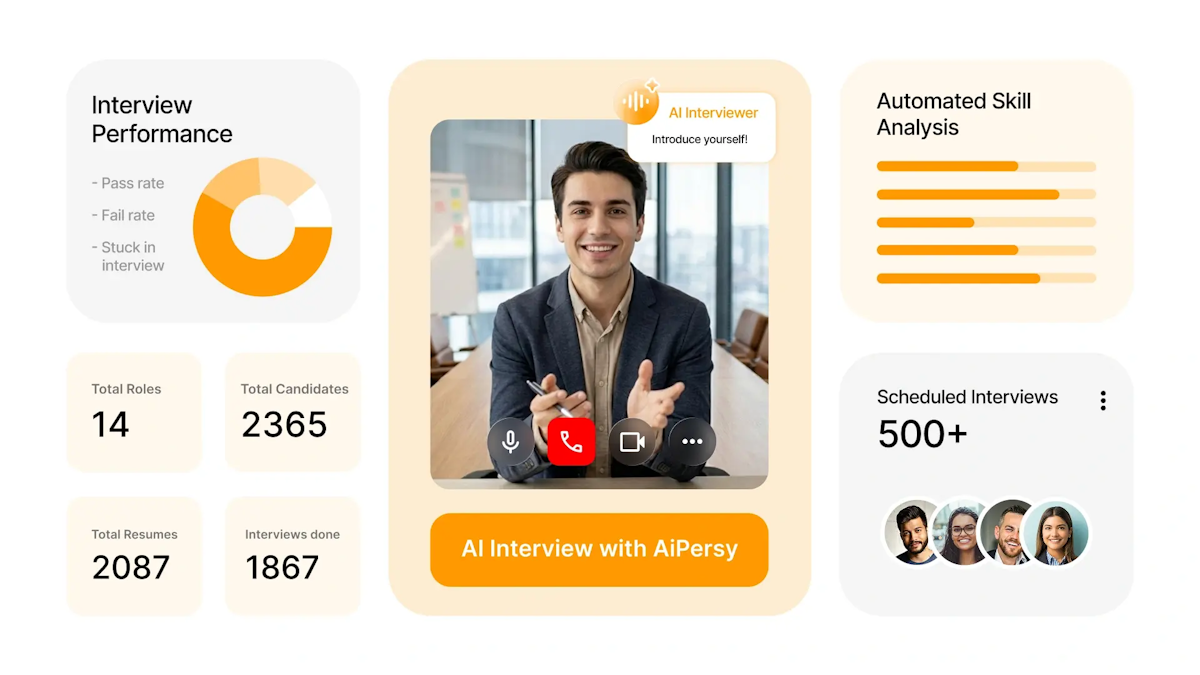
Like every major evolution, AI has completely transformed the way candidates apply for jobs and how companies hire.
And HR teams have felt that shift more than anyone else.
However, before AI went mainstream, Applicant Tracking Systems (ATS) were a valuable asset for the talent acquisition sector.
But with the advent of AI, candidates began using AI resume builders to generate optimized resumes in a minute and apply them in bulk with a single click.
What used to be a steady flow of applicants quickly became a flood, not hundreds, but sometimes thousands of resumes hitting an ATS overnight.
While ATS tools can filter duplicates or surface basic keyword matches, they can’t reflect which candidates actually understand their craft, who’s great at communicating, or who only looks impressive because AI wrote their resume.
However, since the arrival of AI in recruitment, HR teams can finally keep up.
According to research, 67% of organizations have already equipped their hiring teams with AI for various recruitment processes.
It includes: screening candidates, coordinating interviews, managing scheduling complexities, maintaining consistent conversations, and even conducting structured first-round interviews.
But what can AI, as a complete entity, actually do inside a hiring process?
How are fast-growing companies using this technology to scale effectively?
In this guide, we’ll break down the 10 core use cases of AI in recruitment and show how leading companies are using them to hire faster, fairer, and at scale.
Let’s get into it.
What is AI recruitment software?
AI recruitment software uses AI (Artificial Intelligence) to automate the hiring process. Be it screening resumes, scheduling, and rescheduling interviews, and whatnot.
Instead of managing the entire recruitment process manually, these tools operate like intelligent systems that can analyze resumes, understand candidate profiles, and even interact with applicants autonomously.
On the other hand, traditional ATS platforms only automate resume screening and organize job applications.
They help recruiters with job postings, resume collection, and keyword scanning and ranking candidates based on the job description.
Adding an extra edge to that, AI interviewer tools work 24/7 within a recruitment pipeline.
They autonomously scan profiles, sync candidates to roles, conduct conversations, evaluate responses, summarize interviews, assist hiring managers, and remove the repetitive steps that slow down hiring teams.
AI recruitment software typically falls into a few major categories:
Talent Intelligence & Sourcing Tools
The tools in this category help recruiters work more efficiently by scanning numerous profiles, job portals, and relevant data sources to build a funnel with the best-fit candidates.
Screening & Resume Parsing Tools
Resume parsing tools automate the “scanning resumes” part of a hiring process. Many industry professionals use them to automate résumé extraction, matching, and ranking.
Communication & Interviewing Tools
As the name suggests, these are also known as AI interviewers.
Leading companies are already using them to automate tasks related to one-on-one interactions.
This includes conducting candidate conversations, running first-round interviews, asking dynamic questions, scoring answers, generating summaries, and keeping the pipeline moving even when recruiters are offline.
Job Description & Content Optimization Tools
These tools are limited to writing interactive job descriptions, outreach messages, and interview-related questions.
Automation & Scheduling Tools
Recruitment teams use these tools to automate administrative tasks in a hiring process, including scheduling, follow-ups, reminders, and status updates.
Calendly, Zapier, and Fetcher are some relevant examples in this category.
Every day, AI interviewer tools are replacing traditional ATS software because they can automatically screen, interview, evaluate, summarize, and rank candidates, thereby accelerating the entire recruitment funnel.
That’s the major reason why fast-growing recruitment teams are shifting from AI parsing and ATS tools to AI recruitment software as their primary asset.
10 Core Use Cases of AI in Recruitment for Fast-Growing Companies
Fast-growing companies have already recognized that AI in recruitment isn’t just a luxury; it’s a necessity.
They're rapidly equipping their hiring teams with the AI Interviewer tools and are already clocking remarkable numbers.
The following 10 most critical, real-world use cases of AI in recruitment illustrate how AI agents can give hiring teams a cutting edge.
Automated Resume Screening
One of the earliest and most widespread uses of AI in recruitment is the automation of resume screening.
Instead of recruiters manually opening hundreds of resumes, AI systems extract skills, experience, certifications, and contextual indicators within seconds, generating a list of the most relevant candidates.
For talent acquisition teams facing overwhelming applicant volumes, this ensures that top candidates surface instantly, long before manual screening begins.
For founders and business leaders, this means roles don’t sit idle while the hiring pipeline moves slowly; the process accelerates from the first touchpoint.
AI Interviewers Conducting First-Round Interviews Automatically
AI interviewers have been a breakthrough in modern recruitment because they don’t just “read” resumes; they evaluate human ability.
These AI agents conduct structured first-round interviews through text, voice, video, or avatar, without requiring a single minute from recruiters or hiring managers.
They assess communication clarity, problem-solving, reasoning, role-specific knowledge, and how well candidates explain their past work.
Recruiters receive structured reports instantly, hiring managers save hours otherwise spent on initial screenings, and leadership teams finally get a consistent, unbiased way to evaluate talent at scale.
Multi-Role Candidate Matching Across the Organization
Fast-growing companies often have multiple open roles at once, and the best candidates are frequently a fit for more than one position.
AI in recruitment automatically identifies these overlaps. Instead of relying on a recruiter’s memory or manual tracking, AI systems map a candidate’s skills and experience against all open roles and suggest ideal fits.
This prevents strong candidates from slipping through cracks and allows hiring managers to discover talent they wouldn’t have considered, increasing overall hiring efficiency without inflating headcount.
Automated Interview Scheduling and Smart Rescheduling
Scheduling interviews has long been one of the most frustrating bottlenecks in recruitment.
AI eliminates this entirely by coordinating between calendars across the organization, identifying mutual availability, and automatically booking interviews.
If a candidate or hiring manager needs to reschedule, the system recalculates availability instantly.
For HR teams, this removes hours of administrative back-and-forth. For candidates, it creates a smoother experience.
And for leadership teams, it ensures hiring momentum never slows because logistics get in the way.
AI Chatbots and Candidate Engagement Assistants
One of the biggest frustrations candidates face is the “black hole” after applying.
AI chatbots solve this by engaging candidates instantly, answering their questions about roles, guiding them through next steps, and helping them understand the company’s hiring process.
As a result, recruiters no longer struggle to respond to every inquiry, and hiring managers benefit from significantly higher candidate engagement rates.
This use case is significant for fast-growing companies where employer brand and responsiveness directly influence offer acceptance.
AI-Generated Job Descriptions and Talent Marketing Content
Writing job descriptions is more than a creative task; it directly impacts the quality and diversity of applicants.
AI recruitment tools help companies generate role descriptions, highlight the right skill sets, remove bias language, and tailor content to various seniority levels or regions.
For recruiters, this reduces JD creation time from hours to minutes. For HR leaders, it ensures consistency in role clarity across departments.
And for founders or business leaders, well-structured JDs attract higher-quality talent from the start, reducing downstream costs.
Automated Skills Assessments and Objective Scoring
In technical, communication-heavy, or analytical roles, AI plays a major role in assessing real-world skills.
Whether it’s coding challenges, writing tasks, sales simulations, or problem-solving assessments, AI systems evaluate submissions using consistent scoring models.
Recruiters no longer need to manually sift through assignments, hiring managers receive objective results they can trust, and leadership teams gain confidence that candidate quality is driven by performance, not by guesswork or inconsistent reviewer standards.
AI-Generated Interview Summaries, Notes, and Scorecards
Note-taking during interviews is one of the least strategic yet most necessary tasks in recruitment.
AI interviewers remove this burden entirely by producing structured summaries after each interview.
These summaries highlight strengths, concerns, reasoning style, communication clarity, skill match, and recommended next steps.
For hiring managers, this means they can review candidates in minutes, even if they weren’t present for the first-round interview.
For TA teams, it creates consistent documentation across all candidates, something that becomes essential as companies scale.
Predictive Hiring Analytics and Success Forecasting
Modern AI recruitment software analyzes historical hiring patterns, performance data, tenure, and skill signals to predict how well a candidate is likely to perform in a specific role.
This enhances decision-making for TA leaders, guides hiring managers toward stronger selections, and gives founders and executives confidence that hiring decisions are data-backed.
Predictive insights help avoid costly mis-hires, reduce turnover, and strengthen long-term talent strategy, critical factors for companies scaling rapidly.
End-to-End Workflow Automation Across the Recruitment Pipeline
The greatest advantage of AI in recruitment is its ability to unify the entire hiring funnel.
Instead of recruiters juggling dozens of manual tasks like sourcing, screening, interviewing, summarizing, scheduling, sending reminders, following up, and syncing with hiring managers, AI streamlines and automates the entire workflow.
Recruiters finally get the bandwidth to focus on meaningful human interactions, hiring managers get faster decisions, and leadership teams benefit from a significantly compressed time-to-hire.
This full-stack automation is what separates modern fast-growing companies from those stuck in traditional hiring models.
Final Words
Nowadays, the pace at which a company grows is ultimately determined by how quickly it hires.
And as applicant volumes surge, job roles multiply, and competition for top talent intensifies, the gap between traditional hiring and AI-powered recruitment widens dramatically.
What once relied heavily on manual screening, endless coordination, and intuition-driven decisions is now being led by AI interviewers, intelligent automation, and predictive insights.
Fast-growing companies aren’t adopting AI in recruitment because it’s a trend; they’re adopting it because the old way simply can’t keep up.
AI recruitment software screens faster, interviews instantly, summarizes objectively, and automates the administrative weight that once consumed most of a recruiter’s day.
The result is a recruitment funnel that runs consistently, fairly, and at a pace aligned with modern business demands.
But having an AI in recruitment doesn’t imply replacing humans; it gives them a cutting edge.
It means recruiters can focus on real conversations instead of repetitive tasks.
Hiring managers make clearer, data-backed decisions. Leadership teams finally gain visibility into a predictable, scalable hiring pipeline.
And candidates experience a process that feels transparent, responsive, and bias-free.
If your company is scaling, the question isn’t whether AI fits into your hiring strategy; it’s how quickly you can integrate it before your competitors do.
Because the organizations embracing AI interviewers today are the ones closing roles faster, hiring better talent, and building teams that can win in the market.
The future of recruitment isn’t automated or human; it’s both, working in synergy. And for fast-growing companies, that future has already begun.