How to Use AI in Hiring (Without Slowing It Down)
“By 2025, nearly 99% talent acquisition leaders applied artificial intelligence in some form across their hiring processes.”
You’re already using AI to screen resumes, streamline interview scheduling, and organize the candidate data.
Yet your performance metrics still feel stuck, you sense something is off in how you’re using AI, or perhaps there’s a tip, trick, or strategy in recruitment that you still need to discover.
This is why, through this guide, we’re removing that complexity from your daily use of AI in different segments of hiring.
This guide is designed to remove that complexity from your daily use of AI. Here’s what you’ll take back to your desk after this quick read:
- Crystal clear knowledge of AI and its actual effects on talent acquisition.
- Practical ways to leverage the benefits of AI and tackle the key challenges in hiring.
- A deep dive into where recruitment is heading and how to stay ahead of the next shift in AI.
- A breakdown of the AI-powered hiring tech purpose-built to make every recruiter’s life easier and ensure smoother experiences for candidates.
Let’s begin…
What Does “AI in Hiring” Mean?
AI in hiring means using technologies like machine learning, natural language processing, and predictive analytics directly within talent acquisition processes.
Here, instead of indulging in repetitive tasks, TA teams use AI to source candidates, screen resumes, assess skills, and even manage scheduling to hire quickly but smartly with more objective decisions.
By shifting routine work to AI, hiring leaders free up time to focus on strategy, while data helps surface top talent without the bias that often influences human judgment.
How to use AI in hiring processes in 2026?
Implementing AI in hiring doesn’t always lead to faster time‑to‑hire or more thoughtful decisions behind each shortlist. So, how exactly are hiring teams using AI in 2026?
That’s why, while building AiPersy, we sat down with hiring leaders worldwide and listened closely to the challenges they face every day with AI in recruitment.
The result is this curated checklist to use AI in hiring in the right way, being used by leading TA teams.
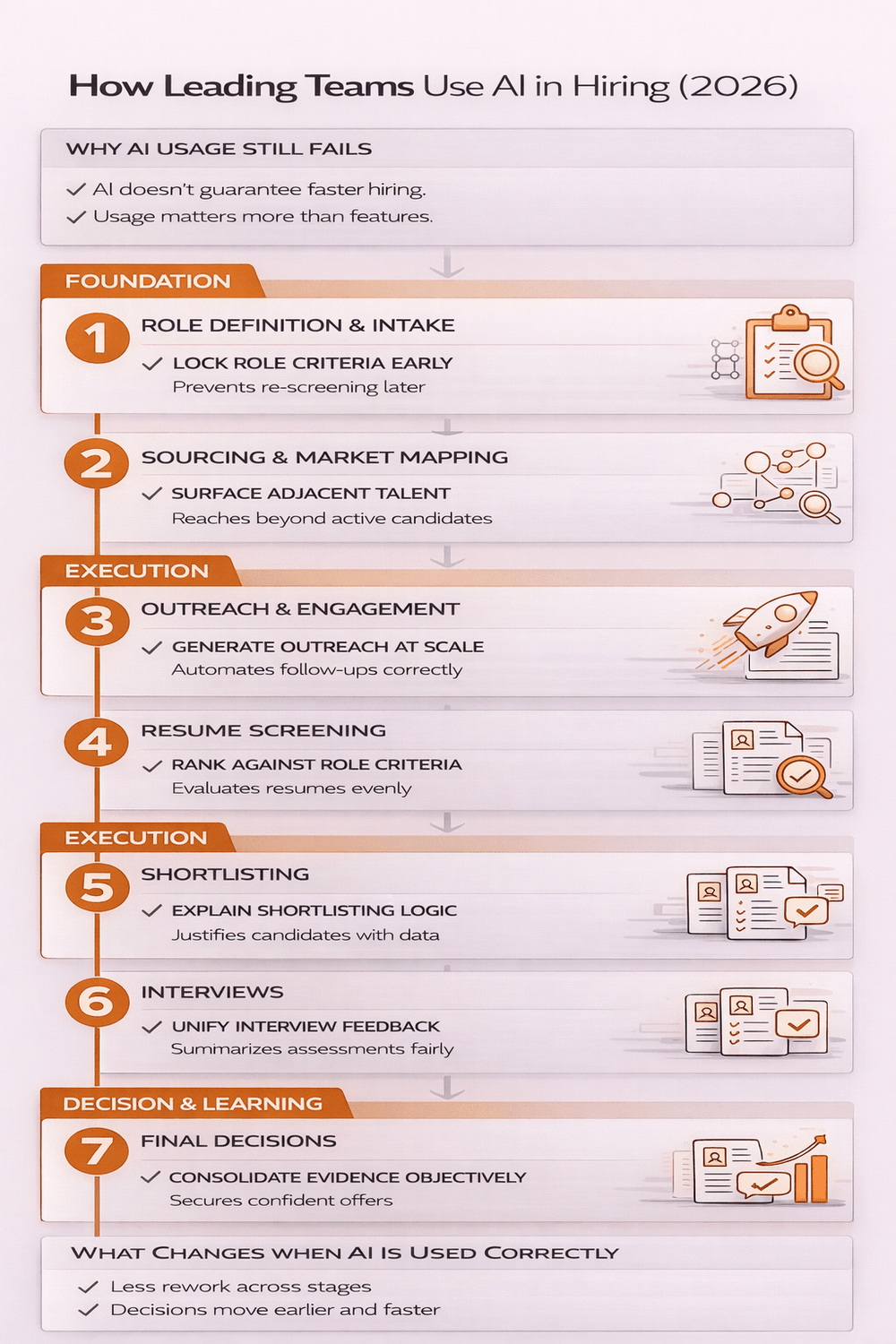
Stage 1: Explaining the Hiring Role Definition & Intake
What AI does: Recruiters use AI to structure the raw inputs provided by the hiring managers for a vacancy into structured role criteria.
What it fixes: Implementing AI in stage 1 of hiring saves recruiters from rework on shortlisted candidates (which basically means screening new candidates again for the same role) because the job description keeps changing.
Because AI locks in what you're looking for early, so screening doesn't fall apart later.
Stage 2: Sourcing & Market Mapping
What AI does: It helps recruiters identify passive talent (people who aren’t actively applying for jobs but may be open to opportunities if approached) and candidates from adjacent roles or industries that they wouldn't typically find in a manual search.
What it fixes: AI saves TA teams from wasting bandwidth on repetitive back‑and‑forth searches across job platforms like LinkedIn, keeping recruiters focused on building meaningful hiring pipelines instead of chasing the same profiles
Stage 3: Outreach & Candidate Engagement
What AI does: Recruiters use AI to generate personalized outreach drafts and automated follow-up communication so they aren't starting every conversation from scratch.
What it fixes: It prevents the loss of candidate interest and momentum that happens when recruiters get tied up in other tasks and miss follow-up windows.
Stage 4: Resume Screening
What AI does: AI scans resumes against the pre-set role criteria and ranks them based on how well they match the requirements
What it fixes: It saves recruiters from the repetitive stress of "rescreening" the same profiles and ensures that every resume is being evaluated against the same standard.
Stage 5: Shortlisting
What AI does: It provides a clear explanation for why a candidate was ranked a certain way and keeps the shortlist updated in real-time as new applications come in.
What it fixes: It removes the confusion between TA and hiring managers because the "why" behind a shortlist is backed by data, meaning fewer candidates get rejected for vague reasons.
Stage 6: Interviews
What AI does: It handles structured pre-screen questions and organizes the candidate feedback for a given interview into a justifiable summary for the hiring team.
What it fixes: It removes the bottleneck of manual scheduling and prevents "fragmented feedback" where different interviewers are judging candidates on different sets of criteria.
Stage 7: Final Decisions
What AI does: It pulls together data from the resume, assessments, and interview notes to show the pros and cons of each finalist.
What it fixes: It eliminates "decision paralysis" at the final stage and ensures that the hiring managers aren’t just onboarding candidates on the basis of a "gut feeling".
Stage 8: Post-Hire Learning
What AI does: It tracks the actual performance of new hires and matches it back to their original application data to see which traits actually led to success.
What it fixes: It stops TA teams from repeating the same hiring mistakes and prevents the waste of bandwidth on sourcing criteria that don't actually result in high-performing employees.
Benefits of AI in hiring
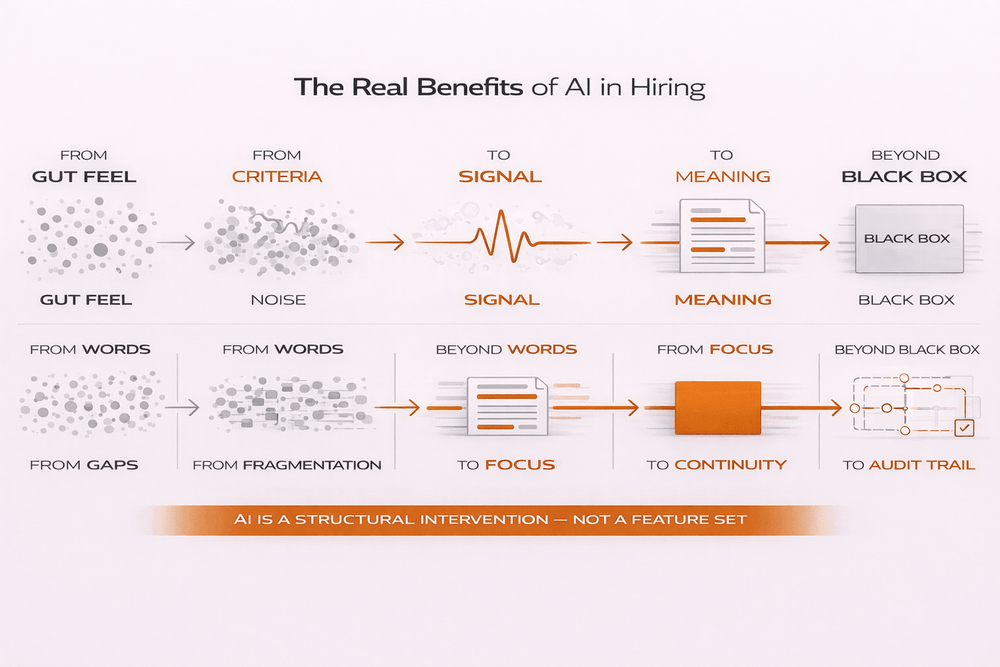
Implementing AI isn't about chasing a trend; it’s about fixing the specific gaps where human bandwidth hits a wall within a hiring funnel.
When integrated correctly, these are the primary shifts we see in high-performing TA teams:
Removes "Recruiter Bias" from the Selection Logic
Recruiters are human, which means screening is often inconsistent. One recruiter might move a candidate forward while another rejects them based on a "gut feeling" or arbitrary criteria.
This is where AI hiring tools take charge; they allow you to set structured, objective criteria from the start.
It brings an unbiased view to the hiring process, recognizing exactly what skills the team is missing, so the shortlist is based on data rather than just feelings.
High-Quality Inbound and Fewer "Trash" Applications
In this AI-driven era, a usual job posting often brings a flood of irrelevant applications.
This, in turn, puts the TA team into an endless loop of manual "re-screening" that wastes hours of bandwidth for no result.
This is where AI structures your job ads to attract the right fit immediately.
It also allows you to handle "hidden" or confidential roles by using chatbots to vet candidates for specialized projects without having to go public with sensitive openings.Ending the "Keyword Mismatch"
Most databases force recruiters to rely on specific keywords, meaning a great candidate who didn't "optimize" their CV gets overlooked.
However, AI recruiting software reads the document as a whole. It understands the expertise behind the words, so you don't miss out on top talent just because they didn't use the exact phrasing your search bar required.
Recovers Productivity
According to recent findings, the average HR manager loses about 14 hours a week on manual tasks.
Consequently, when a hiring process takes too long, top-tier candidates often move to other offers.
Therefore, instead of a recruiter manually drafting every email or analyzing every Excel sheet through ChatGPT, AI hiring tools run these background tasks in seconds.
In a nutshell, by automating the initial analysis and documentation, AI reduces your "time-to-fill."
This enables your recruiters to stop being administrators and focus on the final 10% of the hire where human judgment is actually required.
Consistent Candidate Engagement
In hiring, the candidate experience also suffers because sending manual updates to numerous applicants drains recruiters’ bandwidth.
AI takes over the rigorous manual work of follow‑ups and answers each FAQ proactively.
This strengthens your employer brand without requiring recruiters to manually type every status update.
Legal & Ethical Safety
With the EU AI Act and local bias laws now in full effect, "black box" hiring is a liability.
AI recruiting tools fix this by creating a paper trail for every decision, ensuring your hiring process is not only faster but fully compliant with 2026 bias-audit requirements.
The 2026 AI Hiring Checklist
Understanding the benefits is one thing, but speed only matters if it’s directed at the right stages of the funnel. Use this checklist to audit your current hiring workflow.
Sourcing & Market Mapping
[ ] Are you still manually building Boolean strings for every search?
[ ] Is your pipeline limited to the same pool of LinkedIn profiles?
Use AI to map passive talent and "silver-medalists" already in your database.
Outreach & Engagement
[ ] Is your bandwidth wasted drafting "first-touch" emails from scratch?
[ ] Are you losing candidates because follow-up windows are being missed?
Use AI recruiting tools to handle the hiring communications as well as automated follow-ups.
Resume Screening
[ ] Are you manually re-reading resumes for the same basic requirements?
[ ] Is your screening inconsistent because of "reviewer fatigue"?
Use AI recruiting tools like AiPersy to rank candidates based on role fit immediately.
Shortlisting & Manager Hand-off
[ ] Do you waste time justifying your shortlist to hiring managers?
[ ] Are you re-screening because the hiring manager "doesn't see the fit"?
As discussed earlier, the AI-powered recruiting tools provide a data-backed summary of why a candidate was ranked.
Interviewing & Feedback
[ ] Is your process bottlenecked by manual scheduling?
[ ] Is candidate feedback messy or inconsistent across different interviewers?
Experts recommend using AI to organize responses into a justifiable summary for the team.
Final Decision & Selection
[ ] Are you hiring based on "gut feeling" rather than objective data?
[ ] Does the final decision take days because of "decision paralysis"?
With AI-powered hiring tech such as AiPersy, TA teams can easily pull all signals (resume, interview, assessments) into a side-by-side comparison.
Post-Hire Feedback Loop
[ ] Are you repeating the same hiring mistakes every six months?
[ ] Is your sourcing criteria static and never updated?
The process-driven AI recruiting tools can easily compare performance data of new hires against original application data to refine the next search.
Real‑Life Case Studies of AI in Hiring
Implementing AI into your recruitment funnel isn't a theoretical experiment.
For global leaders, it has been the difference between a choked talent pipeline and a competitive advantage.
Here is how high-performing talent acquisition teams are using AI-hiring tools:
Hilton: Slashing the 6-Week Bottleneck
The Problem: Hilton was struggling with high-volume hiring for its global properties. Their manual process, including a 100-question assessment, took roughly 42 days to fill a single training class.
Solution: They replaced the manual work with AI-driven video assessments and predictive analytics to score candidate "soft skills" instantly.
The Result: 90% reduction in time-to-hire from 42 days to just 5 days.
Despite the automation, their Candidate Net Promoter Score (cNPS) clocked 84.9 because applicants got answers in minutes.
Furthermore, by integrating AI-driven video assessments and predictive analytics, Hilton reduced the average time-to-hire from 42 days to just 5.
This 90% increase in speed allowed their team to secure top-tier hospitality talent in a fraction of the time, moving from a multi-week administrative process to a simplified recruitment process that fills entire training classes in under a week.
Unilever: 1.8 Million Applications, Zero Repetitive Work
The Problem: Unilever receives nearly 2 million applications a year. Using human recruiters to "first-screen" this volume was taking 4 to 6 months, causing them to lose top-tier talent to faster startups.
Solution: They moved to a "Digital-First" funnel where AI-powered games and video interviews filter the top 20% before a human ever touches the file.
The Result: Unilever resolved bottlenecks in their hiring funnel by automating the initial “sift” of nearly 2 million annual applications.
By replacing manual phone screens with AI‑driven games and video analysis, they saved more than 50,000 hours of recruiter and candidate time in just 18 months.
This not only saved bandwidth for their TA team but also ensured they could secure top talent by reviewing resumes instantly.
Starbucks: Journey to an Effortless Hiring Process
The Problem: In 2024/2025, Starbucks aimed to open one new store every month.
But manually screening thousands of CVs for a company with a customer-first ideology was impossible.
Solution: They integrated an AI "Smart Interviewer" that uses chat-based scenarios to check soft skills and make scenario-based judgments.
Result: With the help of AI, Starbucks effectively automated the most difficult operation of its high-volume hiring.
This decision saved their hiring team over 1,900 hours every month in manual CV screening alone.
Beyond just the time saved, they saw a 56% reduction in early-stage turnover, proving that the AI wasn't just fasterm it was better at matching candidates to the actual requirement of the role than a manual search.Schneider Electric: Reactivating the "Hidden" Workforce
The Problem: 47% of employees leaving Schneider Electric said they saw "no future" at the company, even though there were thousands of internal openings.
And hiring managers couldn't find internal talent, so they wasted budget on external ads.
Solution: They launched an "Open Talent Market" (AI Internal Marketplace) that matches current employees to new roles, mentors, and side projects in seconds.
Result: By launching an AI-driven "Open Talent Market," Schneider Electric successfully reactivated their internal hiring funnel.
In just a few weeks, the platform unlocked nearly 127,000 hours of hidden capacity and has since scaled to save the company over $15,000,000 in productivity gains and reduced recruitment costs.
This didn't just remove the "manual stress" of hiring more candidates.
It also ensured that instead of paying for expensive contractors, the company could find the exact candidates it needed within 15 seconds.
Is It Legal to Use AI in Hiring?
Yes, in 2026, using AI in hiring is perfectly legal and increasingly necessary.
Regulators are no longer looking at your intent; they are looking at your results.
If your AI tool creates a biased outcome, for example, "I didn't know how the algorithm worked" is no longer a valid legal defense.
The following are the three big legal pillars for using AI in hiring in 2026:
The Mandatory Bias Audit (The NYC & California Standard)
Following the lead of NYC’s Local Law 144, major jurisdictions, including California and Illinois, now require annual, independent bias audits for any "Automated Employment Decision Tool" (AEDT).
This means you cannot audit your own tech. You must be able to show a third-party report proving your AI hiring software doesn't discriminate based on race, gender, or age
And if you’re hiring in Europ then it’s essential to know that recruitment AI is officially classified as "High-Risk."
As of August 2026, companies must provide "Explainable AI." This means if a candidate asks why they were rejected, you must be able to provide a clear, non-technical explanation of the data points the AI used.
The "Vendor Liability" Trap
This is a common misconception in the hiring industry that if the AI software is biased, it’s the software company’s fault.
However, the Recent rulings (including the landmark Mobley v. Workday case) have confirmed that the employer is the primary "deployer" and holds the legal struggle.
How to Stay Compliant with AI Hiring Tools
Here is how you keep your talent acquisition process running with AI recruiting tools while staying completely compliant:
Demand Transparency: Never sign a contract with an AI vendor that won't share their bias-testing data or offer an "Explainability" feature.
Keep the "Human-in-the-Loop": Legal risk increases when AI makes a final hiring decision autonomously.
Therefore, always remember that AI should rank and suggest candidates, and humans should decide.
Data Retention: In 2026, most states in the US require you to keep all AI-related hiring records (including why the AI ranked someone low) for at least four years.
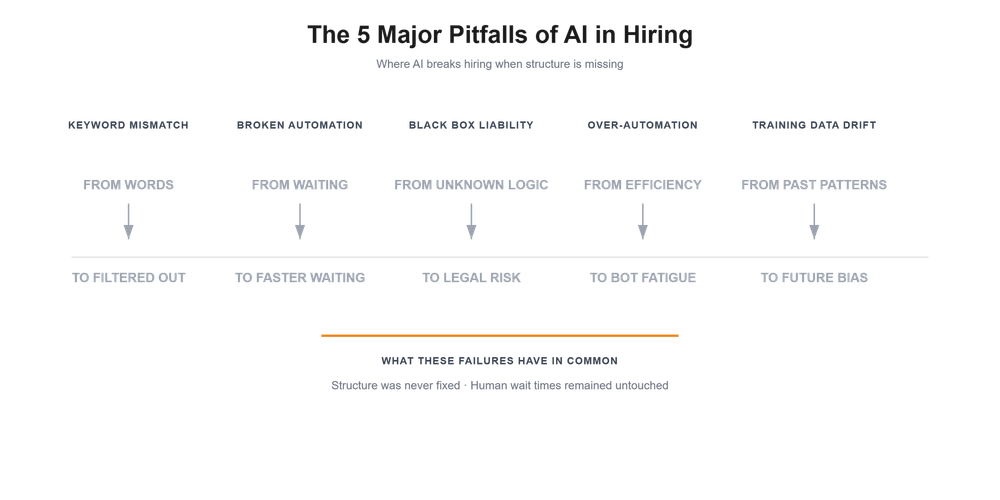
The 5 Major Pitfalls of AI in Hiring
In 2026, the testing phase with AI hiring tools is over.
We’ve seen exactly where these tools fail and when they lead to efficiency. If you want to avoid any consequences while using AI in hiring, watch out for these five traps:
The Keyword Mismatch
Early AI tools were just enhanced search bars looking for exact word matches.
Suppose, if a candidate wrote "Customer Success" instead of "Account Management," they were ghosted.
This is because relying on filters narrows your talent pool and excludes "hidden talent" who possess the right transferable skills but didn't use the specific vocabulary your search bar requires.
Therefore, only use tools with Semantic Search (like AiPersy). It looks at the intent and context of a career path, not just the vocabulary.
Automating a Complex Recruitment Process
Integrating AI recruiting technology into a process that is already slow means you’re only making it more difficult.
If your hiring managers typically take two weeks to review a shortlist, even a 5-second AI screening tool won't save your overall time-to-hire.
Therefore, always map your entire funnel first and identify where the actual human wait times are occurring.
Use AI to bridge those specific hurdles, like instant interview scheduling or hiring communications, rather than just using it to find more applicants.
The "Black Box" Liability
Many vendors still offer "proprietary" AI where the decision-making logic is kept hidden, making it impossible for you to see how a candidate's score was actually calculated.
In 2026, using these "Black Box" tools is a major liability; if a candidate or regulator asks why a certain person was rejected, "the algorithm said so" is like losing a legal defense.
Therefore, you must prioritize Explainable AI (XAI) by only partnering with platforms such as AiPersy that provide a clear, data-backed rationale for every ranking.
Over-Automation
As AI becomes more common, candidates are becoming highly sensitive to "bot fatigue."
If every single touchpoint from the initial outreach to the rejection notice is a generic, AI-generated message, you risk compromising your employer’s brand reputation.
In order to fix this, you should never use AI recruiting software for the "Final 10%" of the hire.
Keep the AI focused on the repetitive administrative work, like scheduling and basic FAQs.
It actually gives your recruiters the bandwidth to be more human during high-stakes moments.
Training Data "Drift"
AI learns by spotting patterns in your past decisions, which means if your company historically hired from only a small handful of universities, the AI will learn to treat those schools as a prerequisite for success.
This "Algorithmic Bias" can quietly start "cloning" your existing team and deteriorating your diversity efforts without you even realizing it.
The only way to permanently solve this is through continuous monitoring.
It means you should perform quarterly bias audits to check your shortlists and ensure the AI isn't accidentally favoring one demographic or background over another based on outdated historical data.
How AiPersy Supports AI‑Driven Hiring
You've already tried and tested AI hiring tools proficient in automating tasks, writing job descriptions, or scoring a pile of resumes.
However, AiPersy is different. It doesn't just automate tasks; it automates the decisions between tasks.
Here’s what separates AiPersy from the traditional ATS+AI model:
From Sequential Waiting to Parallel Flow
In a traditional hiring process, stages are interdependent. It means at first you finish sourcing, then you screen, then you schedule, then you interview.
Even with AI, the recruiter still acts as the manual "gate" between every step.
This is where AiPersy takes the lead; it uses a parallel evaluation engine. The second a resume meets your human-defined threshold, an interview is triggered automatically.
While interviews are running, screening continues, and rankings update in real-time.
Role-First, Not Application-Driven
Most hiring tools start with the application and try to "find the best of what we got."
On the other hand, with AiPersy, you define the rules like role expectations, skill requirements, and score thresholds.
AiPersy then executes those rules continuously. This ensures that every candidate is measured against your "ideal" standard.
Decisions, Not Just Suggestions
Traditional AI tools "suggest" a rank, but then wait for a human to approve the next move, which ultimately creates friction within the process.
However, AiPersy is authorized to act on your behalf. By automating the "move" from resume match to interview invite, it compresses hiring timelines.
As a result, you stay in control by setting the "governance" rules upfront, allowing the AI to handle the administrative execution without compromising your judgment.
Eliminating the "Black Box"
A major risk in 2026 is "Black Box" AI that scores a candidate without an explanation, leaving you legally exposed.
But with AiPersy, every qualification, score, and decision gate is human-defined and explicitly visible.
It always provides an audit-ready trail that explains exactly why a candidate moved forward, making your process fully transparent and compliant with current bias-audit laws.
Final Words
Mastering how to use AI in hiring isn't about finding a "magic wand" that replaces your team; it’s about recovering the 14 hours a week lost to repetitive administrative work.
By moving from a sequential process in which every step waits for a human gatekeeper to a parallel flow, you ensure that top-tier talent is never missed.
We’ve seen that whether you are a global giant like Hilton or a lean TA team, the goal is common.
Use AI to automate the repetitive decisions between different hiring stages so you can use your bandwidth for the final 10% where human connection matters.
And, by removing "Black Box" risks and focusing on role-first clarity, you stop being an administrator and finally start being a talent strategist.
Ready to see how parallel hiring can compress your timelines from days to minutes? [Book a demo with AiPersy today] and experience an AI hiring tool purpose-built to remove waiting, not judgment.