AI Hiring vs Traditional Recruitment Methods
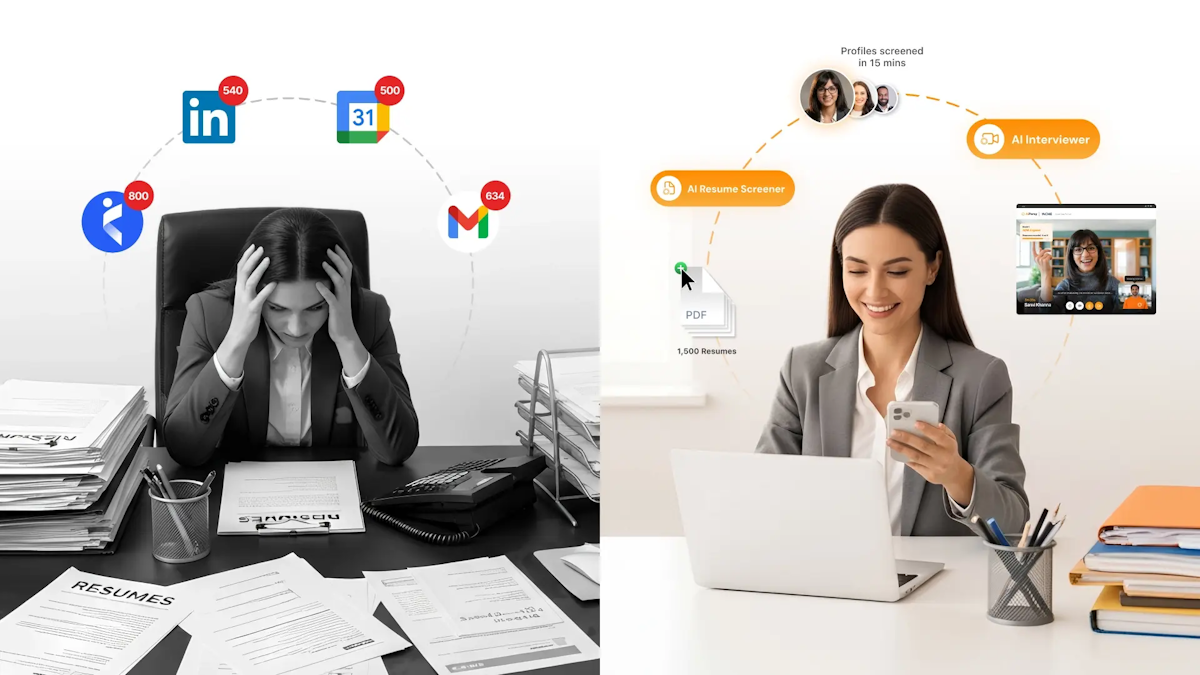
"Organizations using AI-powered recruitment tools report 31% faster hiring times, while traditional recruitment takes an average of 44 days to fill a position."
Yet most companies still operate hybrid workflows where AI handles screening and coordination, while humans make final decisions through traditional interview processes.
This gap reveals the core operational difference between AI hiring and traditional recruitment.
Traditional methods advance candidates sequentially, with each stage waiting for the previous to complete. AI hiring enables parallel evaluation, where screening, assessment, and shortlisting happen simultaneously.
This guide compares both approaches across key operational dimensions: how evaluation happens, where waiting occurs, when decisions move forward, and where each method works best.
The goal is not to declare one approach superior, but to clarify when each delivers better outcomes based on hiring context and organizational readiness.
What Is Traditional Recruitment? How Hiring Works Today at 80% Companies
In most companies, hiring still follows a linear path. First, hiring teams approve a job role and define requirements.
Then recruiters write job descriptions, set budgets, and publish openings across career pages, job boards, and social platforms.
At this stage, teams optimize for reach. Consequently, volume becomes the primary signal of progress.
Next, job applications arrive in bulk. Recruiters pull resumes into an ATS and begin screening.
However, this step absorbs disproportionate time, even though the majority of applicants do not meet role requirements.
Instead of progressing candidates continuously, teams wait for manual review cycles to finish.
Then the interviews begin. Recruiters schedule conversations around interviewer availability, not candidate readiness.
As a result, momentum slows. Feedback arrives late or in batches, and candidates advance only after calendars align.
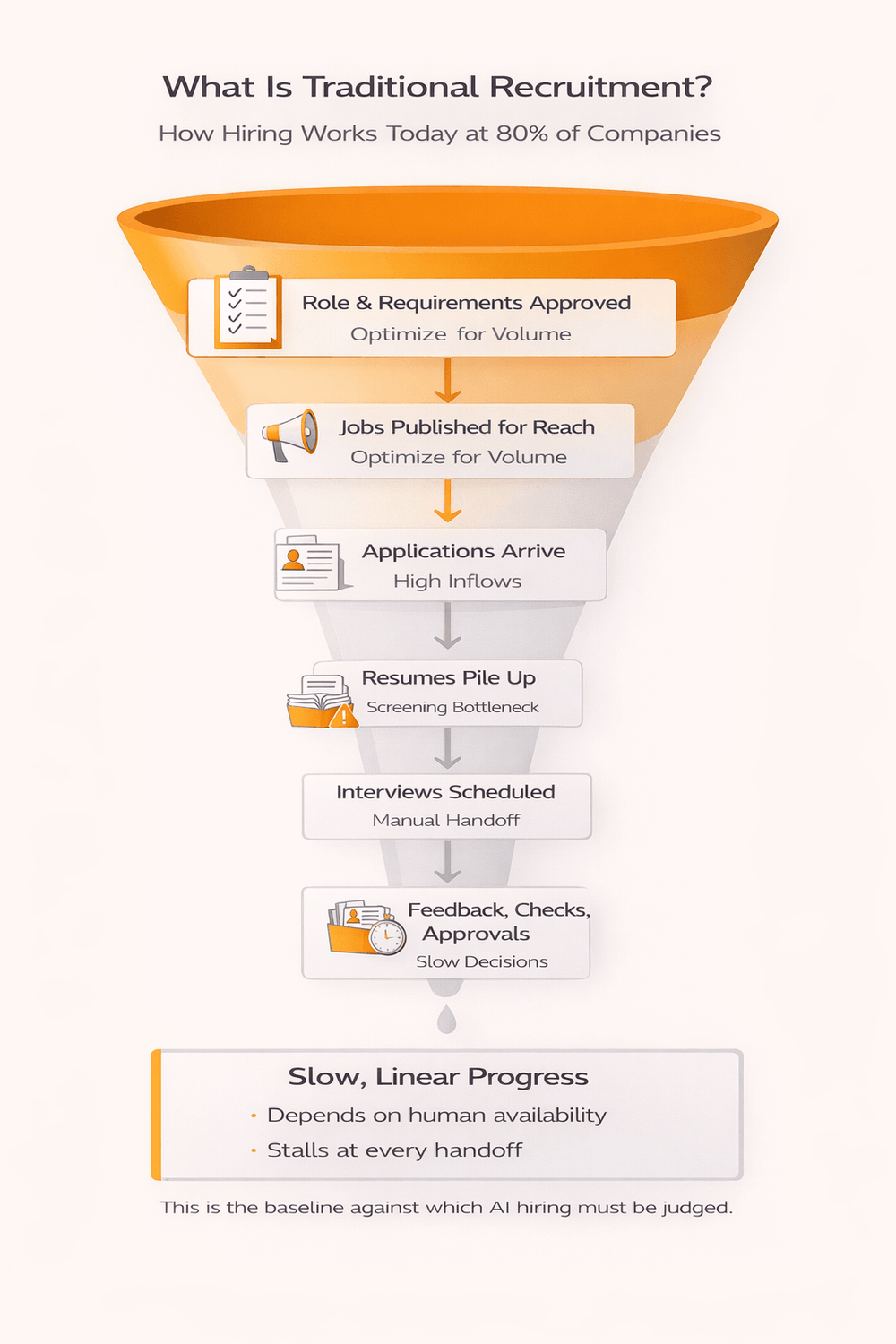
After interviews, offers, approvals, and background checks follow. Each hiring step introduces another handoff.
Meanwhile, hiring managers gain deeper context only after interviews conclude, not earlier, when decisions could move faster.
Throughout this journey, recruiters, hiring managers, and candidates move through the same funnel, but never at the same pace.
Because each stage depends on the previous one completing first, delays compound quietly.
Consequently, average hiring timelines stretch beyond thirty days. Candidates disengage due to silence or waiting. Teams restart searches. Costs rise while roles remain open.
This is how traditional recruitment operates today. Work happens constantly. However, progress still waits on sequential steps, human availability, and late-stage decisions.
That workflow is the baseline against which AI hiring must be judged.
Problems with Traditional Recruitment
Traditional recruitment breaks down not because teams work carelessly, but because the process itself was designed for a slower, lower-volume market.
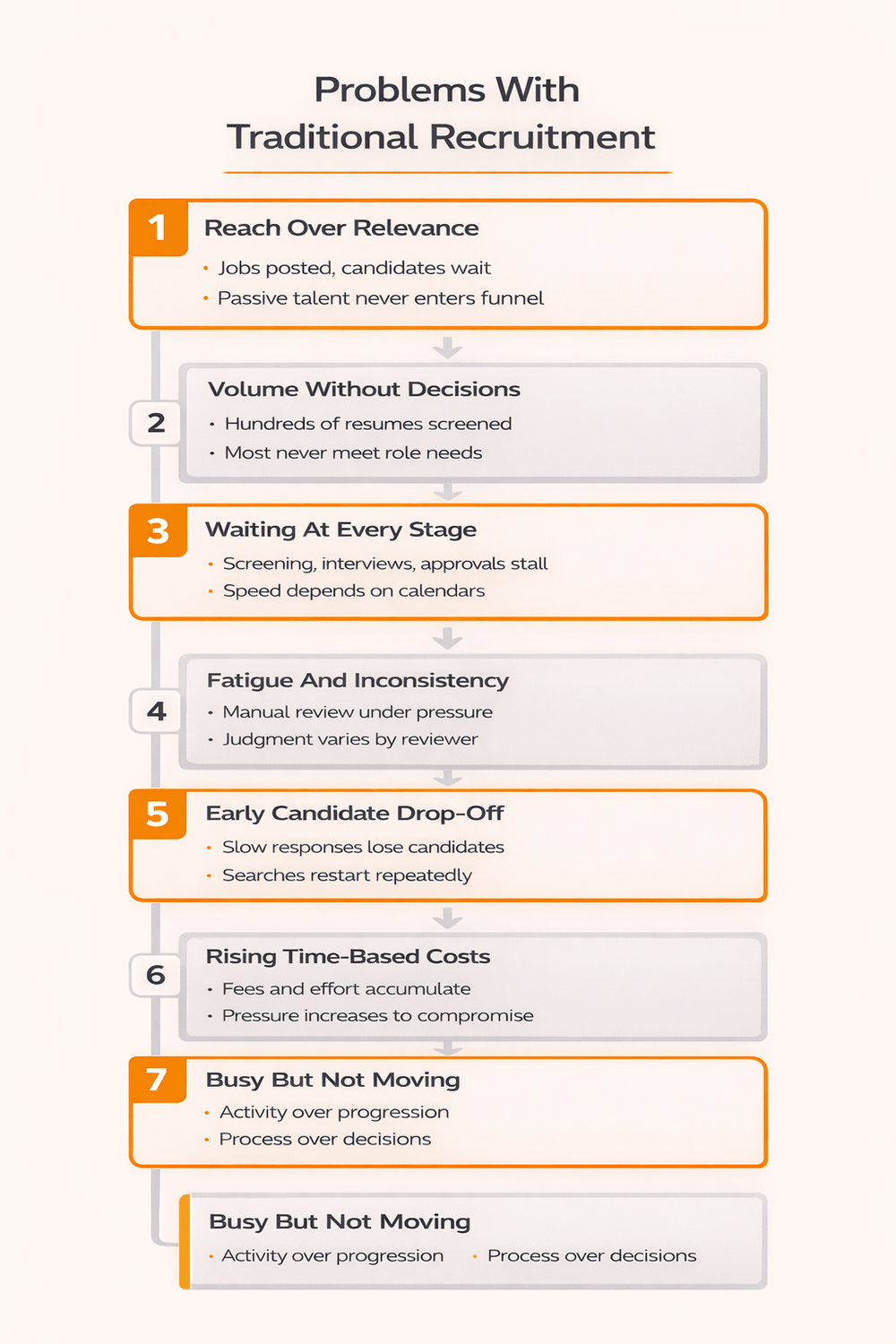
- Reach is prioritized over relevance
Traditional hiring systems focus on publishing job openings and collecting applications.
Teams post roles, wait for responses, and review whoever applies.
However, most experienced candidates do not apply to job postings.
As a result, the strongest candidates often never enter the hiring pipeline.
2. Resume volume delays decisions
Recruiters receive large numbers of resumes for each role, even when only a small fraction meet the requirements.
Teams then spend days reviewing profiles that will not move forward. During this time, qualified candidates receive no signal and often disengage.
3. Each hiring stage forces waiting
Traditional recruitment advances candidates in fixed steps.
First, recruiters complete resume screening. Next, interviews are scheduled. Then, interview feedback is collected. Offers move forward only after approvals are secured.
Because each step must finish before the next begins, hiring speed depends on calendar availability rather than candidate readiness.
4. Manual screening weakens consistency at scale
When resume volume increases, recruiters reduce review depth to keep up.
Different reviewers apply criteria differently. Early judgments vary. Strong candidates are filtered out without discussion.
Teams then add more interviews and rechecks later in the process, which extends timelines further.
5. Candidate drop-off increases
Long response times and unclear next steps cause candidates to lose interest. Candidates who receive faster signals from other employers exit the process.
When this happens, teams restart sourcing and repeat screening for the same role.
6. Costs rise as roles stay open
Hiring delays drive up both direct and indirect costs. Advertising spend continues, agency fees mount, and recruiter time expands. Meanwhile, open roles erode team productivity.
Over time, the pressure to fill positions can push hiring teams to compromise on quality.
What is AI Hiring?
AI hiring refers to the use of machine intelligence to evaluate, prioritize, and progress candidates using data and defined criteria, rather than relying solely on manual review and human availability.
In traditional recruitment, teams move candidates forward after each step completes. AI hiring changes that flow.
Instead of waiting for resumes to be reviewed, interviews to be scheduled, or feedback to be consolidated, AI systems evaluate candidates continuously as they enter the funnel.
Practically, this means AI supports hiring at multiple stages. It screens resumes against role-specific signals, assesses responses through structured interviews or questionnaires, and ranks candidates based on evidence rather than intuition.
As a result, hiring teams see decision-ready information earlier in the process.
However, AI hiring does not remove humans from hiring. Instead, it shifts human effort away from repetitive review and coordination toward judgment and final decisions.
Therefore, the real value of AI hiring is not automation alone, but earlier clarity and reduced waiting between stages.
This distinction matters because many tools automate tasks, while fewer systems change how hiring decisions actually move.
AI Hiring vs Traditional Recruitment
The difference between AI hiring and traditional recruitment is not the tools you use. It is what you do each day, when candidates move forward, and where time gets lost.
| What you deal with | Traditional recruitment (what usually happens) | AI hiring (what changes in practice) |
| How candidates enter | Candidates apply to your job posting. You collect resumes and begin reviewing them once enough volume comes in. | Candidates apply and are screened as soon as they submit a resume. Each profile is evaluated individually instead of waiting for a pile to form. |
| When screening happens | You or your recruiter review resumes manually. Screening starts after applications close or reach a certain number, which often takes several days. | Resumes are screened as they arrive using criteria you define upfront, such as skills, experience, and education. |
| How interviews work | Interviews are the first real signal of fit. You schedule them only after screening is complete, which means coordinating calendars and waiting for availability. | Interviews happen earlier. Some are structured or asynchronous, so you can review responses before scheduling live conversations. |
| When decisions get made | Decisions are made after all interviews finish. Candidates wait while you complete the full round and then compare everyone at once. | Candidates are ranked as interviews and assessments finish. Strong candidates can move forward even while others are still in process. |
| Where time gets lost | Time is lost waiting for resumes to accumulate, schedules to align, feedback to arrive, and approvals to clear. | Coordination is automated. Candidates move forward when they meet your qualification criteria instead of waiting for manual handoffs. |
| What recruiters actually do | Recruiters spend time screening resumes, scheduling interviews, and chasing feedback. Candidate conversations compete with administrative work. | Recruiters review shortlists, speak with qualified candidates, and make final decisions. Administrative work runs in the background. |
Traditional recruitment moves candidates in sequence. Each step must finish before the next begins.
On the other hand, AI hiring allows evaluation and progression to happen at the same time. You still make the final decision, but you no longer wait between every step to get there
How AI can help hire faster
Hiring does not slow down because recruiters type slowly or schedule poorly. Instead, it slows down because progress depends on one step finishing before the next can begin.
Therefore, speeding up hiring requires accelerating the flow of candidates through the funnel, not just automating individual tasks.
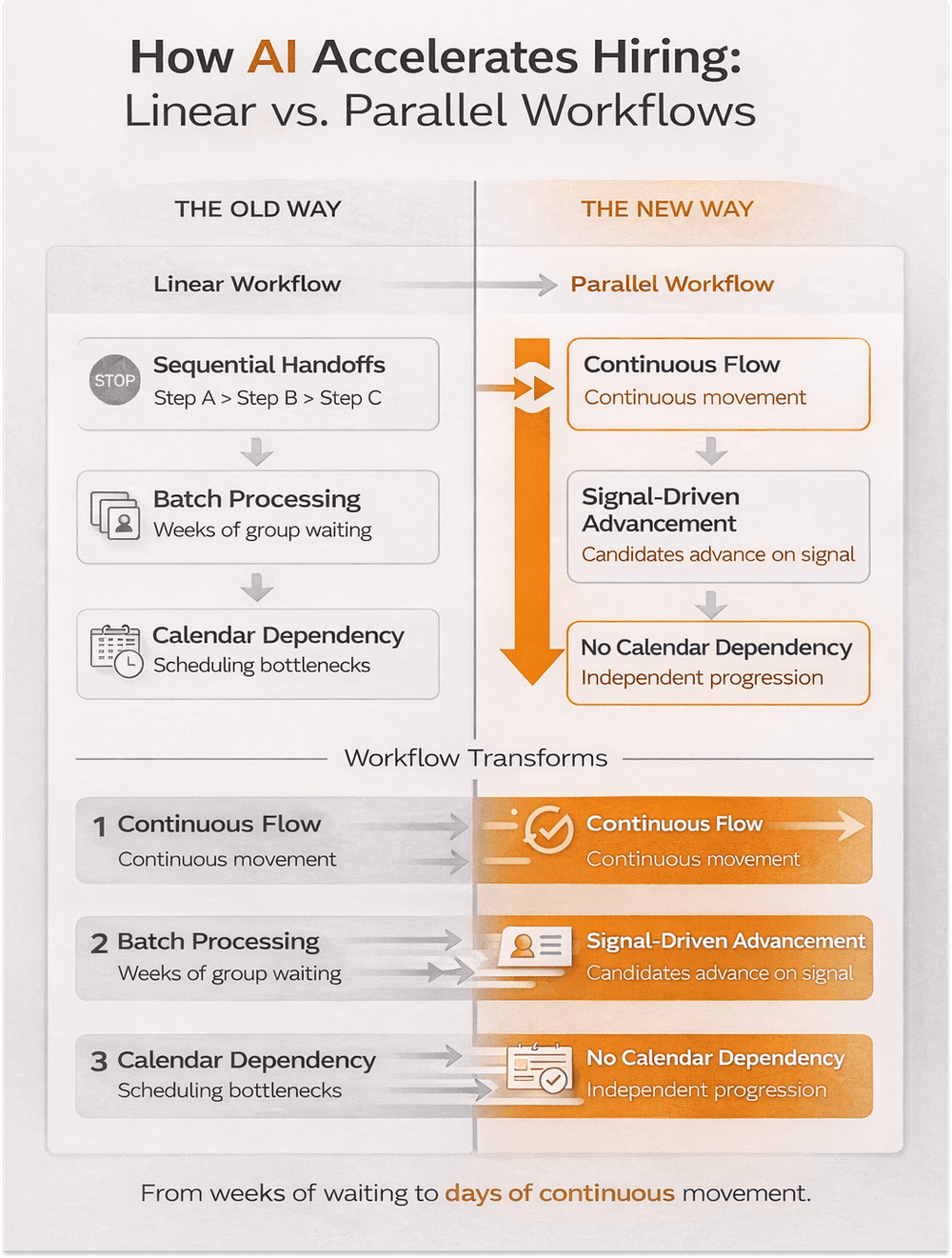
1. AI accelerates hiring by removing stage-by-stage waiting
In traditional workflows, candidates move only after a stage fully completes.
Recruiters finish screening first. Then the interviews begin. Feedback follows later. Consequently, candidates wait even when they are clearly qualified.
AI-enabled workflows change this sequence. Candidates no longer wait for an entire batch to finish screening. Instead, evaluation runs continuously.
As soon as a candidate meets predefined role criteria, the system advances them.
As a result, qualified candidates move forward while others are still being reviewed. Momentum builds early, not after weeks of accumulation.
2. AI enables parallel evaluation instead of batch processing
Most hiring delays come from batch behavior. Teams review resumes in groups. Interviewers provide feedback together.
Decisions wait until everyone weighs in. Therefore, time stretches even when effort stays constant.
AI accelerates hiring by evaluating candidates in parallel. Each profile is assessed independently against the role’s requirements.
Scoring, qualification, and ranking happen continuously. Because of this, teams stop waiting for volume before acting.
They gain visibility into strong candidates immediately, not at the end of the funnel.
AI moves candidates forward without calendar dependency
Interviews remain one of the biggest bottlenecks in hiring. Recruiters often wait days to align interviewer availability, even when candidate readiness is clear.
Consequently, speed depends more on calendars than on signals. Workflow-driven AI reduces this dependency.
Structured, asynchronous evaluations run before live interviews. Candidates demonstrate fit without waiting for real-time coordination.
Therefore, live interviews become validation steps, not gating steps. Hiring progresses even when humans are unavailable.
AI shifts decision-making earlier in the funnel
Traditional hiring defers real judgment until late stages. Hiring managers gain clarity only after multiple interviews.
As a result, weak candidates move too far, and strong candidates wait too long.
AI accelerates hiring by pushing structured evaluation forward. Scoring, thresholds, and role-fit logic apply early. Hiring managers see ranked, decision-ready candidates sooner.
AI reduces restarts by maintaining momentum
When candidates drop off in traditional hiring, teams often restart the search. New sourcing begins. Screening resets. Timelines stretch again.
Accelerated workflows prevent this. Continuous evaluation keeps multiple qualified candidates moving forward simultaneously. If one candidate exits, others remain active.
When Traditional Recruitment Still Works Better
AI hiring is not always the right answer. Traditional recruitment outperforms automation in three specific situations, not because AI lacks capability, but because speed is not the constraint you need to solve.
Low-volume, high-stakes roles
If you are hiring a CFO, replacing a departing founder, or filling a role that requires deep trust and discretion, traditional recruitment works better.
These hires depend on relationship-building, confidential conversations, and judgment that cannot be reduced to scored criteria. You are hiring one or two people where fit matters more than speed.
Finding the exact right person is the priority, not moving quickly.
Roles where you do not yet know what “good” looks like
If success criteria are unclear or keep changing mid-search, do not automate your hiring process.
AI executes the logic it is given. When that logic is vague or unstable, automation amplifies confusion instead of reducing it.
When role clarity is still forming, traditional recruitment allows you to learn through conversations, adjust expectations, and refine judgment before scaling decisions.
Organizations not ready to govern AI responsibly
If you cannot explain how candidates are evaluated, do not have audit trails, or lack clear human review checkpoints, traditional recruitment is the safer choice.
Poorly governed AI introduces legal and ethical risk. Research has already shown that opaque AI systems can erode trust in hiring when decisions are not explainable.
In these environments, manual processes contain risk rather than create inefficiency.
So when should you stick with traditional recruitment?
Traditional recruitment is the better choice when:
- hiring volume is low
- job roles require deep trust or discretion
- success criteria are still forming
- governance maturity is not yet in place
Choosing traditional hiring in these situations is not falling behind. It is using the right approach for where your hiring process actually is.
How Companies Are Moving From Traditional Hiring to AI
Companies rarely replace traditional hiring in a single step. Most move toward AI only after their existing process begins to break under pressure.
Below is what that transition looks like in practice, not in theory:
Stage 1: Traditional Hiring Still Holds
In this stage, hiring still appears workable.
Recruiters move candidates forward manually. Managers accept delays as part of the process. Candidates wait because alternatives are limited or timelines are flexible.
The key characteristic here is not efficiency, but tolerance. The software works because the cost of waiting is still hidden.
Stage 2: Task Automation Improves Effort, Not Flow
The first AI adoption step is almost always tactical.
Teams introduce tools to reduce recruiter effort: writing job descriptions faster, scanning resumes more quickly, or coordinating interviews with less manual work.
This lowers workload, but it does not change how decisions move.
Candidates still progress sequentially. Each stage waits for the previous one to finish. Decisions remain dependent on human availability rather than candidate readiness.
As a result, work feels faster, but hiring outcomes do not materially improve.
Stage 3: Bottlenecks Shift Instead of Disappearing
Over time, a consistent pattern emerges. Resumes are processed quickly, but interviews wait. Interviews finish, but feedback accumulates.
Automation increases activity, yet overall progress remains constrained.
At this point, teams stop asking how recruiters can work faster. The more relevant question becomes where candidates are stalling and why decisions are delayed.
This is the moment when organizations realize the problem is structural, not operational.
Stage 4: Workflow Redesign Changes How Decisions Move
The breakthrough comes when teams stop adding tools and start redesigning the process.
- Screening criteria are defined earlier
- Interviews are standardized.
- Progression rules are set before volume spikes.
AI moves from assisting tasks to enforcing order. Evaluation runs continuously, not in cycles.
Candidates advance as soon as they meet thresholds. Recruiters review outcomes instead of managing queues. Waiting shrinks because decisions no longer depend on calendars.
Why Some Teams Stall or Reverse Course
Not every organization reaches this stage.
When AI is deployed without clarity, opaque scoring, and noisy data erode trust. Managers lose confidence and pull decisions back into manual review. Automation gets blamed, but the real culprit is weak criteria and governance.
What Successful Teams Do Differently
The recruitment teams that scale hiring without losing control share a pattern:
- Humans define role criteria.
- Scoring logic stays visible.
- Decisions remain reviewable and auditable.
AI executes rules. People retain judgment. Accountability is preserved while hiring scales.
Where Most Companies Land
Most organizations end up hybrid.
- Traditional hiring handles judgment, persuasion, and trust.
- AI manages evaluation, coordination, and movement.
This balance works only when humans remain responsible for decisions.
The Core Shift
Companies don’t win by automating tasks. They win by replacing sequential waiting with parallel progress. That is the real shift, from traditional hiring to AI-enabled hiring.
How to Choose the Right AI Recruitment Tool
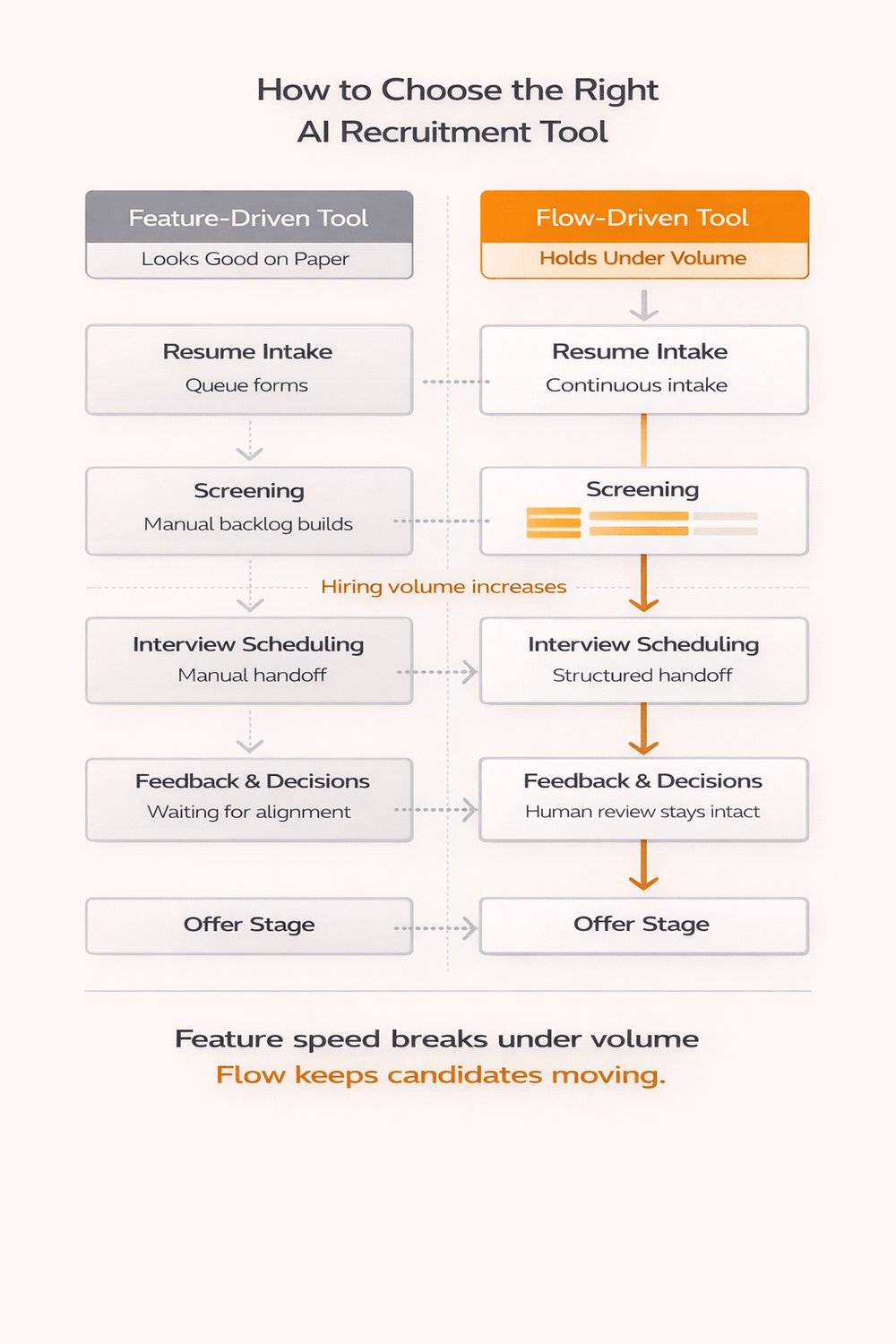
Most HR teams don’t choose the wrong AI hiring tool because of bad intent. They choose it because they focus on features instead of flow.
On paper, many tools look similar. They all screen faster. They all automate something. They all promise better matches.
The difference only shows up once hiring volume increases and the process starts to bend.
The right tool does not just speed tasks. It keeps candidates moving without losing control. Here is how to tell the difference.
Resume analysis that reduces noise, not just workload
Resume parsing is table stakes. The real question is what happens after parsing.
Weak tools extract data and leave humans to interpret it. Strong tools apply role-specific criteria immediately and separate signal from clutter.
Look for systems that:
Score resumes against explicit role thresholds, not generic keyword matches
Keep rejected candidates searchable instead of discarding them
Let you audit why someone advanced or stalled
If resumes move faster but decisions still wait, parsing is not the problem. The logic is.
Candidate interaction that removes waiting, not replaces recruiters
Chatbots help when they eliminate friction early in the process. They fail when they attempt to replace recruiter judgment.
A useful AI assistant answers questions instantly, guides candidates to the right path, and triggers next steps when criteria are met. Consequently, candidates move forward without follow-ups or reminders.
What matters is not conversational polish. Rather, the real test is whether candidates progress without chasing humans.
Scheduling that follows decisions instead of delaying them
Interview scheduling is where most hiring pipelines quietly slow down. Calendars conflict, approvals wait, and candidates lose momentum.
The right AI system schedules interviews only after a decision has already been made. Then it syncs availability automatically and confirms without back-and-forth.
If recruiters still spend time coordinating calendars, automation is only partial. In that case, speed gains disappear under pressure.
Asynchronous interviews that enforce structure early
One-way interviews work best when they replace weak early screening. They fail when they simply add another layer.
Used correctly, they ask the same questions, capture comparable responses, and allow review without scheduling delays.
As a result, early-stage evaluation becomes consistent instead of subjective.
The value is not the video format itself. Instead, the value comes from an evaluation structure applied before human judgment comes into play.
Analytics that explain decisions instead of hiding them
Many AI recruiting platforms provide dashboards. Fewer provide clarity.
Fit scores only matter if reviewers can explain them. Rankings only help when humans can challenge or override them.
Therefore, strong systems show which criteria influenced outcomes and where candidates stalled. They also preserve audit trails so decisions remain reviewable.
When a system cannot justify its output, trust breaks as hiring pressure increases.
Wrapping Up
Traditional recruitment is not broken because people are careless.
It breaks because sequential hiring cannot keep up with modern volume, speed, and expectations.
AI hiring changes this by removing waiting between decisions, not by removing humans from the process.
When evaluation, interviews, and shortlisting happen in parallel, hiring finally starts to move again.
That distinction matters. Speed without structure creates noise. Structure without speed creates delay. Modern hiring needs both.
This is why AI hiring is no longer about tools or automation alone. It is about designing a system where candidates progress continuously, decisions stay visible, and humans remain accountable.
If your hiring process feels busy but slow, the problem is not effort. It is flow.
If you want to see how a role-first, parallel AI hiring engine works in practice, explore how AiPersy is designed to help teams hire faster without losing control, fairness, or trust.