Hidden Cost of Manual Resume Screening

“Initially, recruiters spend about 5 to 10 minutes per resume before deciding whether to continue or move on.”
Most hiring teams treat resume screening as a necessary chore. Slow, yes. Tedious, definitely. But still manageable.
What rarely gets questioned is the cost of keeping it manual.
Not the obvious cost on a spreadsheet, but the hidden cost that shows up later as missed candidates, stalled teams, delayed revenue, and recruiters stretched thin doing work that no longer creates leverage.
This article breaks down the hidden cost of manual resume screening, not just in time or money, but in how it limits scale, distorts decision-making, and slows hiring long before interviews even start.
How Manual Resume Screening Creates Hiring Bottlenecks
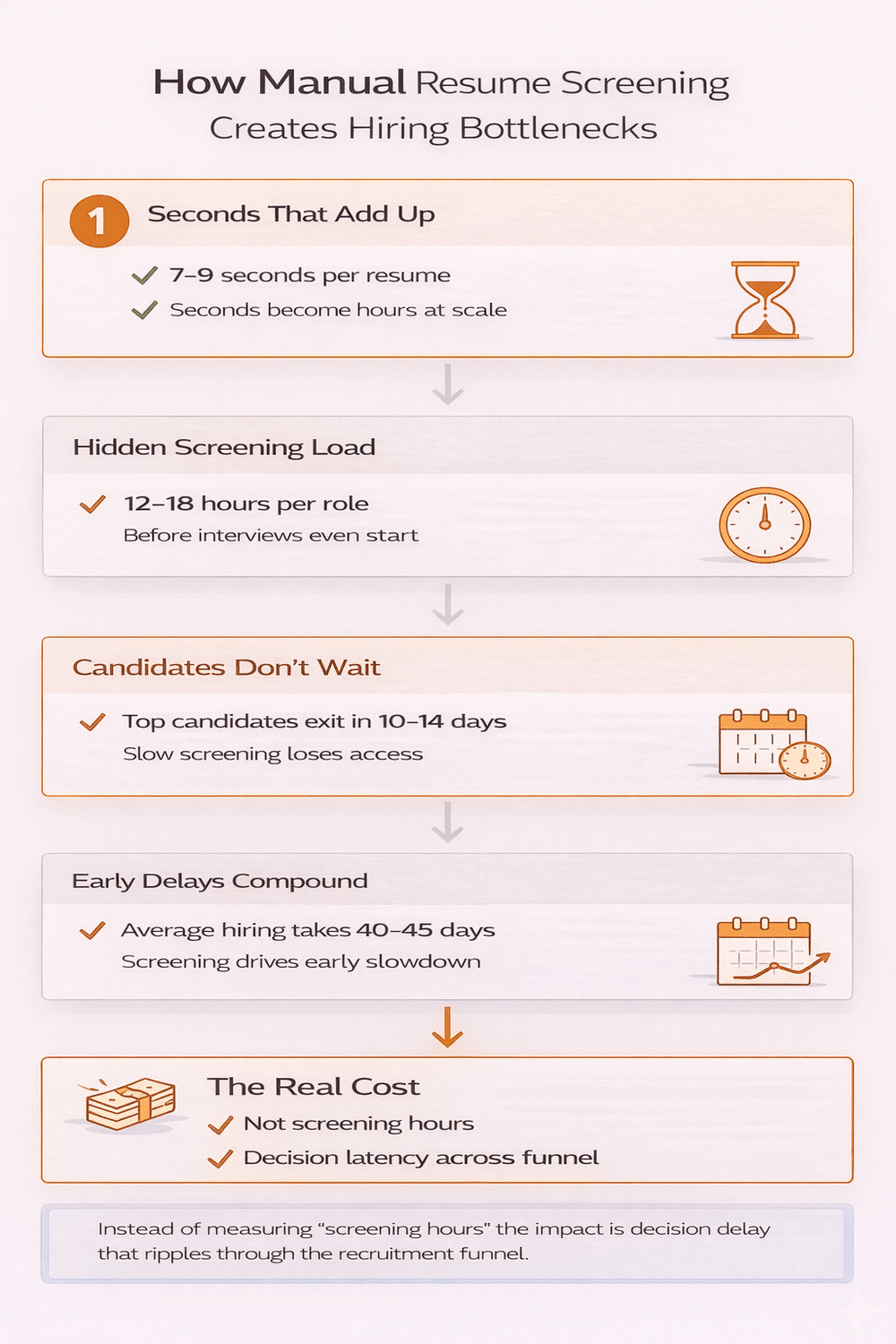
Recent studies show recruiters spend about 5 to 10 minutes on an initial resume scan before deciding whether to continue or move on. At scale, those seconds turn into hours.
When you factor in shortlisting, documentation, internal reviews, and rechecks, recruiters often spend 12 to 18 hours screening resumes for a single job role, even before interviews begin.
Meanwhile, candidates don't wait. Top candidates are typically off the market within 10 to 14 days. Slow screening directly reduces access to the best talent.
This creates a widening gap. The average time to hire still ranges between 40 and 45 days, with early-stage screening responsible for a significant portion of that delay.
This is where the real cost surfaces. Although not labeled as a line item "screening hours," it is decision latency that ripples across the entire recruitment funnel.
5 Hidden Costs of Manual Resume Screening
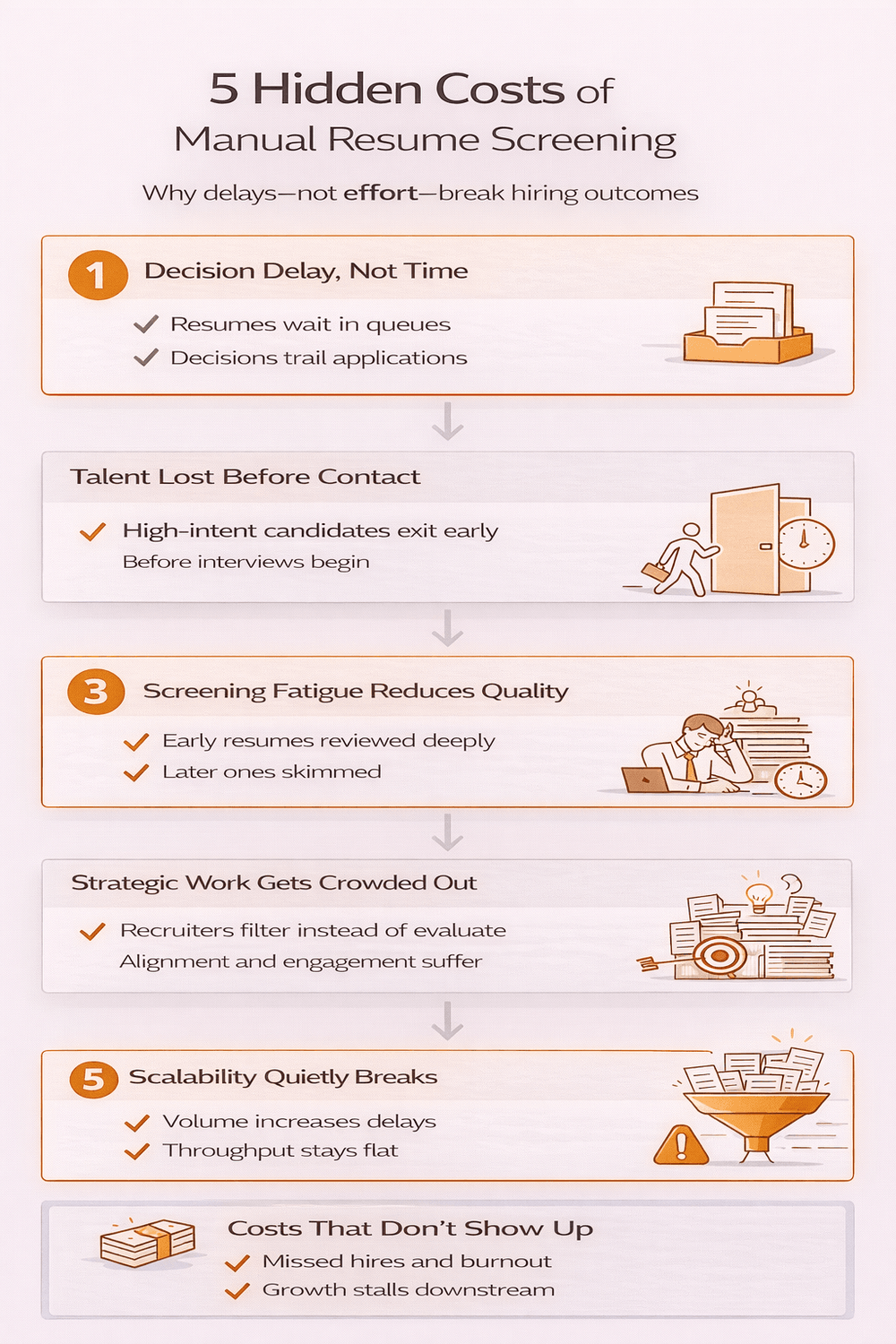
Time Spent Is Not the Problem, Decision Delay Is
Manual screening stretches the gap between application and action. Resumes sit in queues. Shortlists move slowly. Hiring managers see candidates days after they apply, not because teams are careless, but because the process can't move faster.
Each delay compounds. By the time hiring decisions are made, the market has already moved on.
Talent Loss Happens Before Interviews Even Begin
High-intent candidates don't disappear during interviews. They disappear while waiting.
Manual screening slows first contact, delays feedback, and stretches timelines at the exact moment when candidate interest is highest.
Strong applicants move on before your team even knows they existed.
Quality Decays Under Screening Fatigue
Manual screening is linear and mentally draining. Early resumes get thoughtful attention. Later ones get skimmed.
As volume increases, consistency drops. Strong candidates are missed not because they lack qualifications, but because reviewers are tired, rushed, or working through their fiftieth resume of the day.
Over time, this quietly erodes hiring quality without leaving a visible trail.
Recruiters Stop Doing Strategic Work
Every hour spent filtering resumes is an hour not spent interviewing, aligning with hiring managers, improving role clarity, or engaging strong candidates early.
Recruiters drift into traffic control mode instead of evaluation. Organizations pay for strategic talent work, but much of that time gets consumed by repetitive filtering that produces diminishing returns.
Scalability Limits Quietly Cap Hiring Capacity
Manual screening doesn't scale without adding headcount. As hiring demand increases, teams hit an invisible ceiling.
More roles mean longer delays, not higher throughput. Leaders assume the issue is talent availability when the real constraint sits at the top of the funnel.
These costs rarely appear in hiring reports. They surface later as missed hires, frustrated managers, burned-out recruiters, and stalled growth.
Why Resume Parsers and ATS Automation Fail at Scale
When hiring pressure increases, most teams reach for tactical fixes:
- Add a resume parser
- Turn on ATS automation
- Apply keyword filters
On paper, this feels like progress. In reality, bare minimum progress is made.
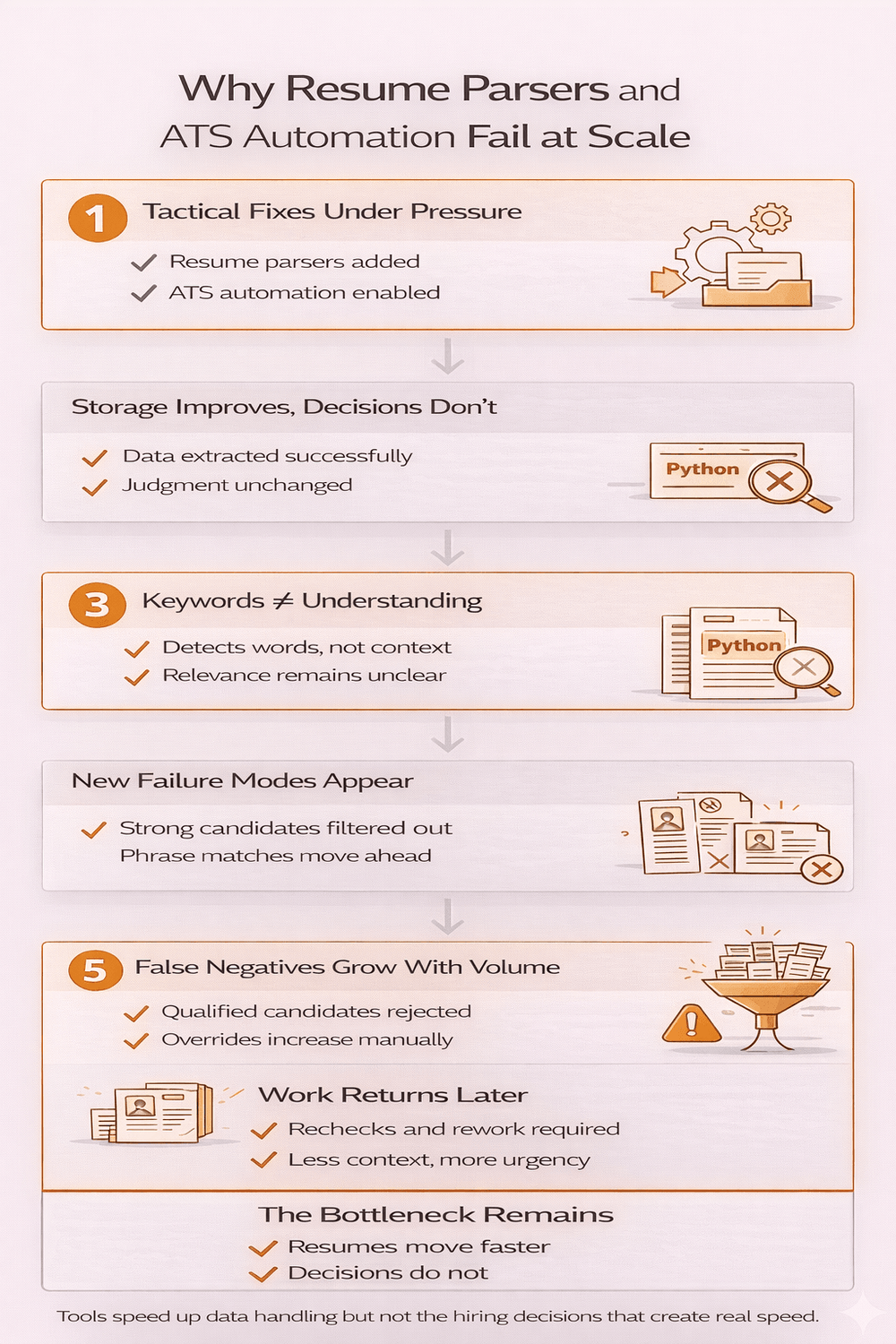
Resume Parsers Improve Storage, Not Decisions
Resume parsers extract data such as:
- Job titles
- Skills
- Years of experience
That makes resumes easier to search. However, it does not make screening smarter.
For example, a parser can detect the word “Python," but it cannot tell whether that experience is:
- Core or incidental
- Recent or outdated
- Relevant to this specific role
Keyword Filters Create New Failure Modes
Basic ATS automation relies on keywords and rule-based scoring. This removes some noise, but introduces risk.
Strong candidates get filtered out because:
- They phrase experience differently
- They come from adjacent industries
- Their resumes don’t match exact wording
Meanwhile, less relevant candidates move forward because they matched the phrasing.
False Negatives Increase at Scale
As volume grows, these systems often:
- Reject qualified candidates
- Reject qualified candidates
- Force recruiters to override rankings manually
Recruiters then:
- Re-check results
- Loosen criteria
- Rebuild shortlists
As a result, the work returns later with more urgency and less context.
The Core Problem Still Remains
Resume parsers and ATS automation speed up data handling and reduce human effort.
However, they do not eliminate the bottleneck. They make resumes move faster, but they don’t make decisions happen sooner. And as long as decisions are delayed, hiring remains slow.
How AI Resume Screening Works (vs Manual Screening)
Faster screening isn't about reading resumes more quickly. It's about restructuring how evaluation happens within a recruitment funnel.
Here's what changes when screening is designed for speed and quality:
Screening Happens in Parallel, Not in Batches
Most hiring teams still screen in batches. Resumes pile up, recruiters wait for volume to stabilize, and only then does the review begin.
Modern systems like AiPersy evaluate resumes the moment they enter, even when uploaded in bulk. Role-specific criteria are already defined, so candidates are assessed simultaneously instead of waiting for review windows.
Shortlists begin forming while applications are still arriving, not days after the role goes live.
Shortlists Update Themselves
Manual screening produces static shortlists. When requirements shift, recruiters re-check resumes or start over entirely.
With AI-driven platforms, candidates are continuously scored and ranked. When the criteria change, the shortlist updates automatically without restarting the process.
For recruiters, this removes one of the most draining parts of screening: no second pass, no rework.
Recruiters Stop Reading Resumes Line by Line
Speed doesn't come from reading faster. It comes from reading less.
AI systems convert resumes into structured profiles that surface skills, experience relevance, and role fit upfront. Recruiters see signals before documents, not after.
In practice, this means fewer resumes read end-to-end and more time spent evaluating candidates who already meet the bar.
Screening Triggers Next Steps Automatically
In traditional workflows, resume screening and interviews are disconnected. Even after a candidate is shortlisted, interviews wait on scheduling, follow-ups, and coordination.
Modern platforms like AiPersy allow screening outcomes to trigger AI interviews automatically. Candidates who meet defined thresholds move forward without recruiter intervention or calendar back-and-forth.
This is where speed compounds, and decisions translate directly into action instead of creating another task for TA teams.
Teams Stay Aligned Without Slowing Down
Fast screening often breaks down when collaboration begins. Feedback spreads across messages, spreadsheets, and meetings.
When evaluation is centralized, recruiters, hiring managers, and interviewers see the same candidate data in real time. Alignment happens inside the system, not across tools.
The outcome: fewer stalled hiring decisions, fewer candidates lost to internal delay.
Speed Comes From Consistency, Not Shortcuts
Faster screening only works when it's consistent. Otherwise, speed introduces risk.
Strong systems allow teams to define evaluation logic, thresholds, and role-specific criteria centrally.
Screening decisions are traceable, reviewable, and adjustable, protecting quality while allowing teams to move faster.
Why This Matters Now
The gap between manual screening and modern hiring isn't just about efficiency. It's about access.
When screening takes days, top candidates are already interviewing elsewhere. When decisions wait on manual review, hiring velocity collapses before interviews even start.
Research consistently shows that top candidates are off the market within 10 days. Even small delays at the screening stage cost teams access to their best-fit talent.
This is why faster screening alone isn't enough. Speed has to compound across stages:
- Screening must flow directly into evaluation
- Evaluation must trigger interviews
- Interviews must feed hiring decisions without friction
If any one step resets the pace, velocity collapses again.
How AiPersy Removes the Bottleneck
AiPersy is purpose-built for this shift in the recruitment industry.
By combining AI resume screening, AI interviews, and shared evaluation into a single system, AiPersy turns early hiring stages into a continuous pipeline instead of a series of stops.
In real-life this means:
- Candidates are evaluated as they apply (parallel screening)
- Interviews start without coordination delays (auto-triggered)
- Hiring teams stay aligned without slowing the funnel (centralized evaluation)
For recruiters, this means fewer stalled roles, fewer lost candidates, and more time spent making real hiring decisions instead of managing delays.
The result isn't just faster screening. It's a hiring process that keeps pace with the market, protects quality, and moves at the speed modern talent expects.
Ready to see how modern hiring works? See AiPersy in action →