Benefits of AI-Powered Hiring for Recruiters in 2026
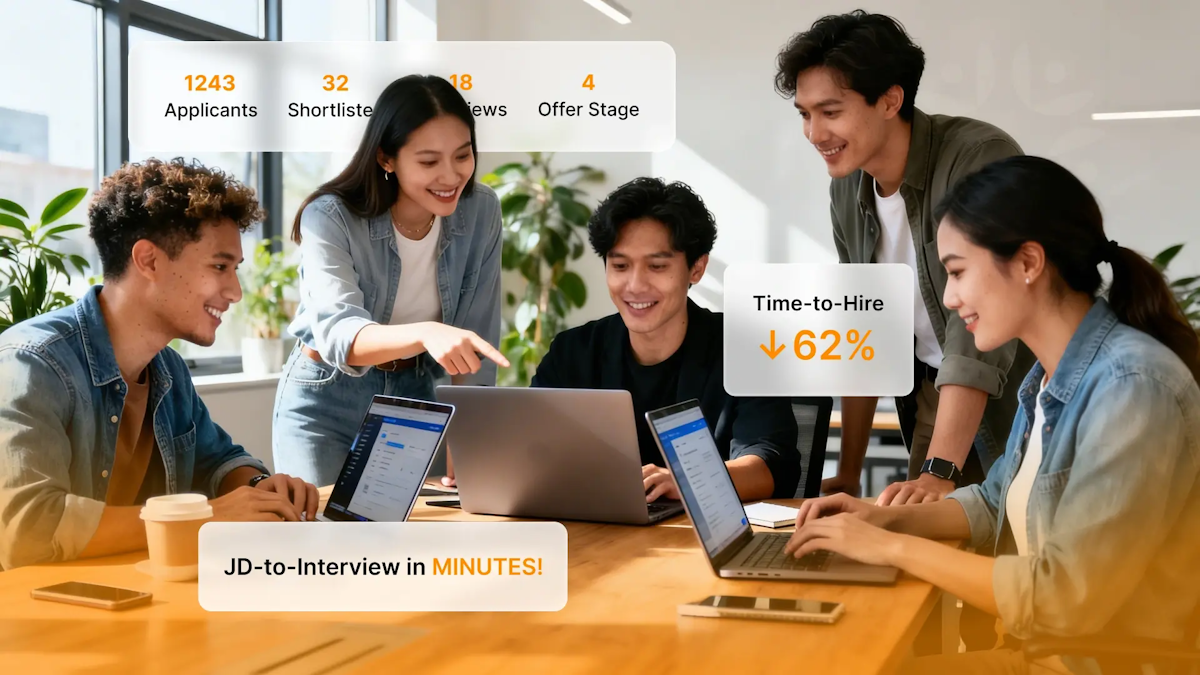
"Every empty seat in your company is costing you thousands of dollars per day."
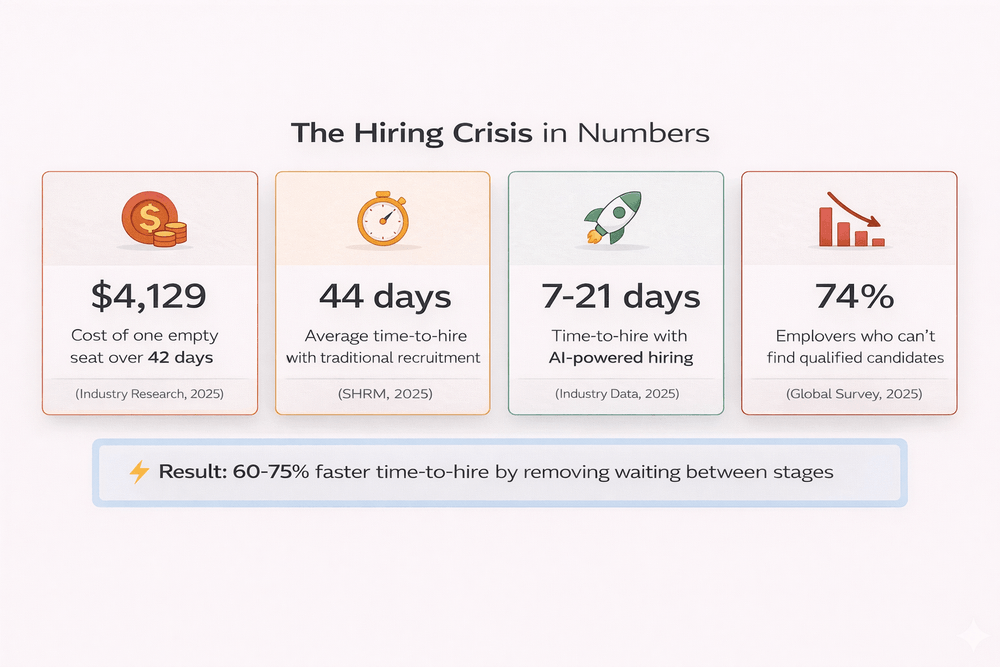
In 2025, the average time to hire stretches 44 days, while top candidates leave the market in under 10.
This gap is why fast-growing companies are turning to AI-powered hiring, not to replace recruiters, but to remove waiting, manual screening, and coordination delays.
In this guide, you’ll learn what AI-powered hiring actually means today, the measurable benefits it delivers, where traditional recruitment tools break down, and how to evaluate whether this approach fits your hiring needs.
By the end, you'll understand why some companies fill critical roles in days while others are stuck in 44-day cycles, and more importantly, how to join the winners.
What Are AI-Powered Hiring Tools?
AI-driven hiring platforms leverage machine learning and natural language processing to assess and rank candidates at scale, far beyond simply storing resumes or automating emails.
| What they actually do | What they don't do |
| Screen resumes for skills and experience (not just keywords) | Replace recruiters or make final hiring decisions |
| Rank candidates against role-specific criteria | Guarantee unbiased outcomes (they require governance) |
| Conduct structured initial assessments | Work as simple keyword filters |
| Automate scheduling and coordination | |
| Reduce early-stage bias through consistent evaluation |
Think of them as decision acceleration systems that surface strong candidates faster while keeping humans accountable for final judgment.
The Real Benefits of AI-Powered Hiring for Recruiters
Recruiters in fast-growing companies don’t adopt AI hiring tools out of curiosity. They adopt them because their existing hiring process starts breaking under pressure.
What follows are not abstract advantages. Each benefit below maps to a specific bottleneck that appears when hiring volume increases, timelines compress, or roles stay open too long.
1. Faster Time-to-Hire by Removing Waiting, Not Skipping Steps
In most companies, hiring doesn’t fail suddenly. It slows down quietly when:
- Resumes pile up
- Interviews stretch across weeks
- Candidates wait without updates
That’s why average time-to-hire still sits around 40–45 days for many roles.
What AI changes: AI-powered hiring shifts when evaluation happens. Instead of waiting for recruiters to manually review resumes in batches, structured screening and ranking begin the moment resumes enter the software.
What improves as a result:
- Qualified candidates surface in minutes, not weeks
- Early screening stops being the longest delay in the funnel
- Shortlists form while applications are still arriving
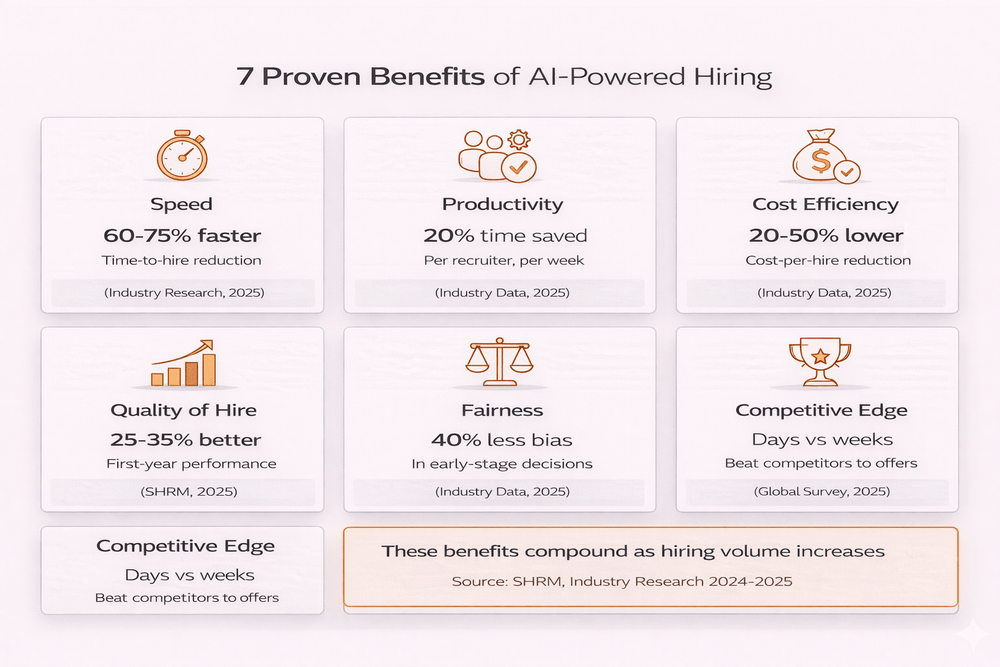
Case studies consistently show 60–75% reductions in time-to-hire when screening, scheduling, and early interviews run in parallel instead of sequence.
2. Recruiter Productivity That Scales Without Burnout
Recruiter workload doesn’t scale linearly. When application volume doubles:
- coordination work explodes
- follow-ups multiply
- context switching increases
Recruiters end up spending more time managing logistics than evaluating candidates.
What AI changes: AI-driven recruiting tools absorb repetitive coordination work, including:
- resume triage
- first-round screening
- interview scheduling
- candidate status updates
What improves as a result:
- recruiters regain up to 20% of their workweek
- one recruiter can manage larger pipelines without cutting corners
- consistency improves across candidates
This matters because productivity isn’t just about speed. It’s about capacity without exhaustion.
Recruiters stay focused on judgment, closing, and stakeholder alignment, where human value actually matters.
3. Lower Cost-Per-Hire by Reducing Vacancy Time
Most hiring cost discussions focus on visible expenses:
- software licenses
- agency fees
- recruiter headcount
But the highest cost is usually invisible, which is open roles.
Every unfilled position creates:
- lost productivity
- delayed revenue
- increased workload for existing teams
For revenue-generating roles, this cost can reach thousands per day.
What AI changes: By shortening time-to-fill, AI-powered hiring reduces how long roles stay open.
What improves as a result:
- revenue days are recovered sooner
- agency reliance drops
- vacancy costs shrink
Research shows 20–50% reductions in cost-per-hire when vacancy duration decreases.
4. Higher Quality of Hire Through Early Structure
Many fast-growing companies have felt the cost of hiring quickly based on gut feel, only to pay for it later through attrition or underperformance.
What AI changes:
AI enforces structure before human judgment kicks in. Candidates are evaluated against:
- predefined role criteria
- consistent screening logic
- standardized interview inputs
What improves as a result:
- early decisions rely on signal, not intuition
- interview performance is contextualized, not over-weighted
- role fit improves
Studies show 25–35% improvements in first-year performance when structured evaluation replaces unstructured screening.
5. Fairer, More Defensible Hiring at Scale
Bias doesn’t disappear automatically with AI. Poorly designed recruiting software can amplify it.
The benefit appears only when fairness is treated as a design constraint, not a byproduct.
What AI changes (when implemented correctly):
- anonymized early screening
- standardized scoring criteria
- audit-ready decision trails
- human-in-the-loop oversight
What improves as a result:
- bias reduces by up to 40% in early-stage decisions
- evaluation logic stays consistent as volume increases
- evaluation logic stays consistent as volume increases
For fast-growing companies, this consistency matters. Subjective decisions multiply with scale. AI enforces the same logic everywhere, while humans retain accountability.
6. Better Candidate Experience Without Losing the Human Touch
Candidates don’t reject automation. They reject silence, confusion, and waiting in a hiring experience.
What AI changes: AI removes friction from early-stage interactions:
- faster responses
- timely status updates
- interviews scheduled without back-and-forth
What improves as a result:
- candidates feel progress instead of uncertainty
- drop-off decreases
- trust increases
Research consistently shows that candidates still expect human touchpoints at key stages. Smart AI recruiting tools recognize and respect that limit:
- AI handles logistics and consistency
- humans handle explanation, feedback, and final conversations
Thus, AI doesn’t make hiring impersonal. It gives recruiters more time to be human where it matters.
7. Hiring Speed Becomes a Competitive Advantage
In fast markets, top candidates don’t wait weeks. They exit the market in days.
What AI changes:
Because evaluation begins earlier and runs in parallel, companies can:
- surface strong candidates faster
- make decisions sooner
- extend offers before competitors finish screening
What improves as a result:
- teams form earlier
- execution accelerates
- growth compounds faster
Speed only works when paired with structure. AI provides that structure, allowing companies to move fast without increasing hiring risk.
How Modern AI Hiring Actually Works
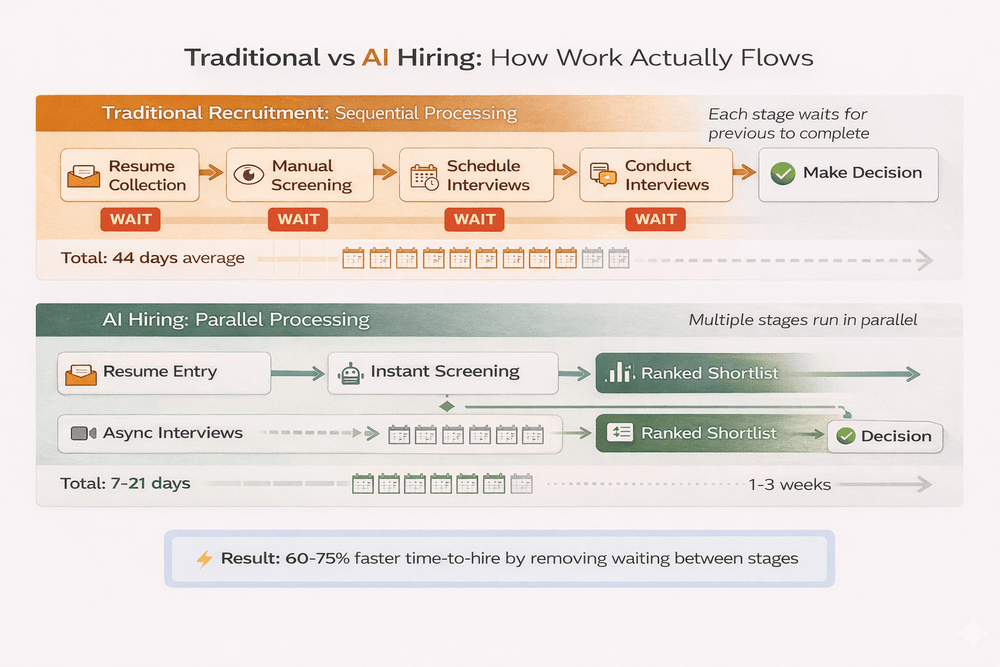
Traditional hiring moves candidates through stages sequentially: screen all resumes first, then schedule interviews, then make decisions. Each step waits for the previous to finish.
Where time is actually lost:
- Waiting for resumes to pile up before screening begins
- Coordinating calendars between interviewers and candidates
- Collecting feedback in batches before moving forward
- Multiple approval cycles before offers go out
Research shows 40-60% of time-to-hire is waiting, not active evaluation.
The core structural change AI hiring makes:
Traditional hiring runs like an assembly line, one stage at a time. AI hiring runs multiple stages simultaneously.
What this looks like in practice:
| Traditional approach | AI-powered approach |
| Collect 200 resumes over 2 weeks | Screen resumes as they arrive (continuous) |
| Screen all resumes (3-5 days) | Qualified candidates get interview invitations immediately |
| Schedule interviews (1-2 weeks of coordination) | Asynchronous interviews run while screening continues |
| Conduct interviews (2-3 weeks) | Shortlist forms in real-time as data comes in |
| Collect feedback and decide (1 week) | Hiring managers review ranked candidates, not raw applications |
| Total: 6-8 weeks | Total: 1-3 weeks |
The speed gain comes from removing waiting between hiring stages, not from cutting corners or skipping human judgment.
Why Traditional Recruitment Tools Can't Keep Up
Traditional recruitment tools, even with "AI features" added, struggle because they were designed for sequential workflows.
The core problem: Most tools only activate after candidates apply and accumulate. Screening begins late, interviews wait on calendars, and decisions queue behind approvals.
What adding "AI features" to an ATS actually changes:
| What Improves | What Stays the Same |
| Resume parsing happens faster | Screening still starts late |
| Chatbots respond instantly | Candidates still wait between stages |
| Scheduling is automated | Interviews still gate all progress |
| Admin effort decreases | Workflow remains sequential |
As a result, individual tasks speed up, but hiring doesn't.
Why the problem is worse now:
Generative AI has flooded recruiters with polished resumes. More applications look qualified on paper, which means:
- More candidates need screening
- The signal-to-noise ratio has dropped
- Keyword-based filters add confusion instead of clarity
Traditional tools apply structure too late, after complexity has entered the funnel. By then, the volume has already created a bottleneck.
What to Look For in an AI Hiring Tool (Buyer’s Checklist)
Not all AI hiring tools solve the same problem. Many make individual steps faster, but few change how hiring actually moves. This checklist focuses on structural signals, not surface-level features.
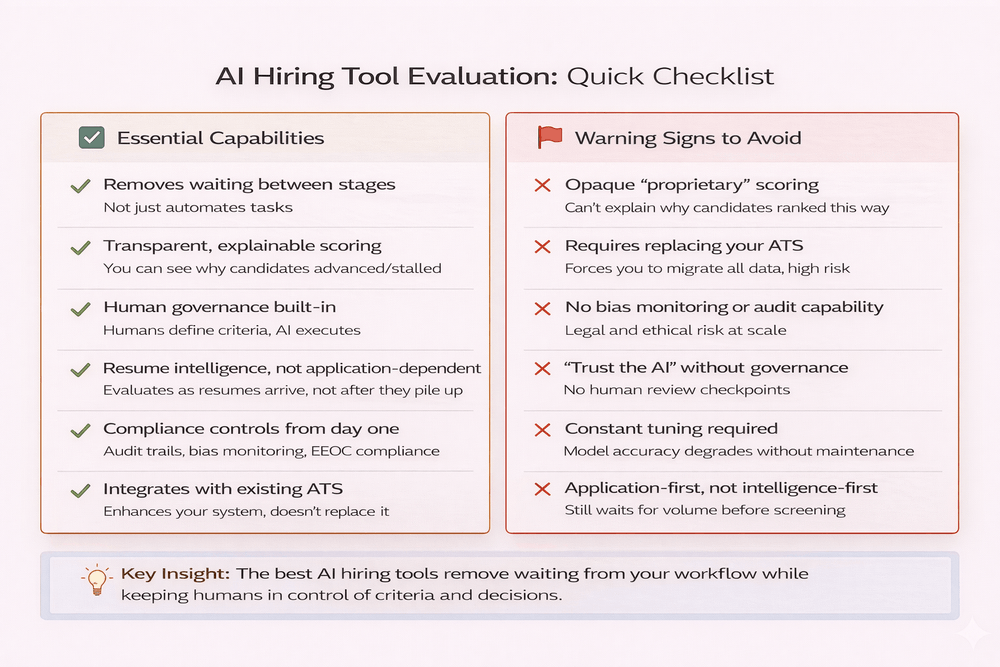
Does the Tool Reduce Waiting or Just Automate Tasks?
This is the most important question to ask. Traditional recruiting tools wait for applications to pile up before screening begins. Research shows that this waiting accounts for most of the time-to-hire.
| What to look for | What to be cautious of |
| Evaluation starts as soon as resumes enter the system | Tools that “speed up screening” but still require manual handoffs |
| Screening, assessment, and shortlisting run in parallel | Systems where candidates wait for someone to click “next stage” |
| Candidates move forward when criteria are met, not when stages close |
Ask directly: Does this tool remove waiting between steps, or only automate work inside them?
Is the Scoring Transparent and Explainable?
AI only improves hiring when decisions can be explained.
Research on compliance and bias consistently shows that black-box rankings increase legal and ethical risk, especially at scale.
| What to look for | What to be cautious of |
| Clear visibility into how candidates are scored | “Proprietary” models that cannot be explained |
| Explicit criteria tied to role requirements | Rankings without clear reasoning |
| Adjustable thresholds you can review and control | Scores you’re told to “trust” |
If you can’t explain why someone advanced or stalled, accountability is already lost.
Is Human Governance Built Into the Workflow?
Effective AI hiring systems do not remove judgment. They reposition it.
The strongest research-backed models use human-in-the-loop governance, where AI handles evaluation at scale, and humans retain decision authority.
| What to look for | What to be cautious of |
| Humans define role criteria upfront | Systems where humans only review outcomes at the very end |
| Review and override options at key decision points | Tools that automatically reject candidates without visibility |
| Clear ownership of final decisions |
Does the Tool Rely on Applications or Resume Intelligence?
Many AI recruiting tools remain application-driven. This limits speed and creates unnecessary friction.
Research shows that intelligence-driven evaluation outperforms application-first models, especially for fast-growing teams hiring at volume.
| What to look for | What to be cautious of |
| Bulk resume ingestion and analysis | Tools that cannot evaluate until candidates apply |
| Continuous evaluation as data enters the system | Systems treating resumes as attachments, not data |
| Screening that does not depend on application timing |
Speed improves when the evaluation starts earlier than the application funnel.
Are Compliance and Fairness Controls Built In (Not Added Later)?
AI hiring tools now operate under real regulatory scrutiny. Current requirements include:
- Bias audits (e.g., NYC Local Law 144)
- Transparency and risk management (EU AI Act)
- Ongoing adverse impact monitoring
| What to look for | What to be cautious of |
| Clearly documented evaluation logic | “Compliance-ready” claims without evidence |
| End-to-end, audit-ready decision records | Post-hoc reporting instead of built-in controls |
| Verified exclusion of protected attributes and proxy variables |
Compliance cannot be bolted on later. It must be part of system design.
Does It Integrate Without Replacing Your ATS?
AI should not replace your system of record. The strongest hiring stacks separate:
- Evaluation and decision flow (AI layer)
- Compliance, history, and reporting (ATS layer)
| What to look for | What to be cautious of |
| Clean integration with your existing ATS | Tools that require replacing your ATS to work well |
| Independent evaluation logic | Systems that blur evaluation with record-keeping |
| No forced data lock-in |
Replacing your ATS increases risk. Enhancing it reduces friction.
Red Flags to Watch For:
Be cautious of AI hiring tools that:
- Promise speed without explaining how waiting is removed
- Rely on opaque models you cannot audit
- Emphasize chatbot activity over evaluation quality
- Require constant tuning to stay accurate
- Cannot demonstrate bias monitoring or explainability
Final Words
For fast-growing companies, AI-powered hiring is no longer about experimentation. It is about reducing waiting, restoring control, and protecting growth momentum.
As this article showed, long time-to-hire cycles, manual screening, rising vacancy costs, and inconsistent evaluations compound quickly when hiring volume increases.
AI-powered hiring changes the flow of decisions by moving evaluation earlier, enforcing structure, and allowing roles to progress in parallel rather than in queues.
The result is faster hiring without sacrificing fairness, auditability, or quality of hire.
If you are scaling and still relying on traditional recruitment tools, the real risk is not adopting AI. It is continuing to operate a workflow built for slower conditions.
If you want to see what a role-defined, human-governed, parallel hiring workflow looks like in practice, you can review how AiPersy evaluates resumes, interviews candidates asynchronously, and produces shortlists in minutes instead of weeks.