Why AI Parsing Fails, and AI Interviewers Don’t
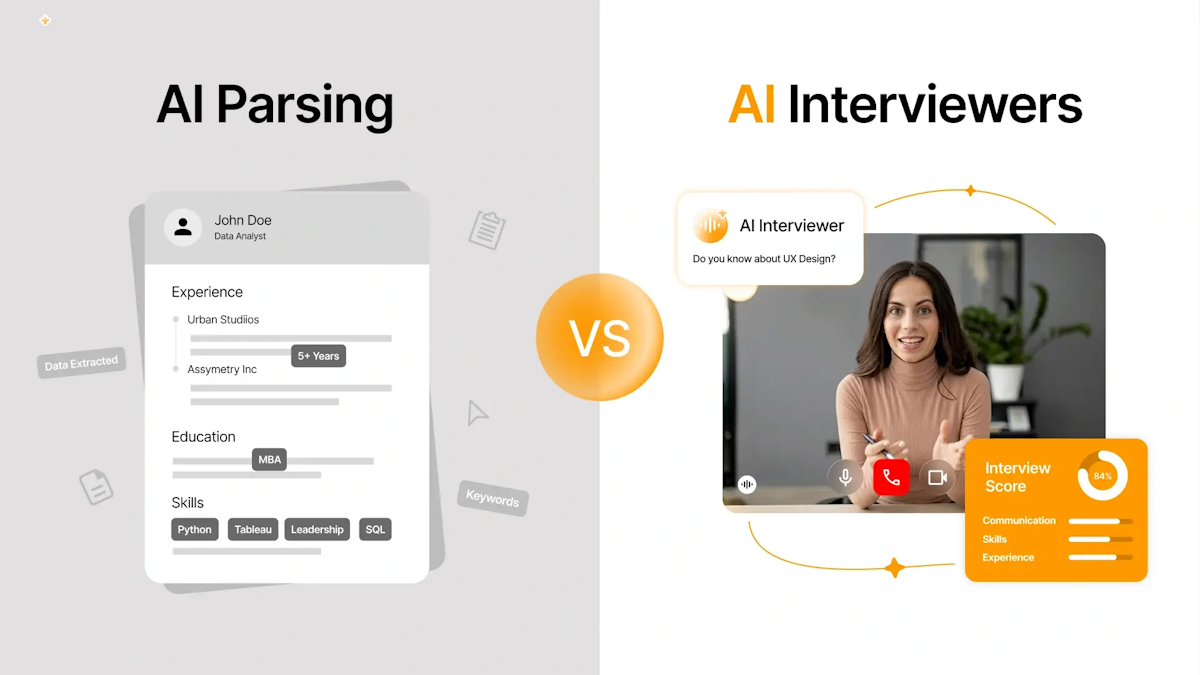
Hiring teams today don’t struggle with a lack of applicants. They struggle with volume.
A single job post can attract hundreds of resumes overnight, amplified by AI resume builders and one-click applications.
While ATS tools and AI parsing help process this flood faster, hiring timelines still stretch longer than expected.
If your hiring funnel feels busy but slow, this breakdown will help you understand what truly accelerates hiring and what does not.
The True Cost of Manual Resume Screening
When it comes to screening resumes manually, there’s more to it than meets the eye.
It’s one of the most expensive, time-consuming, and draining steps in recruiting.
The time cost alone is an alarming factor in manual resume screening.
For instance, if your hiring team takes 2-3 minutes to scan a single resume, then screening 300 resumes could take around 10 to 15 hours of repetitive screening.
However, time cost isn’t the only factor here; quality and consistency drop too.
As fatigue sets in, recruiters tend to rely heavily on keywords, formatting, or whoever applied earliest.
This creates a bias within the hiring teams that the job applications received later in the stack rarely get any attention, no matter how skilled the candidate is.
Then come the downstream bottlenecks.
A delayed first pass means interviews are pushed out, hiring managers wait longer for shortlists, and top candidates accept offers from faster-moving competitors.
Manual screening slows hiring and weakens every subsequent decision point.
In the next section, we’ll learn whether the AI recruiter tools are genuinely fast enough to fix this bottleneck, and what they actually improve.
What AI Resume Parsing Actually Does
Speed, yes, this is the prime factor contributing to the worldwide adoption of AI resume parsing.
Think of a recruiter manually reading each resume.
On the other hand, there’s an AI Interviewer tool that scans resumes, extracts key information, and shortlists candidates based on relevance, within a fraction of a second.
But to understand what it truly solves (and what it doesn’t), it’s important to look at how resume parsing actually works under the hood.
At its core, AI parsing uses NLP (Natural Language Processing) and machine learning models to parse a résumé into structured data points.
It identifies skills, job titles, education, years of experience, certifications, responsibilities, and even contextual clues like seniority or domain familiarity.
The tool then maps those data points against the description’s requirements.
This is why parsing is dramatically faster; it never reads any resume the way a human would.
Furthermore, AI-powered parsing is consistent. An HR professional might not keep the same degree of accuracy throughout the day.
But an AI recruiter applies the same evaluation logic for every resume, ensuring consistency that humans cannot maintain at scale.
For these futuristic tools, keywords are not the only compass; they utilize advanced Large Language Models (LLMs) to detect patterns like “led a migration to AWS” as evidence of cloud experience or “managed a team of five” as a leadership signal, even when exact keywords vary.
However, parsing has its boundaries. You can use such tools to accelerate the resume screening process.
Still, for interviewing candidates, analyzing problem-solving ability, and judging how convincingly a candidate explains their work, AI recruiter tools are what you need.
In other words, AI parsing fixes one particular bottleneck: the time recruiters spend opening and interpreting hundreds of resumes.
It does not replace the deeper evaluation that comes later in the funnel.
This is exactly why teams that adopt parsing often see faster screening, but don’t always see faster hires.
Parsing accelerates the initial phase, but it doesn’t save you from the friction that follows.
Where AI Resume Parsing Fails Short
Parsing is useful for data extraction purposes in the initial phase of the recruitment funnel during screening.
But it fails to aid the hiring teams with the rest of the processes within the funnel.
Parsing cannot:
- understand how candidates think
- test real skills
- evaluate clarity of communication
- analyze how convincingly someone explains past work
- distinguish between entry-level vs deep expertise
- detect culture alignment
- score problem-solving ability
Furthermore, it also can’t fix the administrative bottlenecks that slow hiring:
- manual scheduling
- interview coordination
- hiring manager delays
- note-taking
- comparison across candidates
- summarization
- feedback loops
That’s why the organizations that once struggled with slow hiring funnels are evolving beyond parsing with a fully fledged AI interviewer tool.
Why Recruiters Are Moving From Parsing to AI Interviewers
AI resume parsing solved one narrow problem in hiring: the time recruiters spend opening and interpreting resumes.
It made the top of the funnel faster. It did not make decisions faster. As hiring teams scaled, this limitation became clear.
Even with perfect parsing, recruiters still had to schedule interviews, conduct first-round evaluations, take notes, summarize conversations, and align with hiring managers.
The bottleneck simply moved downstream. AI interviewers emerged to address this gap.
Unlike parsing tools, AI interviewers evaluate candidates instead of just reading documents.
They conduct structured first-round interviews automatically through text, voice, video, or avatars, without relying on recruiter or interviewer availability.
These systems assess how candidates explain their work, reason through problems, communicate clearly, and demonstrate role-specific knowledge.
They apply the same evaluation logic to every candidate, removing early-stage inconsistency while preserving depth.
Most importantly, AI interviewers operate without queues. The moment a candidate applies, evaluation begins.
There is no waiting for calendars, no back-and-forth scheduling, and no delay before insights are available.
AI interviewers remove:
- scheduling delays
- rescheduling loops
- manual note-taking
- inconsistent first-round interviews
- subjective early judgments
- slow handoffs to hiring managers
They deliver:
- consistent, role-ready interviews
- structured evaluation rubrics
- objective candidate comparison
- instant summaries
- ATS-ready scorecards
- faster decision cycles
This is not a small efficiency gain. It is a structural shift in how hiring progresses.
Parsing accelerates reading resumes. AI interviewers accelerate evaluating people.
Recruitment teams that adopt interview automation do not just screen faster.
They clear early-stage evaluations faster, which is what actually compresses time-to-hire.
Final Words
Manual screening is slow. AI parsing is faster. But neither solves the deeper bottlenecks inside hiring.
Parsing accelerates reading resumes. AI interviewing accelerates evaluating people. Parsing improves the funnel’s first step.
AI interviewers improve the entire funnel.
In the recruitment industry, where speed directly determines whether you win or lose top candidates, the teams that combine AI parsing with AI interviewing aren’t just screening faster; they’re hiring faster, more confidently, and more consistently.
Therefore, if your goal is simply to scan resumes quickly, parsing is enough.
If the goal is to make high-quality hiring decisions faster, teams are increasingly turning to AI interviewers as the next evolution beyond parsing.