What Is an AI Interviewer? Complete Guide (2026)
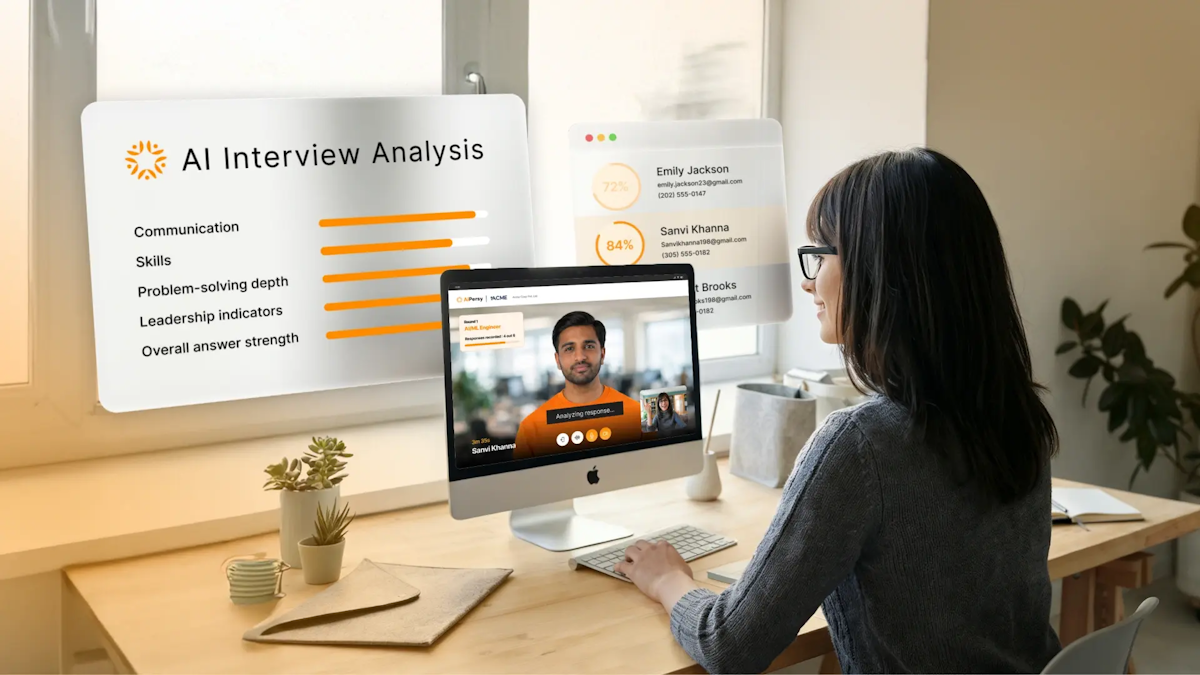
Nowadays, AI has become a standard across industries.
In recruitment, especially, there are myriad AI interviewer tools available online, each differing in functionality.
As a result, HR and TA professionals often find themselves back at square one, asking: “What is an AI Interviewer?”
This guide breaks down how these tools work, where they fit into your hiring process, the risks to watch for, their costs, and how to evaluate them effectively in 2026.
What Is an AI Interviewer?
An AI interviewer is a software powered by AI and machine learning that conducts, screens, and scores interviews automatically using predefined questions and scoring rules that hiring teams configure in advance.
Tools like AiPersy trigger interviews automatically when candidates pass screening, so evaluation starts immediately instead of waiting for calendar coordination.
How Does an AI Interviewer Work?
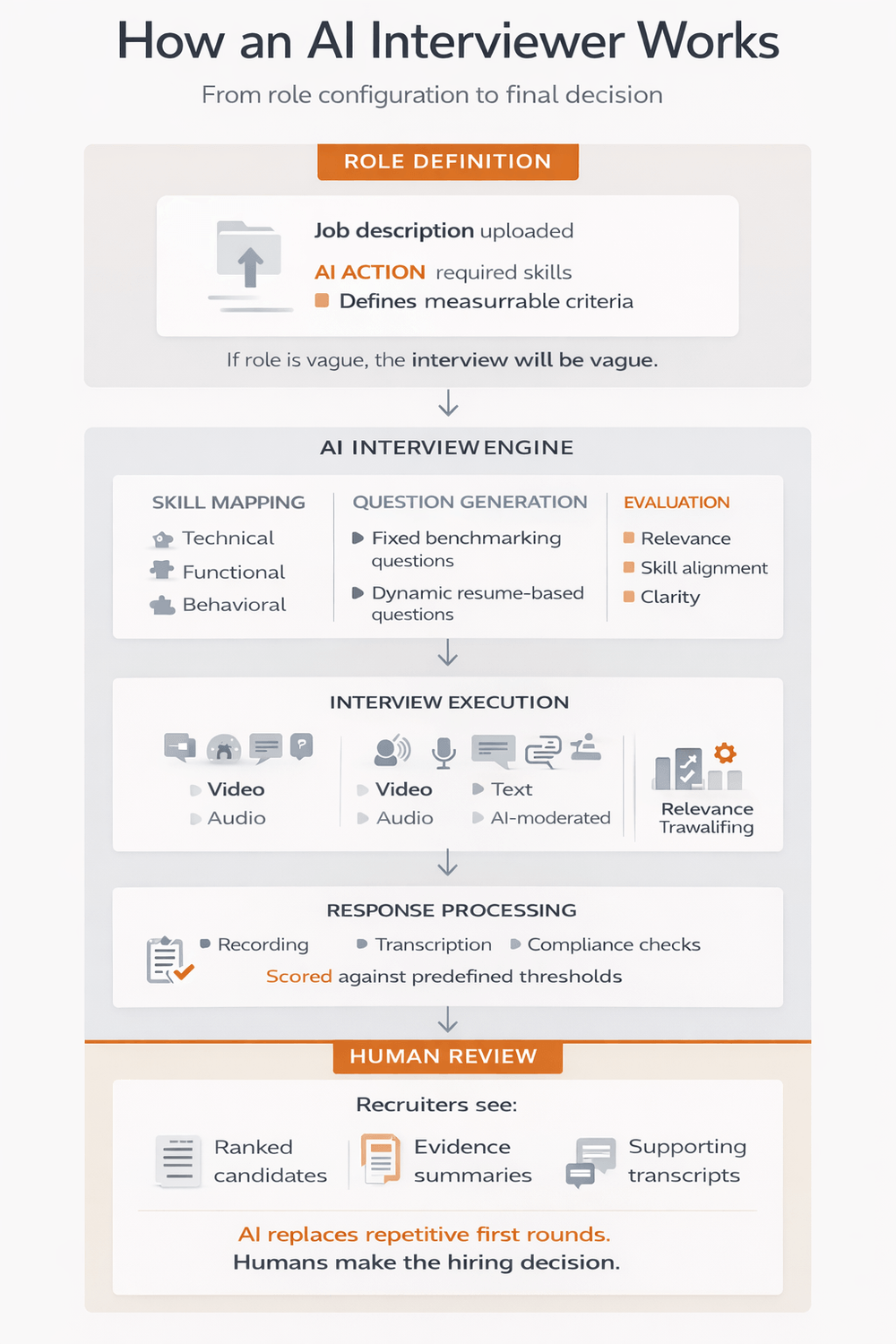
An AI interviewer converts what you desire from a candidate into interview questions, then it collects candidate responses, and evaluates those responses against predefined criteria without a human being involved in the initial round.
However, the quality depends entirely on how clearly you define the role upfront. Here's the step-by-step process:
Job Description Analysis
Initially, the hiring team uploads or defines the job description in the software.
The AI reads it and identifies required skills, preferred experience, behavioral competencies, and role-specific expectations.
Therefore, the interview reflects the exact requirements of that role. If your job description is vague, the interview process will likely be broken.
Skill Mapping
The AI translates the job description into measurable skills needed for an effective evaluation, such as:
- Technical skills (Python, SQL, React)
- Functional skills (stakeholder management, negotiation)
- Behavioral traits (ownership, communication, resilience)
Question Generation
After mapping the skills of each candidate, the AI generates questions for the interview.
Seemingly, most AI interviewer platforms use two types:
- Fixed questions asked to all candidates for benchmarking
- Dynamic questions that are always personalized based on the candidate's resume
For example:
- Fixed: "Describe a time you handled a difficult client."
- Dynamic: "You mentioned leading a migration project. What challenges did you face?"
Using this combination, AI recruiting tools maintain fairness while keeping the interview relevant.
Interview Execution
Once the candidate completes the interview within the platform. TA teams typically choose one of four formats to cross-check evaluations done by AI:
- Recorded video responses
- Audio-only responses
- Text-based written answers
- Live AI-moderated interviews
Many modern platforms include video components to make the experience feel more natural for candidates. Some use AI avatars that ask questions verbally, while others simply record candidate video responses.
Meanwhile, the platform records responses, transcribes speech, detects completion compliance, and flags suspicious behavior if proctoring is enabled.
Therefore, your recruiters do not attend every interview, and neither do they have to coordinate calendars.Response Evaluation
Once the candidate submits responses, the AI evaluates content relevance, depth of answer, skill alignment, and communication clarity.
The software applies the same evaluation logic to every candidate. This consistency helps reduce some forms of human bias that appear in unstructured interviews, though it does not eliminate bias.
Because configuration errors, poorly defined criteria, or biased training data can still introduce unfairness.
Furthermore, some platforms also analyze delivery factors like tone and pacing. However, this varies by vendor and jurisdiction due to legal and bias concerns.
The AI then scores each response, generates summaries, and ranks candidates based on defined thresholds. Recruiters receive a dashboard instead of raw recordings.Human Review and Decision
In the final step, your recruiters have to review top-ranked candidates, evaluation summaries, and supporting evidence.
They can advance candidates, reject candidates, or override scores if necessary.
Therefore, AI interviewers do not replace hiring decisions. They only replace repetitive first-round interviews while leaving the final decisions to hiring managers.
What Types of AI Interviewers Are Used in 2026?
AI interviewers in 2026 range from simple chatbots to advanced technical evaluators. The type you need depends on your hiring volume, role complexity, and how much human oversight you want to maintain.
Here are the five main types of AI Interviewers you'll see often in 2026:
Adaptive AI Interviewers (Generative/Agentic)
These platforms adjust questions in real-time based on previous answers. Consequently, the interview feels more like a conversation than a quiz.
Examples: Eightfold.ai, Sapia.ai, AiPersy
Best for: Mid to senior roles where you need depth and context, not just checkbox qualifications.
Limitation: Quality depends heavily on how well you define evaluation criteria in the first place
Conversational AI Interviewers (Text or Voice Chatbots)
These tools engage candidates in real-time text or voice conversations. They screen for basic qualifications, schedule follow-up interviews, and answer candidate questions.
Examples: Paradox.ai (Olivia), HeyMilo
Best for: High-volume, entry-level, or retail roles where you need fast initial screening.
Limitation: They work best with straightforward qualification criteria, but in complex roles, they require more in-depth evaluation.
Asynchronous Video Interviewers (AVI)
Here, candidates record video answers to preset questions on their own time. The AI analyzes spoken words, response depth, and sometimes sentiment or consistency patterns.
Examples: MyInterview, VidCruiter, HireVue
Best for: Roles where communication style matters and you want to eliminate scheduling delays.
Limitation: Candidates often dislike one-way video recording. That means drop-off rates can be higher than text-based formats.
Technical Skill Evaluators
These tools focus specifically on coding, system design, or technical problem-solving. They evaluate code quality, logic, and technical depth automatically.
Examples: AiPersy, HackerEarth, WeCP, iMocha
Best for: Engineering, data science, and technical roles where skills are measurable and testable.
Limitation: They do not assess soft skills, culture fit, or communication ability. You still need human interviews for those.
Game-Based Assessments
Candidates complete interactive games or simulations that measure cognitive skills, personality traits, and behavioral competencies. The AI scores performance patterns.
Examples: HireVue (game modules), Pymetrics
Best for: Roles where cognitive ability and problem-solving matter more than specific technical knowledge.
Limitation: Candidates find these polarizing. Some appreciate the novelty. Others find them gimmicky or irrelevant to the actual job.
Where Does an AI Interviewer Fit in the Hiring Process?
An AI interviewer fits between resume screening and human interviews. It replaces or supplements the first conversation round that typically happens after you shortlist candidates.
Here's where it works in the modern hiring flow in 2026:
Standard hiring process: Resume screening → Manual shortlisting → First-round interviews (scheduling delay) → Second-round interviews → Decision
With AI interviewer: Resume screening → AI interview (triggered automatically) → Human review of results → Final interviews → Decision
The AI interviewer removes the scheduling bottleneck that normally delays first-round conversations.
Consequently, evaluation happens immediately after screening instead of waiting for calendar coordination.
What Are the Benefits of Using an AI Interviewer?
Now that you've learned, AI interviewers remove scheduling delays, standardize evaluation, and let you process high volumes without burning out your hiring team.
In this section, we'll expand those advantages:
Save Bandwidth for Recruiters
Scheduling, conducting, and following up on first-round interviews takes hours per candidate.
AI interviews handle initial screening automatically. Your team reviews only the results. Consequently, recruiters focus on qualified candidates instead of coordinating calendars.Handle High Application Volumes
When you receive 100+ applications per role, manual screening creates a bottleneck.
AI interviews evaluate large applicant pools quickly without requiring additional headcount. This matters most in high-volume hiring where dozens or hundreds of candidates need first-round screening.Surface Candidates Who Don't Shine on Paper
We've seen that resumes often miss context. Career gaps need explanation, and unconventional backgrounds need clarification.
AI interviews allow candidates to present their qualifications in their own words. As a result, you uncover talent that might otherwise be overlooked in traditional resume screening.Provide Consistent Evaluation
AI interviewers ask every candidate the same questions in the same way. They do not get tired during the tenth interview. They do not make change judgments like humans.
Consequently, candidates get evaluated based on your defined criteria rather than the interviewer's mood or availability.
Offer Scheduling Flexibility
Traditional interview scheduling takes nearly 6 days from first contact to completed interview. AI interviews let candidates complete screening on their own schedule, whether during lunch breaks, evenings, or weekends. Neither side waits for the other's availability.
Can an AI Interviewer Handle High-Volume Hiring?
Yes. AI interviewers are built specifically for high-volume scenarios where manual first-round interviews create bottlenecks.
Most platforms can run hundreds or thousands of interviews simultaneously. The constraint is not the AI's capacity. The challenge is how fast your team can review completed interviews and make decisions.
Most AI interview platforms handle 1,000+ concurrent interviews without performance issues. Tools like AiPersy, HireVue, and HackerEarth routinely process high-volume campaigns for retail, contact centers, and seasonal hiring.
How Does an AI Interviewer Compare to a Human Interviewer?
AI interviewers excel at speed, consistency, and scale. Whereas the human interviewers excel at nuance, cultural fit, and adaptive questioning. Here's the practical comparison:
| Factor | AI Interviewer | Human Interviewer |
| Speed | 8 minutes average per candidate, handles thousands simultaneously | 30-60 minutes per candidate, 4-6 interviews per day maximum |
| Cost | $5-$50 per interview after platform setup | $50-$200 per interview (recruiter time + coordination) |
| Consistency | Same questions and scoring criteria for every candidate | Varies by the interviewer's mood, experience, and personal judgment |
| Predictive accuracy | 62% accuracy predicting job performance (structured format) | 56% accuracy (unstructured interviews) |
| Scalability | Processes 250% more candidates per recruiter | Requires additional headcount as volume increases |
| Cultural fit assessment | Cannot evaluate effectively | Reads communication style, team alignment, and organizational fit |
| Adaptability | Follows predefined logic, limited real-time adjustment | Probes inconsistencies, explores unexpected answers, and assesses judgment |
| Candidate satisfaction | 80% for entry-level roles, 60% for executive roles | 75% for entry-level roles, 84% for executive roles |
What the Data Shows
Companies using AI interviews reduce time-to-hire significantly. Unilever cut hiring time from 4 weeks to 4 days using AI screening. Hilton reduced recruiter hours by 75% for early-stage interviews.
However, AI interviews work better for some roles than others. Entry-level candidates appreciate the flexibility (83% liked on-demand scheduling).
Senior professionals report more anxiety with AI interviews because they cannot build rapport or explain context.
Structured interviews predict performance better than unstructured ones, regardless of who conducts them. AI interviews use structured formats by default. Human interviews vary based on the interviewer's preparation.
How Much Does an AI Interviewer Cost in 2026?
AI interviewer costs range from $2,000 to $50,000+ annually, depending on hiring volume, features, and platform sophistication. Most platforms use one of three pricing models:
Per-Interview Pricing
You pay $5-$50 per completed interview. This works well for low-volume hiring or seasonal campaigns.
Example tiers:
- Basic screening: $5-$15 per interview
- Video + AI scoring: $20-$35 per interview
- Technical assessments: $30-$50 per interview
Best for: Companies hiring fewer than 100 candidates per year.
Monthly or Annual Platform Fee
You pay a fixed subscription ($200-$5,000+ per month) for unlimited or high-volume usage.
Typical structure:
- Starter: $200-$500/month (up to 50 interviews)
- Professional: $500-$2,000/month (up to 500 interviews)
- Enterprise: $2,000-$10,000+/month (unlimited interviews)
Best for: Companies with consistent hiring volume across multiple roles.
Custom Enterprise Pricing
Large organizations negotiate custom contracts based on total hiring volume, integrations, and support requirements.
Factors that increase cost:
- Multi-language support
- Advanced analytics and reporting
- ATS integrations
- Dedicated customer success team
- Custom question libraries
- White-label branding
Best for: Companies hiring 1,000+ candidates annually or needing extensive customization.
What Influences the Final Cost of an AI Interviewer
Hiring volume: Most platforms charge based on the number of interviews conducted or candidates processed.
Feature depth: Basic plans offer standard questions and scoring. Advanced plans add behavioral analysis, adaptive questioning, and predictive analytics.
User seats: Some platforms charge per recruiter. Others offer unlimited access for a flat fee.
Contract length: Annual plans typically cost 15-25% less than month-to-month pricing.
Support level: 24/7 support and dedicated onboarding usually come with higher-tier plans.
Hidden Costs to Consider
Implementation time: Most platforms require 2-4 weeks for setup, integration, and question configuration.
Training: Your team needs to learn how to review AI-generated results and calibrate scoring.
Ongoing optimization: You will adjust questions and criteria based on hiring outcomes. This requires ongoing team input.
Tools like AiPersy typically fall in the mid-range pricing category with platform fees based on hiring volume and feature requirements.
What Features Should You Look for in an AI Interviewer?
Selecting the right AI interviewer depends on your hiring volume, role complexity, and how much customization you need. Here are the features that actually matter:
Role-Specific Question Bank
The platform should include preset questions tailored to different job types, such as sales, engineering, support, and marketing. This saves setup time and ensures interviews focus on relevant skills.
However, you also need the ability to customize questions. Generic questions do not capture company-specific requirements or role nuances.
Look for: Pre-built question banks by role, plus the ability to add or edit questions to match your needs.
Real-Time Scoring with Relevant Evidence
The AI should score responses immediately and show you why it scored them that way. You need to see the candidate's actual words, not just a number.
Look for: Scoring metrics that display evidence snippets, keyword matches, and skill-level ratings. Because transparent scoring lets you verify AI decisions and build trust with hiring managers.
Structured Evaluation Criteria
The platform should let you define evaluation criteria upfront, like technical skills, communication clarity, and problem-solving approach. Every candidate then gets scored against the same standards.
Look for: Configurable scoring rules tied to specific job requirements. This creates consistency and reduces variation across candidates.
Candidate-Friendly Interface
Candidates should understand what to expect before starting. Clear instructions, progress indicators, and reasonable time limits reduce anxiety and improve completion rates.
Look for: Practice questions, timer displays, and confirmation that responses were received. A poor candidate experience hurts your employer brand regardless of hiring decisions.
Analytics and Comparison Dashboard
You need a dashboard that shows candidate scores, skill breakdowns, and evidence summaries in one place. This lets you compare candidates quickly without reviewing full transcripts.
Look for: Filtering by score thresholds, skill tags, and interview completion status. The dashboard should help you identify top candidates at a glance.
ATS Integration
The AI interviewer should connect directly to your Applicant Tracking System. As well as interview results, scores, and transcripts should flow automatically into candidate profiles.
Look for: Native integrations with major ATS platforms (Greenhouse, Lever, Workable, etc.) or API access for custom workflows. Manual data transfer between systems wastes time and creates errors.
Customization Options
Beyond questions, you should be able to adjust scoring patterns, pass/fail thresholds, and skill categories. Different roles require different evaluation logic.
Look for: Configurable scoring rules, custom skill tags, and the ability to adjust evaluation criteria as you learn what predicts success.
Audit Trail and Compliance Support
Every interview should be recorded, transcribed, and scored in a way you can explain later. This matters for legal compliance and internal reviews.
Look for: Full transcripts, scoring explanations, and the ability to export interview data. If a hiring decision gets questioned, you need documentation.
Multi-Format Support
Some candidates prefer video responses. Others prefer text or audio. The platform should support multiple response formats to accommodate different roles and candidate preferences.
Look for: Flexibility in how candidates respond (video, audio, text) without changing evaluation logic.
AI Interviewer tools like AiPersy focus on parallel evaluation workflows where interviews trigger automatically after screening, removing manual handoffs. Whereas the AI recruiting platforms like HireVue emphasize video analysis. And, HackerEarth specializes in technical assessments with large question banks.
How Do You Implement an AI Interviewer Without Disrupting Your Hiring Process?
Implementation takes 2-6 weeks if done correctly. The key is starting small, testing thoroughly, and expanding gradually rather than replacing your entire process at once.
Here are the six steps that prevent any further chaos:
Step 1: Define Where AI Fits
Identify which stage currently creates the biggest bottleneck. Do not try to automate everything at once.
Common starting points:
- Initial screening after resume review (most common)
- Technical skill assessments for engineering roles
- High-volume first-round interviews for retail or support roles
Questions to answer:
- Which interviews take the most recruiter time?
- Where do scheduling delays slow hiring most?
- Which evaluation criteria are already structured enough for AI?
Start with one role type or hiring funnel stage. Prove it works there before expanding.
Step 2: Set Clear Evaluation Criteria
AI interviews only work when you define "good" clearly before launching. Vague criteria produce vague results.
What you need to define:
- Required skills and experience level
- Behavioral competencies that matter for this role
- Pass/fail thresholds for each evaluation category
- What "strong," "adequate," and "weak" answers look like
Write this down. If your hiring managers cannot agree on evaluation standards, AI interviews will not solve that problem.
Step 3: Integrate with Your Current Tools
The AI interviewer should connect directly to your ATS. Interview results should flow into candidate profiles automatically.
Integration checklist:
- Does the platform connect to your ATS?
- Can candidates access interviews from mobile devices?
- Where do transcripts and scores appear in your workflow?
- Who on your team sees results and when?
If integration requires major workflow changes, implementation will disrupt hiring. Choose platforms with native ATS connections.
Step 4: Train Your Team Before Launch
Your recruiters and hiring managers need to understand how the AI scores candidates and what they should do with results.
Training topics:
- How to review AI-generated transcripts and scores
- When to override AI recommendations
- How to calibrate scoring against actual performance
- What candidates experience during AI interviews
Most resistance comes from misunderstanding how the tool works. Hands-on training with sample interviews solves this.
Step 5: Run a Pilot Before Full Rollout
Test the AI interviewer on 20-50 candidates before using it company-wide. This reveals configuration issues, unclear questions, or scoring problems.
What to evaluate during pilot:
- Do questions make sense for the role?
- Are scores consistent with human assessment?
- Do candidates complete interviews at expected rates?
- What technical issues appear?
Adjust questions, scoring rubrics, and thresholds based on pilot results. Most platforms require 2-3 rounds of tuning before scoring aligns with hiring standards.
Step 6: Keep Humans in the Loop
AI interviews should inform human decisions, not replace them. Your hiring managers still review candidates and make final calls.
How to maintain oversight:
- Use AI for initial screening and scoring
- Have recruiters review top-ranked candidates and transcripts
- Let hiring managers compare AI scores with their own assessment
- Track which AI-recommended candidates succeed after hiring
Because the goal is faster screening while keeping the human judgment intact.
Tools like AiPersy typically recommend starting with one high-volume role, running a 30-day pilot, and expanding based on results. Most successful implementations take 4-8 weeks from initial setup to confident full-scale use.
How Do You Measure ROI From an AI Interviewer?
ROI from an AI interviewer comes from three sources: reduced recruiter time, faster time-to-hire, and lower cost-per-hire. Measure all three to see the full picture.
Here's how to calculate it:
1. Calculate Baseline Costs (Before AI)
Track these metrics for 2-3 months before implementing AI interviews:
Recruiter time per hire:
- Hours spent scheduling first-round interviews
- Hours conducting initial screening calls
- Hours documenting and comparing candidates
Time-to-hire:
- Days from application to first interview
- Days from first interview to hiring decision
- Total days from application to offer
Cost per hire:
- Recruiter salary cost per completed hire
- Interview coordination overhead
- Recruitment agency fees (if used)
2. Measure Post-Implementation Metrics
Track the same metrics 60-90 days after launching AI interviews:
Time saved per hire:
- Most companies save 2-4 hours of recruiter time per candidate
- At 100 hires per year, that is 200-400 hours saved
- At $50/hour fully loaded cost, that is $10,000-$20,000 in recruiter capacity
Faster time-to-hire:
- AI interviews typically eliminate 5-10 days from the hiring cycle
- Faster hiring means roles produce value sooner
- For a role with $150,000 annual revenue contribution, 10 days saved equals $4,100 in gained productivity per hire
Reduced screening costs:
- Manual first-round interviews cost $50-$200 per candidate in recruiter time
- AI interviews cost $5-$50 per candidate
- At 200 candidates screened per year, savings range from $9,000 to $30,000
3. Calculate Total ROI
Simple ROI formula: ROI = (Total Savings - Platform Cost) / Platform Cost × 100
Example calculation:
Costs:
- AI interviewer platform: $15,000/year
- Implementation time: $5,000 (setup and training)
- Total investment: $20,000
Savings:
- Recruiter time saved: $18,000 (300 hours × $60/hour)
- Faster hiring productivity gains: $41,000 (10 hires × $4,100)
- Reduced screening costs: $15,000 (200 candidates × $75 saved per candidate)
- Total savings: $74,000
ROI: ($74,000 - $20,000) / $20,000 × 100 = 270%
4. Track Secondary Benefits
These are harder to quantify but matter:
Improved candidate experience: Fewer drop-offs during scheduling delays. Track completion rates before and after.
Better hiring consistency: Structured evaluation reduces variability. Track quality-of-hire scores 90 days after start date.
Freed recruiter capacity: Saved time lets recruiters focus on sourcing, stakeholder management, and improving hiring processes. Track what recruiters do with reclaimed time.
Lower agency spend: If AI interviews reduce reliance on external recruiters, track agency fees before and after implementation.
5. Set Success Benchmarks
Most companies see positive ROI within 6-12 months if:
- They hire more than 50 people per year
- First-round interviews currently create scheduling bottlenecks
- Recruiter time is the limiting factor in hiring speed
ROI appears faster for:
- High-volume hiring (100+ hires/year)
- Technical roles where skill screening takes significant time
- Organizations with distributed teams across time zones
ROI appears slower for:
- Low-volume hiring (fewer than 20 hires/year)
- Senior roles where cultural fit outweighs structured evaluation
- Companies with existing efficient scheduling processes
AI recruiting software like AiPersy typically shows measurable time savings within the first 30 days and positive ROI within 6 months for companies hiring 50+ people annually.
Which Companies Should Use an AI Interviewer?
AI interviewers work best for companies with high hiring volume, structured roles, or scheduling bottlenecks. They work poorly for low-volume hiring focused on senior leadership or highly specialized positions.
Here's who benefits most:
Companies That Should Use AI Interviewers
High-volume hiring operations (100+ hires per year) When you hire frequently, manual first-round interviews consume recruiter capacity. AI interviews handle initial screening at scale without adding headcount. Examples: Retail chains, contact centers, healthcare systems, logistics companies, seasonal hiring campaigns. ROI appears within 3-6 months due to significant recruiter time savings. |
Technical hiring at scale Engineering, data science, and technical support roles require skill verification before human interviews. AI evaluators test coding ability, system design knowledge, or technical problem-solving automatically. Examples: Software companies, tech-enabled businesses, and financial services firms hiring developers. Benefit: Technical teams review only candidates who pass skill bars, saving senior engineer time. |
Distributed teams across time zones When recruiters and candidates operate in different time zones, scheduling first-round interviews creates 5-10 day delays. AI interviews remove this friction entirely. Examples: Global companies, remote-first organizations, international hiring campaigns. Benefit: Candidates interview immediately, regardless of geographic location or time zone. |
Companies with inconsistent screening If different recruiters evaluate candidates using different standards, AI interviews standardize early assessment. Every candidate answers the same questions and gets scored against the same criteria. Examples: Companies with large recruiting teams, organizations hiring for multiple locations, and franchises with decentralized hiring. Benefit: Consistent evaluation reduces quality variation across recruiters or regions. |
Organizations scaling hiring rapidly When hiring volume increases 2-3x during growth phases, recruiter capacity becomes the bottleneck. AI interviews let you process more candidates without proportionally increasing recruiting headcount. Examples: Startups scaling quickly, companies entering new markets, seasonal businesses. Benefit: Hiring throughput scales without linear recruiter growth. |
Companies That Should Not Use AI Interviewers (Yet)
Low-volume, specialized hiring (fewer than 20 hires per year) The platform cost and implementation effort do not justify ROI when hiring volume is low. Manual interviews remain more practical. Better approach: Improve your manual screening process before adding AI. |
Senior leadership and executive roles AI interviews cannot assess strategic thinking, organizational fit, or leadership nuance effectively. These roles require extensive human evaluation from the start. Better approach: Use AI for mid-level and entry-level roles only. Keep executive hiring fully human-led. |
Highly creative or unstructured roles Roles where "good" is subjective. For example, vacancies like creative directors, research scientists, and strategists do not map well to structured AI evaluation. Better approach: Use AI for administrative screening (resume parsing) but not interview evaluation. |
Companies with undefined hiring criteria If your team cannot agree on what "strong candidate" means, AI interviews will not solve that problem. The AI will apply inconsistent or vague criteria at scale. Better approach: Define evaluation standards first. Implement AI interviews second. |
Organizations with strong existing processes and low time-to-hire If your current hiring process already moves quickly (under 15 days from application to offer) and recruiters are not overwhelmed, AI interviews add cost without a clear benefit. Better approach: Focus optimization efforts elsewhere. |
Companies like Mastercard use AI scheduling and screening to handle thousands of interviews and reduce scheduling time by 85%.
Whereas, Healthcare systems like Bon Secours Mercy Health process 20,000 hires annually using AI interviews for high-volume clinical roles.
On the other hand, AI interviewing tools like AiPersy work best for companies hiring 50-500 people per year, where first-round interviews create scheduling bottlenecks and evaluation needs to be standardized across recruiters.
Final Words
AI interviewers work when they remove scheduling delays and standardize evaluation without replacing human judgment.
The key is starting small, defining clear criteria upfront, and keeping your team involved in final decisions.
Most companies see ROI within 6-12 months if they hire more than 50 people annually, and first-round interviews create bottlenecks. Implementation takes 4-8 weeks when done correctly.
Related reading:
Ready to remove scheduling delays from your hiring process? AiPersy triggers interviews automatically when candidates pass screening, so evaluation starts immediately instead of waiting for calendar coordination. [See how it works →]
AI interviewing isn't about automating hiring decisions. It's about removing the friction that delays them. Get that right, and faster, more consistent hiring follows.