Why High Volume Hiring Is Easier with AI in 2026
Since the advent of AI, high volume hiring has changed dramatically in the last two years.
Furthermore, recruiters now manage hundreds of applications per role, keyword‑optimized resumes, and tight deadline pressure to hire candidates faster without lowering standards.
High volume hiring becomes easier with AI only when talent acquisition teams redesign their evaluation process around structured criteria and parallel review.
In this guide, you’ll see what breaks first when hiring at scale, how AI fixes it, and when it makes hiring worse.
What is High Volume Hiring?
High volume hiring is the practice of recruiting large numbers of candidates within a compressed timeframe, often for similar roles across departments or locations.
Companies use it during seasonal spikes, rapid growth, new site launches, or high-turnover cycles. It requires handling hundreds or thousands of job applications without compromising evaluation consistency.
Challenges in High Volume Hiring
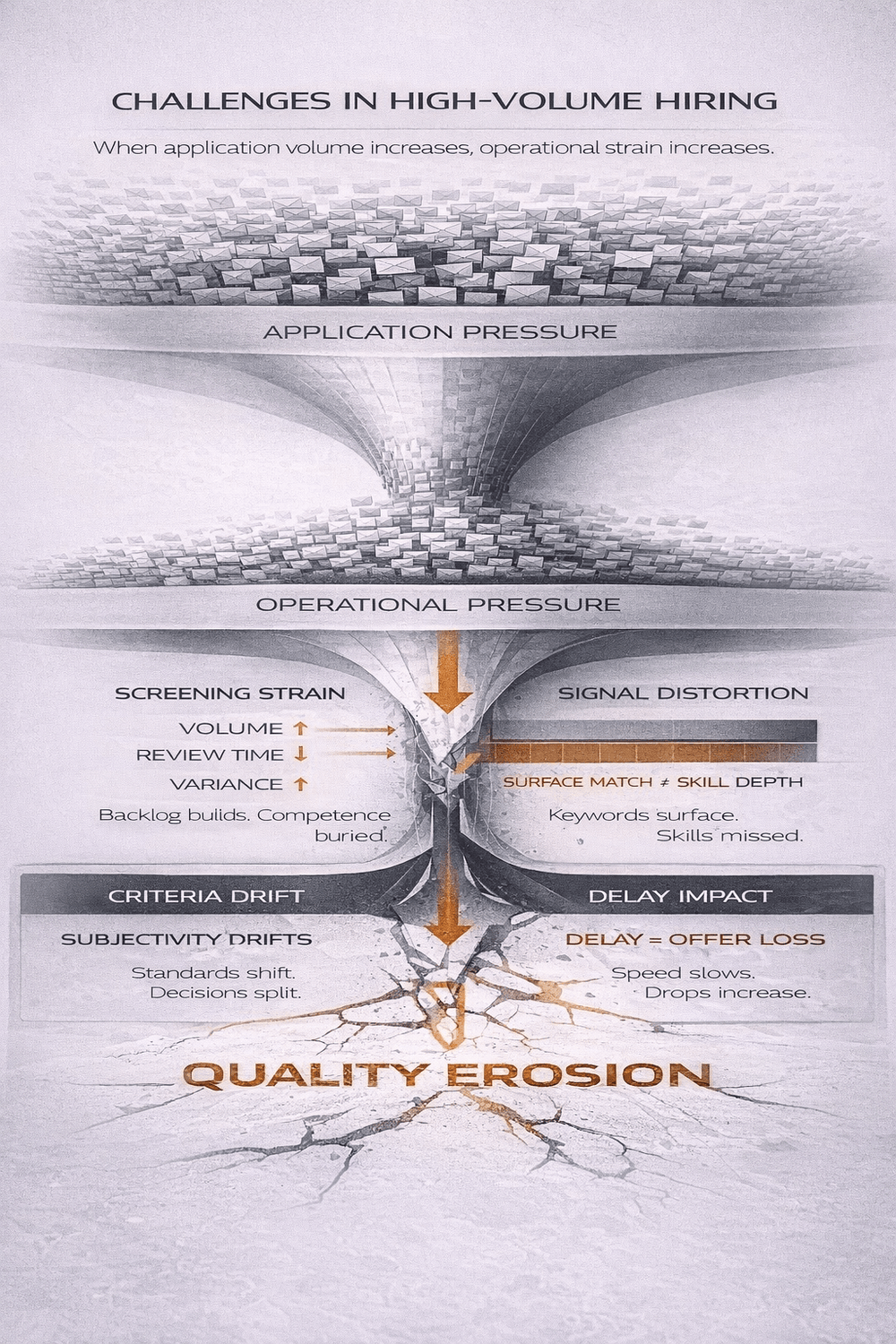
High volume hiring requires filling a large number of similar roles within a short time frame. The primary challenge is maintaining hiring quality while processing large volumes of applications quickly.
When job application volume increases, three operational pressures appear immediately.
1. Screening Speed Without Losing Quality
Recruiters often receive hundreds or thousands of applications per role. Manual resume review becomes slow and inconsistent.
As a result, strong candidates may sit in a backlog while weaker but keyword-optimized resumes surface first.
The challenge is not volume alone. The challenge is separating true competence from surface alignment at scale.
2. Identifying Qualified Candidates in a Noisy Funnel
Higher candidate volume does not guarantee high-quality hiring. In many cases, recruiters report a rise in resumes that match job descriptions perfectly but fail basic evaluation criteria during interviews.
Consequently, hiring teams repeat screening steps during technical rounds.
This duplication increases time-to-hire and frustrates both recruiters and candidates.
3. Maintaining Consistent Evaluation Standards
When multiple recruiters and hiring managers screen simultaneously, evaluation criteria often change subtly.
One hiring manager prioritizes years of experience. Another prioritizes a degree or a certain qualification. A third prioritizes communication skills.
Without structured criteria, hiring decisions become subjective. In the high volume hiring environments, subjectivity leads to inconsistency and creates friction within the recruitment funnel.
4. Candidate Drop-Off From Delays
Metrics related to speed, such as time-to-fill or time-to-hire, matter greatly in volume hiring. However, when screening takes days or weeks, qualified candidates often accept competing offers.
Therefore, slow workflows do not just create inefficiency. They directly impact offer acceptance rates.
How AI Helps in High Volume Hiring
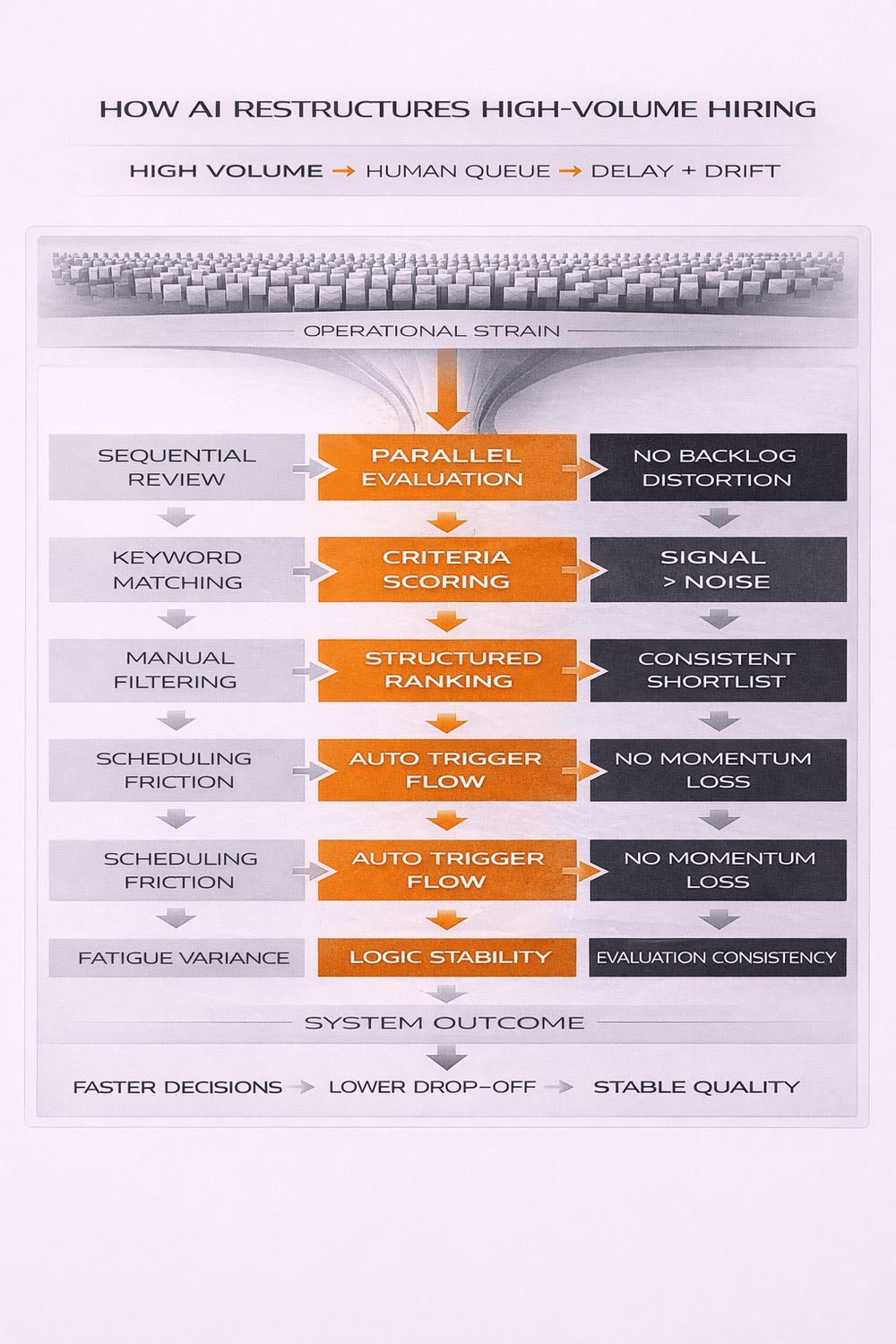
AI helps in high volume hiring by restructuring how candidates are evaluated, not by simply automating tasks within a hiring process.
Therefore, instead of reviewing resumes one by one, AI evaluates job applications simultaneously against predefined criteria. As a result, screening moves from manual sorting to structured scoring.
Here's how:
1. Parallel Resume Evaluation Instead of Sequential Review
In traditional workflows, recruiters review resumes individually, and screening occurs in a queue. As a result, any surge in job applications automatically creates delays.
This is where AI recruiting tools take charge: they evaluate all incoming resumes at once. Every candidate is assessed instantly against the same role criteria. Consequently, strong candidates do not wait behind weaker ones in a manual backlog.
2. Criteria-Based Scoring Instead of Keyword Matching
Most applicant tracking systems rely heavily on keyword filters. However, keyword alignment does not equate to candidate competence.
AI-driven hiring models, configured with explicit job criteria, score candidates based on skill relevance, experience depth, and requirement thresholds.
As a result, resumes that simply repeat job descriptions do not automatically rank higher.
3. Structured Shortlisting Instead of Manual Filtering
Recruiters often spend hours narrowing down the large pool of applicants. As application volume increases, candidate shortlisting becomes inconsistent.
AI interviewer tools generate ranked candidate lists based on defined benchmarks.
However, human recruiters maintain decision authority by reviewing structured score breakdowns instead of raw resumes.
This ensures they guide the final selection while benefiting from AI‑driven consistency.
4. Automated Interview Triggers to Remove Scheduling Lag
Scheduling delays are one of the biggest contributors to candidate drop-off. When recruiters manually coordinate calendars, the process slows.
AI recruiting tools can automatically trigger next-stage interviews when a candidate crosses a predefined threshold. Consequently, qualified applicants move forward immediately.
5. Consistent Evaluation Across Every Candidate
Human fatigue weakens decision quality in high‑volume hiring; moreover, by the twentieth similar interview of the day, judgment declines.
AI recruiting software applies the same scoring logic to every applicant; consequently, evaluation standards remain stable regardless of volume
Benefits of AI in High Volume Hiring
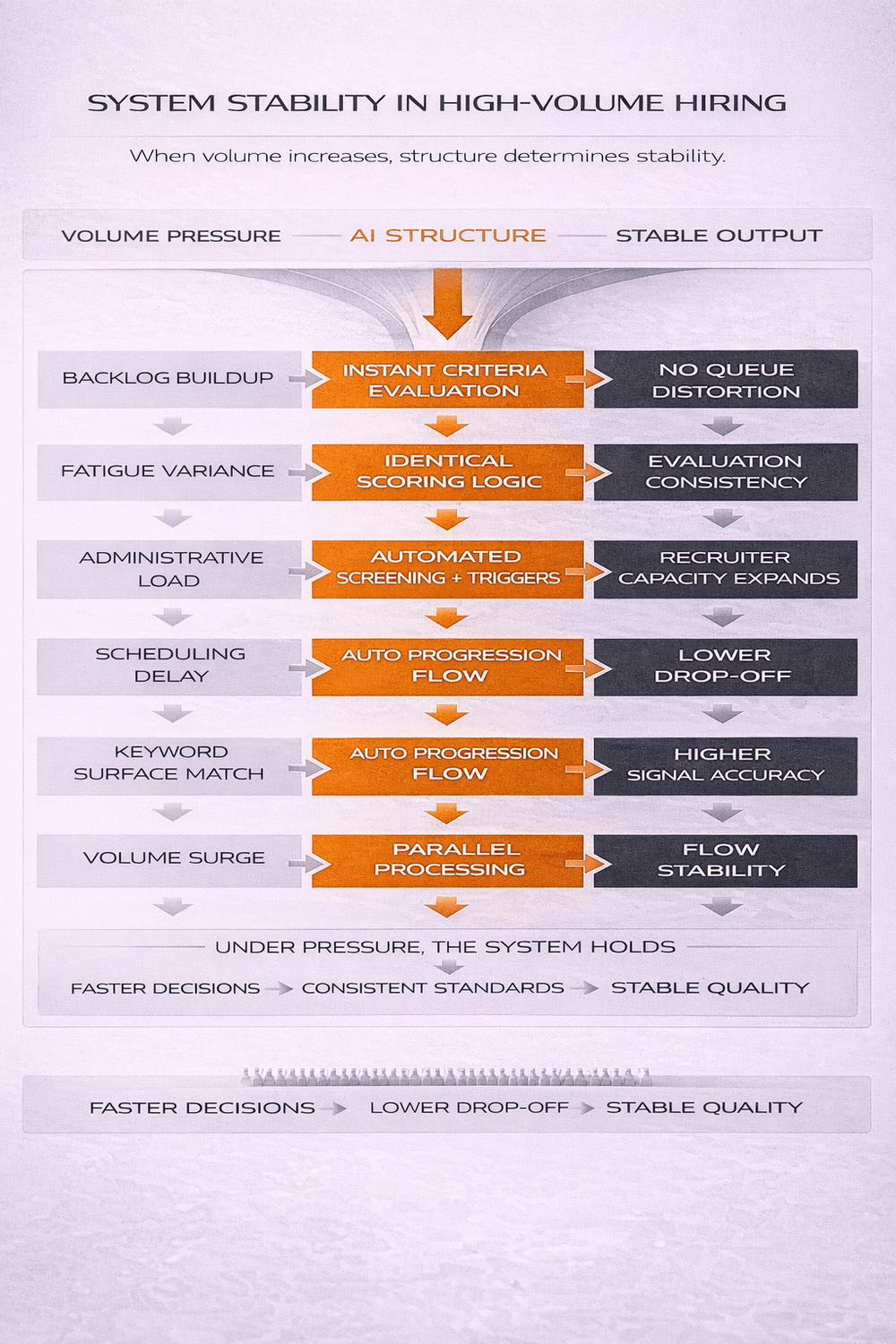
AI interviewer software benefits high volume hiring by improving screening consistency, reducing processing delays, and increasing recruiter capacity without lowering hiring standards.
When configured correctly, AI does not simply speed up recruiting. It stabilizes the hiring flow even under tighter deadlines.
Here are the practical advantages.
1. Faster Screening Without Lowering Standards
High‑volume hiring creates resume backlogs; moreover, manual review slows as volume increases.
AI evaluates applications instantly against defined criteria; consequently, qualified candidates surface immediately instead of waiting in a queue.
2. Consistent Evaluation Across All Candidates
In manual workflows, standards change anytime; furthermore, human fatigue affects the final hiring judgment.
As a result, two similar candidates may receive different treatment. AI applies identical scoring logic to every applicant; consequently, evaluation remains uniform regardless of volume.
3. Reduced Recruiter Administrative Load
Screening, ranking, and scheduling consume significant recruiter hours in high‑volume hiring; moreover, manual effort intensifies as the volume of job applications grows.
AI automates repetitive evaluation and interview triggers; consequently, recruiters shift their focus toward:
Candidate engagement
Hiring manager alignment
Final decision review
4. Lower Candidate Drop-Off
Delays in hiring drive candidate attrition; moreover, when applicants must wait several days for interview confirmation, they often accept competing offers.
AI‑triggered progression moves candidates forward immediately after qualification; consequently, the time‑to‑interview compresses.
5. Improved Screening Signal Accuracy
Keyword‑heavy ATS tools push resumes that simply copy job descriptions; however, alignment on paper does not always reflect the real capability of a candidate.
AI recruiting models designed with weighted criteria cut through superficial matching; instead, candidates are ranked according to defined skill thresholds.
6. Scalable Hiring Without Process Breakdown
Manual systems struggle under scale; moreover, resume review time increases, communication lags, and evaluation inconsistency grows.
Modern AI hiring platforms handle thousands of job applications simultaneously; consequently, volume rises without breaking workflow structure.
Recruiting tools like AiPersy support high‑volume hiring by reshaping how decisions are managed under tighter deadlines; therefore, they ensure consistency, accelerate candidate progression, and strengthen evaluation stability.
What Metrics in High Volume Hiring Improve with AI?
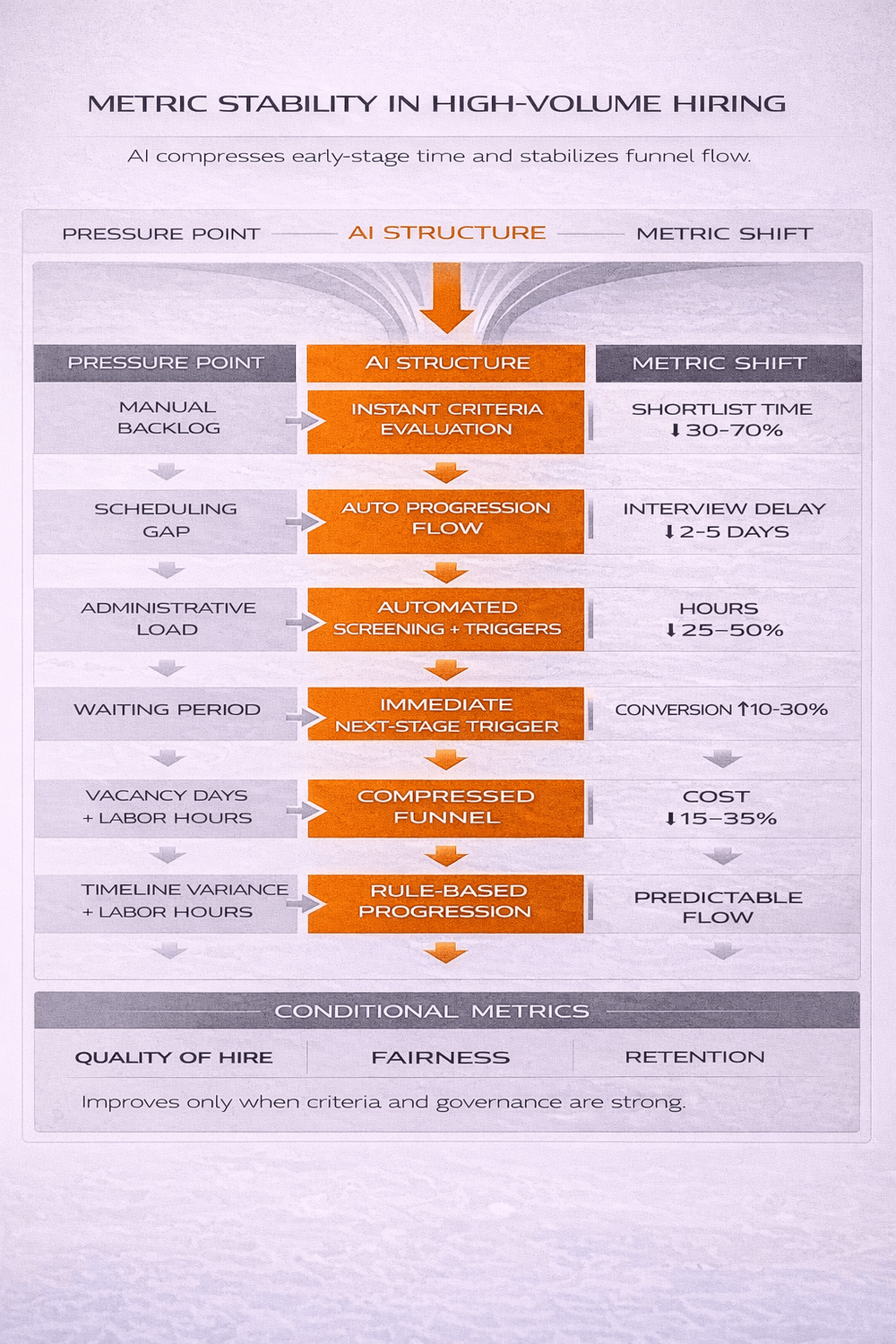
AI improves high volume hiring by reducing application processing time, increasing screening consistency, and stabilizing conversion rates under volume pressure.
However, not every metric moves equally. The most meaningful gains appear in early-stage efficiency and funnel stability.
Here are the metrics that typically improve.
1. Time-to-Shortlist
In manual workflows, recruiters may spend several days reviewing hundreds of applications; moreover, the larger the candidate volume, the slower the hiring process becomes.
Modern hiring platforms evaluate applications instantly against predefined criteria; consequently, qualified candidates surface within minutes or hours instead of days.
Typical improvement: 30–70% reduction in shortlist creation time, depending on the application volume.
Why it matters: Shortlist speed directly determines how quickly interviews begin.
2. Time-to-Interview
Scheduling delays often add 3–7 days between screening and the first interaction; moreover, these idle gaps slow momentum and frustrate candidates.
Thanks to AI, automated progression, and smart scheduling reduce downtime; consequently, candidates move forward immediately after qualification.
Typical improvement: 2–5 days shaved off the early-stage funnel.
Why it matters: Faster interviews reduce candidate drop-off.
3. Recruiter Hours per Hire
High volume hiring consumes recruiter time through resume filtering and coordination; moreover, the administrative load grows as application numbers rise.
When screening and interview triggers are automated, recruiter effort shifts to decision validation rather than manual sorting; consequently, their time is spent on higher‑value activities.
Typical improvement: 25–50% reduction in administrative hours per role cluster.
Why it matters: Capacity increases without hiring additional recruiters.
4. Candidate Drop-Off Rate
Long wait times and unclear progression cause candidates to abandon applications. AI-driven progression shortens waiting periods. Consequently, early-stage funnel abandonment decreases.
Typical improvement: 10–30% boost in early-stage conversion, depending on initial delays.
Why it matters: Volume is ineffective if candidates drop out mid-process
5. Cost per Hire
Cost per hire improves indirectly through faster turnaround and expanded recruiter capacity; moreover, efficiency gains build as hiring scales.
When recruiter hours fall and vacancy days shorten, cost per hire steadies; consequently, overall spend per role declines.
Typical improvement: 15–35% reduction when AI replaces manual screening at scale.
Why it matters: Cost savings compound when hiring hundreds of similar roles.
6. Funnel Consistency
Manual review creates uneven timelines within a recruitment funnel; moreover, some candidates move quickly while others get stuck.
Clear progression rules in AI hiring tools keep the process steady; therefore, each stage runs on a predictable schedule.
Why it matters: Predictability allows workforce planning.
Metrics That Require Caution
Not all improvements are automatic.
Quality of hire improves only when evaluation criteria are well defined.
Fairness in hiring improves only when bias monitoring exists.
Candidate retention improves only when job-role alignment is accurate.
ROI of AI in High Volume Hiring
Return on investment shows up in high‑volume hiring when recruiter labor hours shrink, vacancy days shorten, and early‑stage candidate loss is prevented; moreover, these gains compound as hiring scales.
The return appears when three cost drivers decline:
- Screening labor
- Vacancy time
- Rework from inconsistent shortlisting
ROI is operational before it becomes strategic; therefore, the first impact is felt in day‑to‑day efficiency.
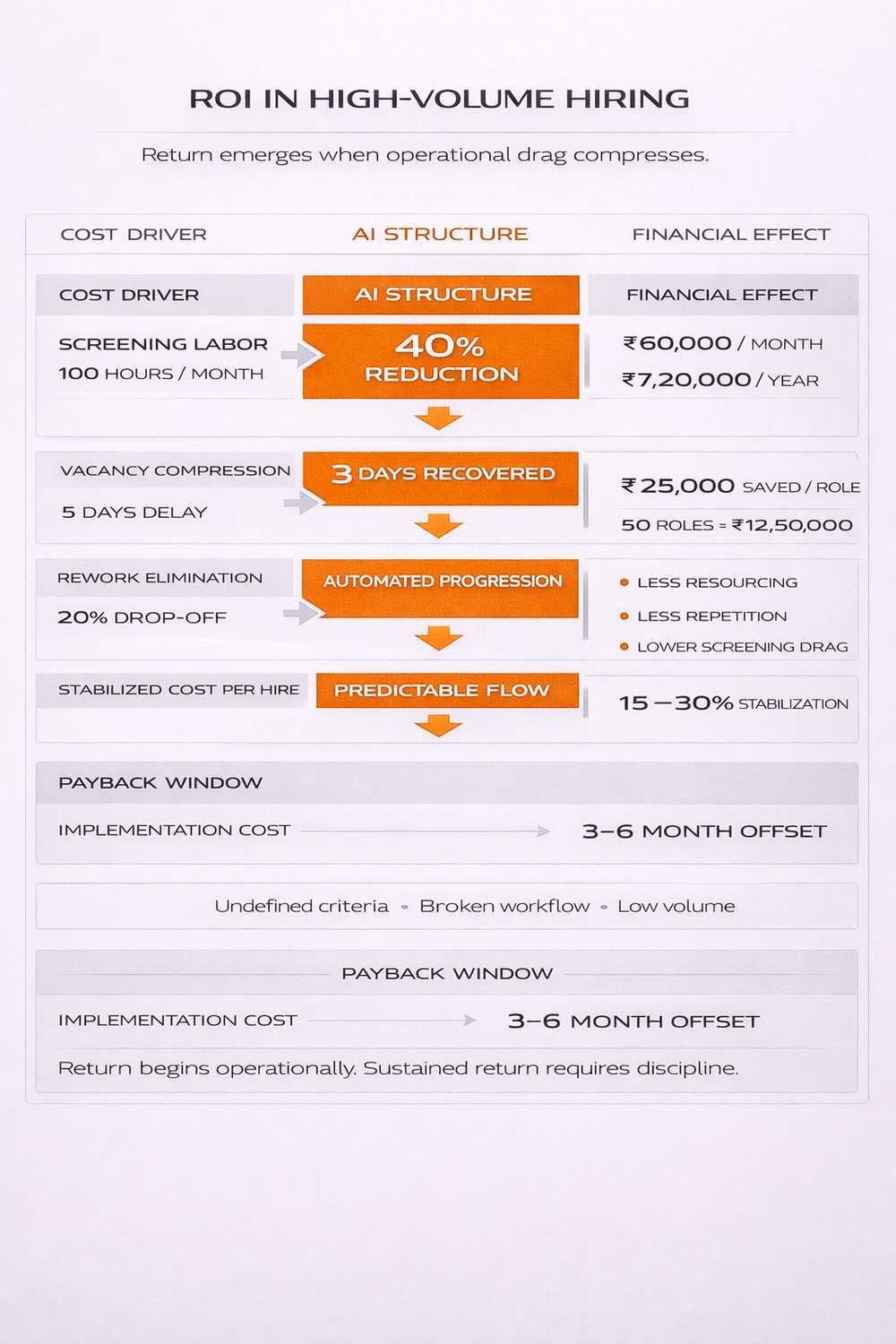
Here is what that looks like in practice
1. Recruiter Labor Savings
Assume:
1,000 job applications per month
6 minutes average manual review time
100 recruiter hours spent on screening
If screening effort drops by 40%, that saves 40 hours monthly; consequently, recruiter bandwidth expands without additional hires.
At ₹1,500 per recruiter hour, the savings equal:
- ₹60,000 saved per month
- ₹7,20,000 annually
This estimate is conservative; moreover, many talent acquisition teams report even higher time compression. Sustainable ROI, however, should always be modeled cautiously.
2. Vacancy Cost Reduction
Unfilled frontline roles create operational drag for recruiters; moreover, every extra day without coverage slows productivity.
For example, if a warehouse role generates ₹5,000 per day in value and remains vacant 5 extra days due to screening delays, that’s ₹25,000 lost per role.
If 50 similar roles are hired annually, the avoidable vacancy cost reaches ₹12,50,000.
When early‑stage delays shrink by even 3 days, savings appear immediately; consequently, vacancy costs drop before they accumulate.
3. Reduced Drop-Off Rework
In high‑volume hiring, delayed follow‑ups increase candidate drop‑off; moreover, every missed touchpoint forces recruiters back to square one.
If 20% of qualified candidates walk away due to slow progression, recruiters must re‑source and re‑screen; consequently, effort is wasted on repetition instead of advancement.
Automated progression in AI reduces that churn; therefore, even a 10% drop in rework lowers sourcing and screening repetition significantly
4. Stabilized Cost Per Hire
Cost per hire improves not because the AI tools are “cheap,” but because outcomes become consistent; moreover, steady workflows reduce unpredictable swings.
When:
Shortlists are generated faster
Interviews begin earlier
Recruiter hours drop
Cost levels out across role clusters; consequently, hiring teams gain predictability in spend.
Typical conservative reduction: 15–30% in high-volume hiring environments where screening is the primary bottleneck.
When ROI Fails to Appear
Return on investment in hiring does not appear automatically; moreover, weak foundations undermine the outcome.
Therefore, ROI in hiring weakens when:
Screening criteria are undefined
AI is layered on top of broken workflows
Recruiters continue manual override at every stage
Volume is too low to justify automation
Here's how
Payback Window
In most high‑volume hiring environments, screening automation offsets implementation costs within 3–6 months; moreover, the initial return is visible in reduced recruiter effort and faster vacancy closure.
However, sustained return depends on:
Clear evaluation thresholds
Workflow redesign
Adoption discipline
Automation reduces operational drag; therefore, ROI emerges only when process discipline is in place.
How to Implement AI in High Volume Hiring
Successful implementation of AI in high-volume hiring requires workflow redesign, defined evaluation criteria, clean data inputs, and staged deployment; moreover, technology alone does not relieve scale pressure. Process structure determines success.
Most failed deployments skip the planning phase and attempt to automate broken workflows; consequently, the outcome is inefficiency rather than ROI.
Here is what the effective implementation of AI in high volume hiring actually involves
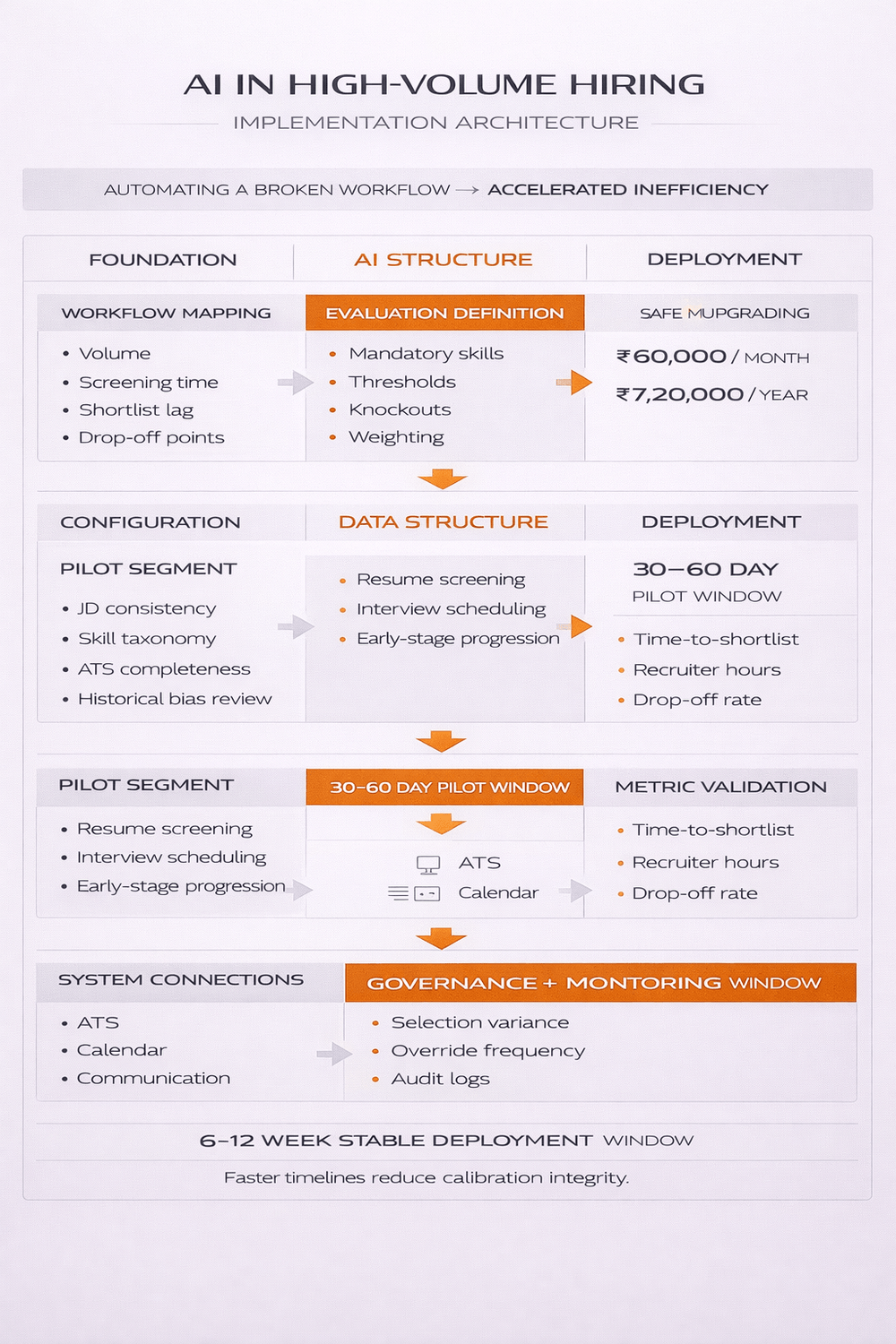
Step 1: Map the Current Hiring Workflow
Before adding AI into your hiring process, document:
Application intake volume
Screening time per resume
Average days to shortlist
Interview scheduling lag
Drop-off points
This baseline establishes measurable targets. Without it, ROI cannot be validated.
Step 2: Define Evaluation Criteria Before Automation
AI hiring tools amplify logic. Therefore, unclear criteria produce inconsistent results faster.
Define:
Mandatory skills
Threshold experience ranges
Knockout conditions
Weighting structure for competencies
High volume hiring succeeds when evaluation rules are explicit, not implied. This phase typically takes 1–3 weeks depending on role complexity.
Step 3: Clean and Structure Historical Data
AI ranking quality depends on input clarity.
Audit:
Job description consistency
Skill taxonomy alignment
ATS data completeness
Historical hiring patterns
If historical data is inconsistent, screening accuracy declines. Data preparation often consumes more time than tool configuration.
Step 4: Start With One Workflow Segment
Do not automate everything at once. Most organizations begin with:
Resume screening
Interview scheduling
Early-stage candidate progression
High volume roles having candidates with repeatable skill patterns work best for pilot programs.
Pilot window: 30–60 days.
Measure:
Time-to-shortlist
Recruiter hours saved
Candidate drop-off
Step 5: Integrate With Existing ATS and Communication Systems
AI must connect to:
Applicant tracking system
Calendar tools
Email or SMS workflows
Integration friction is the most common delay point. Expect 2–6 weeks depending on system complexity.
Step 6: Train Recruiters on Workflow Shift
AI does not replace recruiter judgment. It removes repetitive screening work.
Recruiters shift from opening and filtering every resume to reviewing ranked candidates, checking borderline cases, and aligning with hiring managers on final selections.
If recruiters do not understand how scoring works or when overrides are necessary, they return to manual review. As a result, the backlog rebuilds.
AI reduces sorting. Recruiters focus on final evaluation and stakeholder alignment.
Step 7: Establish Governance and Bias Monitoring
High volume hiring increases exposure to compliance risk.
Track:
Stage progression by demographic grouping (where legally appropriate)
Override frequency
Audit logs
Governance prevents algorithm drift.
Realistic Implementation Timeline
For high-volume, repeatable roles:
Criteria definition: 1–3 weeks
Data cleanup and configuration: 2–4 weeks
Integration: 2–6 weeks
Pilot testing: 4–8 weeks
Total practical window: 6–12 weeks for stable deployment.
Faster timelines often sacrifice stability.
When Implementation Fails
AI deployment underperforms in recruitment when:
Criteria are vague
Hiring managers resist structured scoring
Recruiters override most automated decisions
Volume is too low to justify automation
AI is added without workflow redesign
This means that the AI technology accelerates structure within, but it cannot compensate for its absence.
Why AiPersy Is the Best AI Recruiting Tool for High-Volume Hiring
AiPersy is the best AI recruiting tool for high-volume hiring because it replaces sequential resume screening with parallel, role-defined evaluation logic.
Unlike platforms such as Eightfold AI or Hyring, which automate layers within ATS-based workflows, AiPersy restructures the hiring architecture itself.
It is designed for environments where:
300–1,000+ applications arrive per role
Recruiters cannot manually re-review every resume
Time-to-shortlist directly impacts hiring operations
Hiring evaluation decisions must remain auditable and consistent
AiPersy eliminates screening queues, enforces explicit score thresholds, and produces structured shortlists within minutes.
At scale, eliminating waiting time matters more than improving resume similarity accuracy.
| Capability | AiPersy | Eightfold AI / Hyring-Style Tools |
| Evaluation Model | Role-defined thresholds | Resume similarity & inferred matching |
| Screening Method | Parallel evaluation | Sequential ATS pipeline |
| Interview Logic | Structured skill scoring | Behavioral & predictive inference |
| Threshold Governance | Explicit, predefined cutoffs | Model-based ranking |
| Compliance Exposure | No facial or tone inference | Behavioral analytics may apply |
| High-Volume Fit | Built for sustained inflow | Built for workflow augmentation |
Final Words
High-volume hiring becomes sustainable only when evaluation moves from sequential screening to structured, parallel logic.
AI does not solve the backlog by accelerating resume review. It solves the backlog by removing waiting layers entirely. Role-defined thresholds, explicit governance, and parallel evaluation architecture determine whether scale produces flow or friction.
This framework reflects current 2026 hiring realities, where AI-assisted workflows are common, but structured hiring architecture remains rare.
If you’re evaluating automation, the real question is not “Should we use AI?”
It’s: Does our hiring sequence eliminate waiting, or just accelerate it?
For a deeper operational breakdown of AI in hiring, review the implementation framework outlined above and assess where your current hiring workflow fails.