What Is AI Resume Screening? Complete Guide (2026)
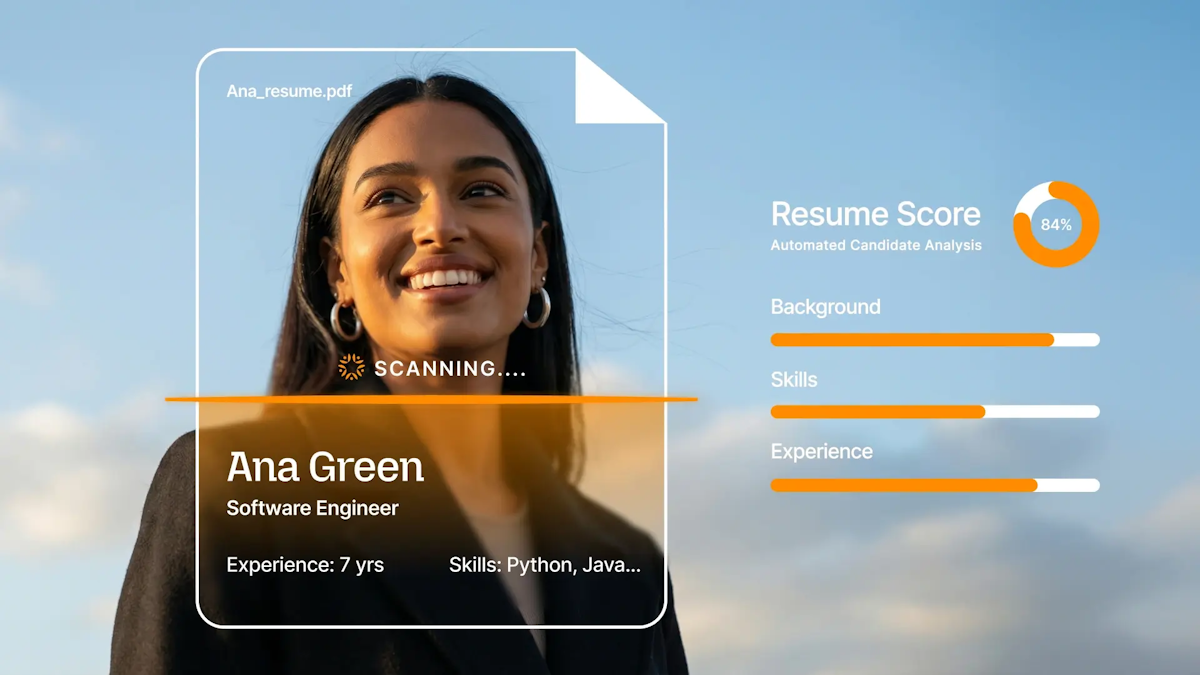
Recruiters spend 40-60% of their time reading resumes manually. At 300 applications per role, that creates 15-20 hours of screening work before a single interview happens.
AI resume screening automates this process. The software reads resumes, extracts qualifications, compares them against job requirements, and ranks candidates by match score. Recruiters review prioritized shortlists instead of unsorted resume stacks.
This guide explains how AI resume screening works, what problems it solves, where it introduces bias risk, how much it costs, and which companies should use it.
What Is AI Resume Screening?
AI resume screening uses machine learning algorithms to evaluate job applications automatically based on predefined job requirements.
The software parses resume text, extracts qualifications like skills and experience, compares them against role criteria, and generates scores that rank candidates. Recruiters receive prioritized candidate lists instead of unsorted resume stacks.
How Does AI Resume Screening Work?
AI resume screening follows six sequential steps from application to candidate ranking:
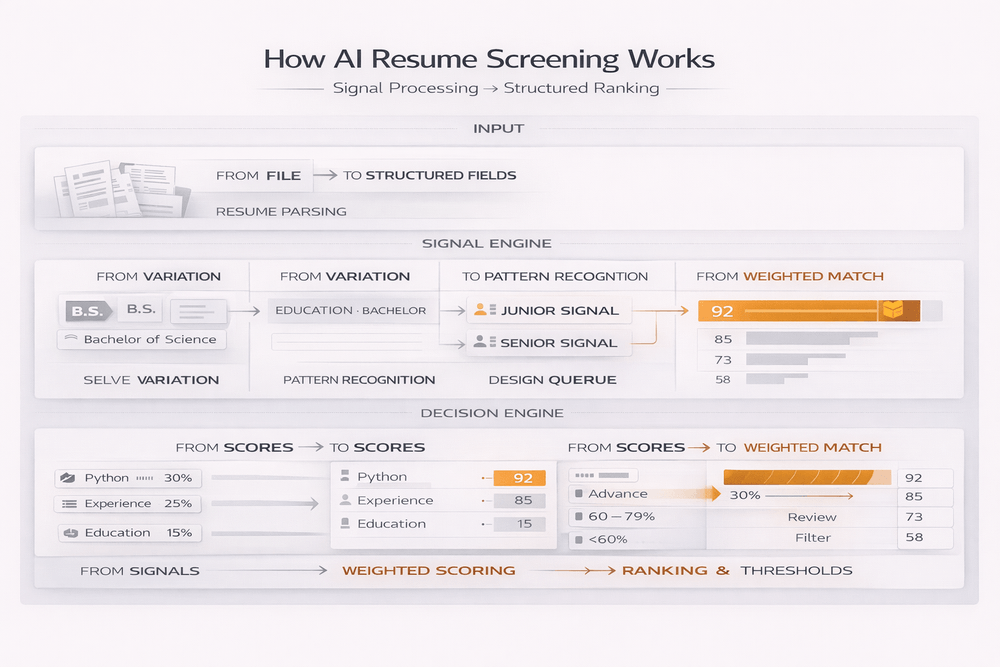
- Resume parsing - Converts PDFs and Word files into structured data fields
- Data extraction - Identifies skills, experience, education, and achievements
- Pattern recognition - Recognizes senior-level indicators versus entry-level signals
- Scoring - Compares qualifications against weighted job requirements
- Ranking - Orders candidates from highest to lowest match score
- Filtering - Applies threshold rules to advance, flag, or reject candidates
Step 1: Resume Parsing
The software converts resumes from various formats into structured data. It identifies sections like work experience, education, and skills. The parser extracts job titles, company names, dates, degrees, and certifications into separate data fields.
Step 2: Data Extraction and Normalization
The AI extracts specific data points: years of experience, technical skills, education level, and job titles. It normalizes variations, recognizing "B.S." and "Bachelor of Science" mean the same thing, or "JavaScript" and "JS" refer to the same skill.
Step 3: Pattern Recognition
Machine learning models identify patterns correlating with successful hires. The software distinguishes senior-level experience from entry-level based on action verbs, scope indicators, and achievement descriptions. It recognizes "architected scalable softwares" indicates senior work while "assisted with maintenance" suggests junior scope.
Step 4: Scoring Against Criteria
The software compares extracted data against job requirements. Each criterion receives a weight (e.g., "Python experience" = 30%, "5+ years experience" = 25%). The AI calculates how well candidates match each requirement and generates overall scores.
Step 5: Ranking and Filtering
Candidates get ranked from highest to lowest score. The software applies threshold rules: candidates above 80% advance automatically, 60-79% flag for human review, below 60% get filtered out.
Step 6: Continuous Learning
Some softwares learn from recruiter feedback. When recruiters override AI decisions, the software adjusts scoring logic. This requires careful monitoring to avoid learning biased patterns.
What Data Does AI Resume Screening Analyze?
AI resume screening evaluates six primary data categories:
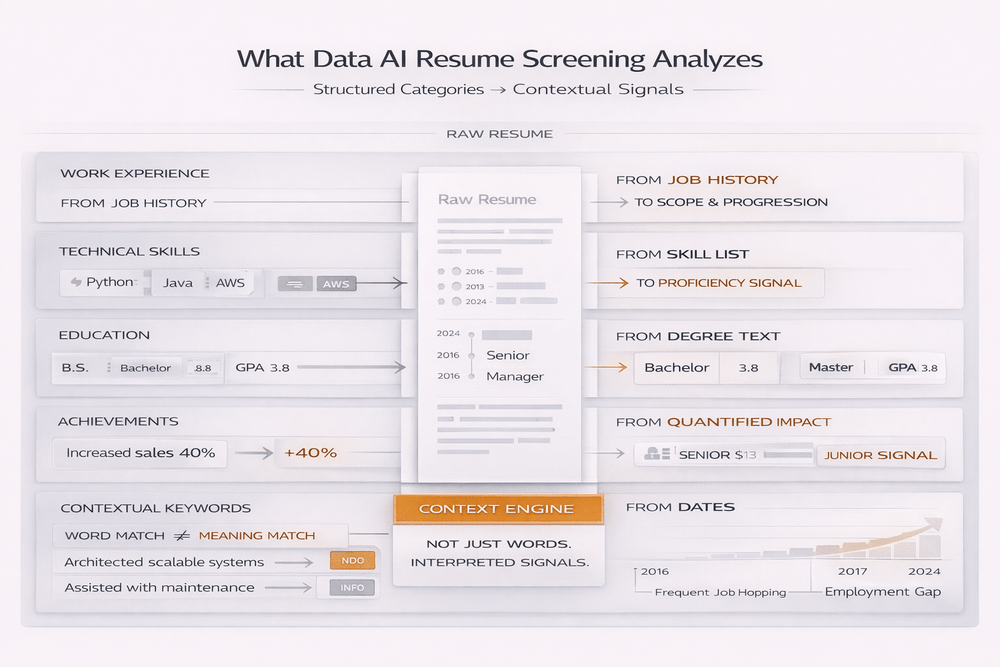
- Work experience - Job titles, companies, dates, responsibilities, and career progression
- Technical skills - Programming languages, software proficiency, certifications, and competencies
- Education - Degrees, institutions, graduation dates, majors, and GPA
- Achievements - Quantifiable results like "Increased sales 40%" or "Managed $2M budget"
- Keywords in context - Not just word presence but semantic meaning and scope
- Career patterns - Employment gaps, job tenure, and progression consistency
The software doesn't just match keywords; it even understands context. It recognizes "architected scalable softwares" indicates senior-level work, while "assisted with software maintenance" suggests junior responsibilities.
How Is AI Resume Screening Different From Keyword Filtering?
AI resume screening understands context and meaning. Keyword filtering matches exact words only.
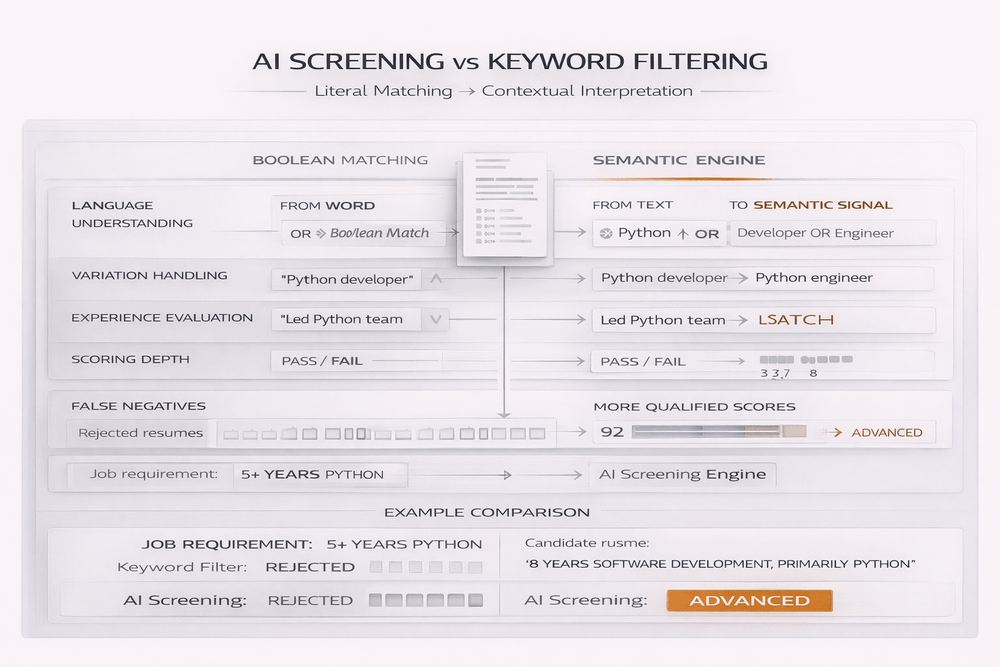
| Factor | AI Resume Screening | Keyword Filtering |
| Language understanding | Interprets semantic meaning and context | Matches exact words using Boolean logic |
| Variation handling | Recognizes "Python developer" = "Python engineer" | Requires exact phrase match |
| Experience evaluation | Distinguishes "led Python team" from "used Python" | Treats both identically if "Python" appears |
| Scoring depth | Evaluates qualification strength and seniority | Binary pass/fail based on word presence |
| False negatives | Lower - catches qualified candidates phrased differently | Higher - rejects candidates missing exact keywords |
Example Comparison
Job requirement: 5+ years Python experience
Candidate resume: "8 years software development, primarily Python"
- Keyword filter: Rejects (doesn't match "5+ years Python" exactly)
- AI screening: Advances (recognizes 8 years exceeds requirement)
Keyword filtering produces high false rejection rates. AI screening reduces this by understanding context.
What Are the Main Types of AI Resume Screening Tools?
Organizations choose from five AI resume screening categories:
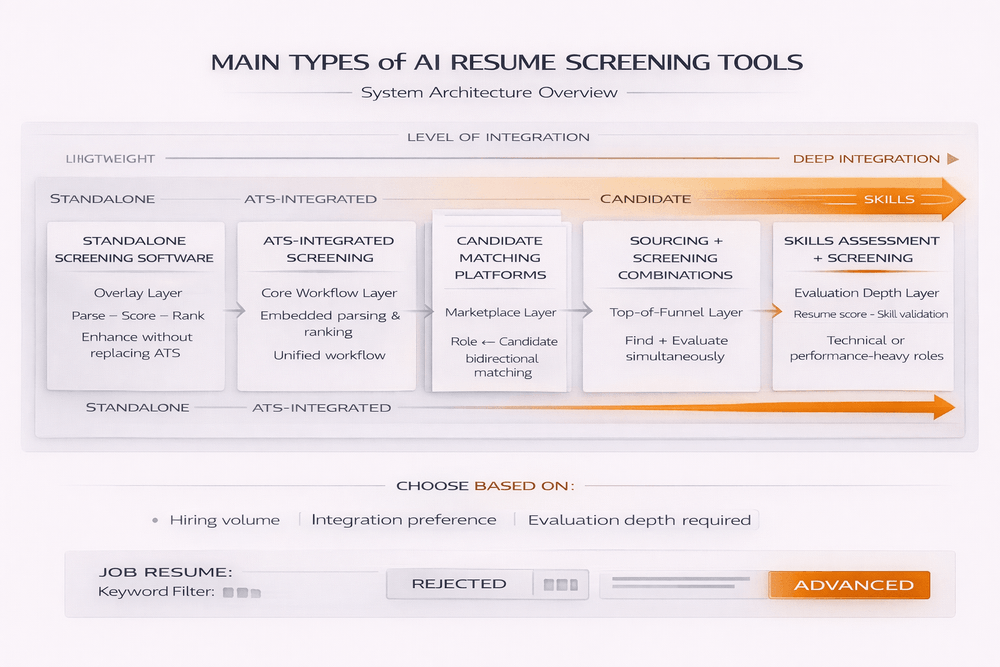
- Standalone screening software - Dedicated platforms for resume parsing and ranking
- ATS-integrated screening - Built-in AI features within applicant tracking softwares
- Candidate matching platforms - Bidirectional softwares matching candidates to roles
- Sourcing + screening combinations - Find and evaluate candidates simultaneously
- Skills assessment + screening - Combine resume evaluation with skills testing
Each type serves different use cases. Standalone tools offer powerful screening without replacing your ATS. ATS-integrated softwares keep everything in one platform. Matching platforms work best for high-volume hiring.
What Problems Does AI Resume Screening Solve?
AI resume screening addresses six specific hiring constraints:
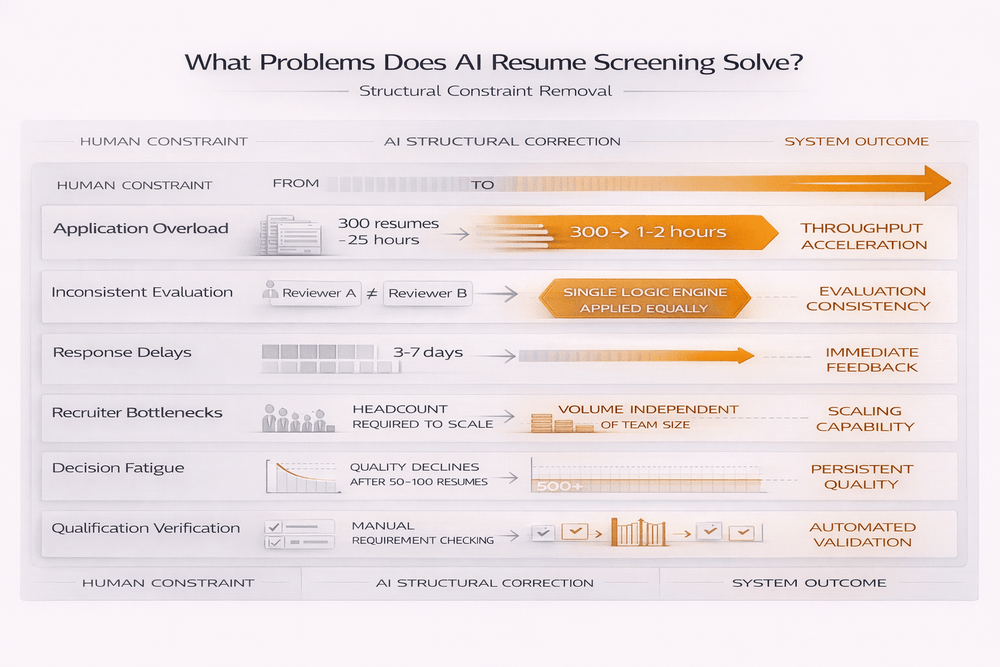
- Application overload - Processes 300 resumes in 1-2 hours vs. 20-25 hours manually
- Inconsistent evaluation - Applies identical criteria to every candidate
- Response delays - Provides same-day evaluation vs. 3-7 day manual review
- Recruiter bottlenecks - Handles unlimited volume without adding headcount
- Decision fatigue - Maintains quality across 500 resumes (manual quality degrades after 50-100)
- Qualification verification - Automates basic requirement checking automatically
Recruiters at scaling companies receive 200-500 applications per role. Manual review takes 2-4 minutes per resume. AI screening processes those volumes in hours, not days.
What Are the Benefits of AI Resume Screening?
AI resume screening delivers eight measurable improvements:
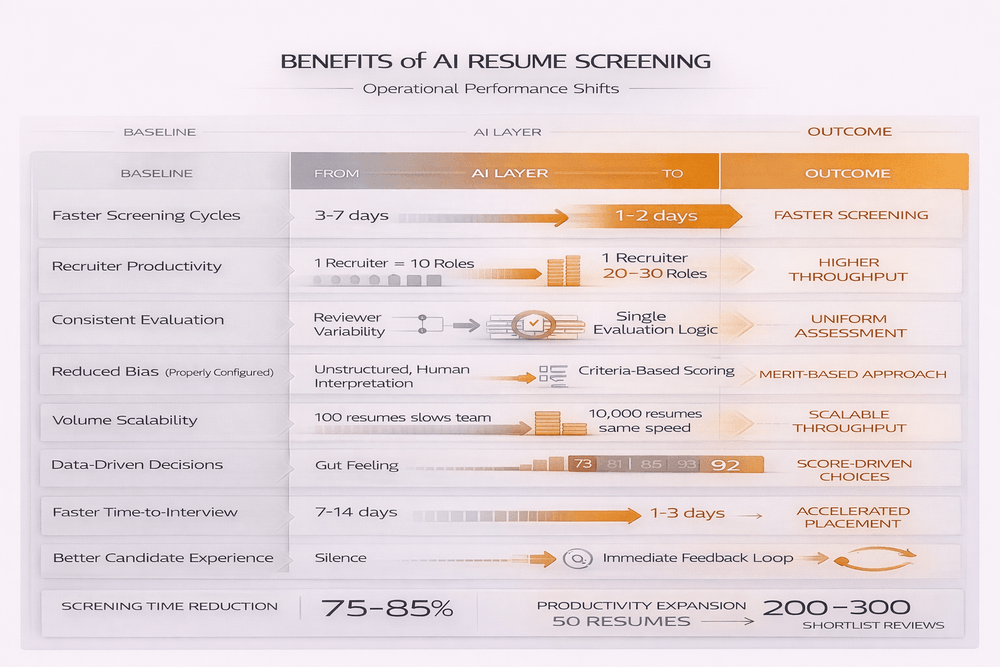
- Faster screening cycles - Reduces time from 3-7 days to 1-2 days
- Higher recruiter productivity - One recruiter manages 2-3x more roles
- Consistent evaluation - Eliminates the "recruiter lottery" where outcomes depend on who reviews
- Reduced screening bias - Evaluates qualifications without demographic influence (when configured properly)
- Scalable to volume spikes - Handles 100 or 10,000 applications with identical speed
- Data-driven decisions - Provides quantified scores with evidence
- Faster time-to-interview - Moves candidates from application to interview in 1-3 days vs. 7-14 days
- Better candidate experience - Delivers faster responses and clearer rejection feedback
Organizations reduce resume screening time by 75-85%. A recruiter who manually screened 50 resumes daily can review AI-generated shortlists for 200-300 candidates in the same time.
What Are the Limitations of AI Resume Screening?
AI resume screening cannot solve every hiring challenge:
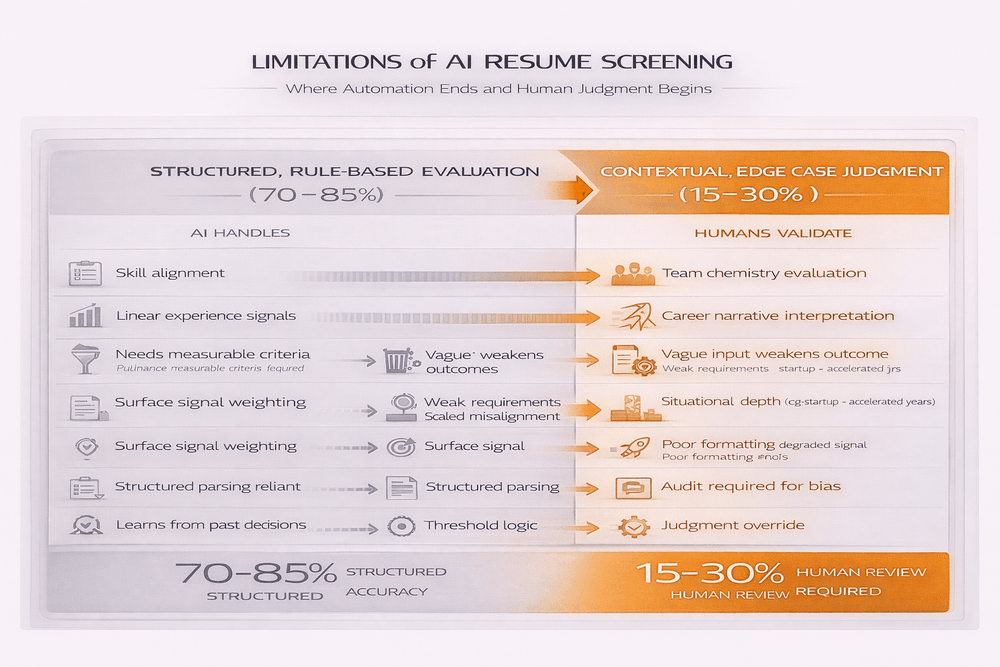
- Cannot evaluate cultural fit - Requires human judgment through interviews
- Struggles with non-traditional backgrounds - Penalizes career changers and unconventional paths
- Requires clear job requirements - Vague criteria like "strong communication" produce poor results
- Amplifies poorly defined criteria - Bad requirements produce bad results faster
- Limited context interpretation - Misses nuance like startup experience equaling 2x traditional years
- Dependent on resume quality - Poorly formatted resumes confuse parsing softwares
- Feedback loop risks - Can learn biased patterns from historical decisions
- Cannot replace human judgment for edge cases - Borderline candidates need human evaluation
- Maintenance overhead - Requires ongoing criteria updates and bias auditing
Well-configured software achieves 70-85% accuracy. The remaining 15-30% requires human review for context, non-traditional backgrounds, and judgment calls.
Is AI Resume Screening Accurate?
AI resume screening achieves 70-85% precision and 75-90% recall when configured properly.
Precision: 70-85% of AI-advanced candidates meet requirements when recruiters review them.
Recall: 75-90% of qualified candidates who apply get advanced by the AI.
This means 15-30% of AI-advanced candidates are false positives (don't actually qualify), and 10-25% of qualified candidates are false negatives (incorrectly filtered out).
What Affects Accuracy
Clear requirements improve accuracy dramatically. "5+ years Python development with Django framework" produces better screening than "experienced Python developer."
Quality training data matters. softwares trained on thousands of successful hires perform better than softwares trained on 50 hires.
Regular calibration maintains accuracy. Organizations auditing AI decisions monthly maintain 80%+ accuracy. Those never auditing drift to 60-70%.
Accuracy vs. Manual Screening
AI screening provides 85-90% consistency (applies same criteria each time). Manual screening provides 60-70% consistency (varies by recruiter fatigue and mood).
AI produces more consistent results than manual screening but not necessarily more accurate results. Consistently applied bad criteria produce consistently bad outcomes.
Is AI Resume Screening Biased or Legally Risky?
Yes. AI resume screening can introduce or amplify bias, and organizations remain legally liable for discriminatory outcomes.
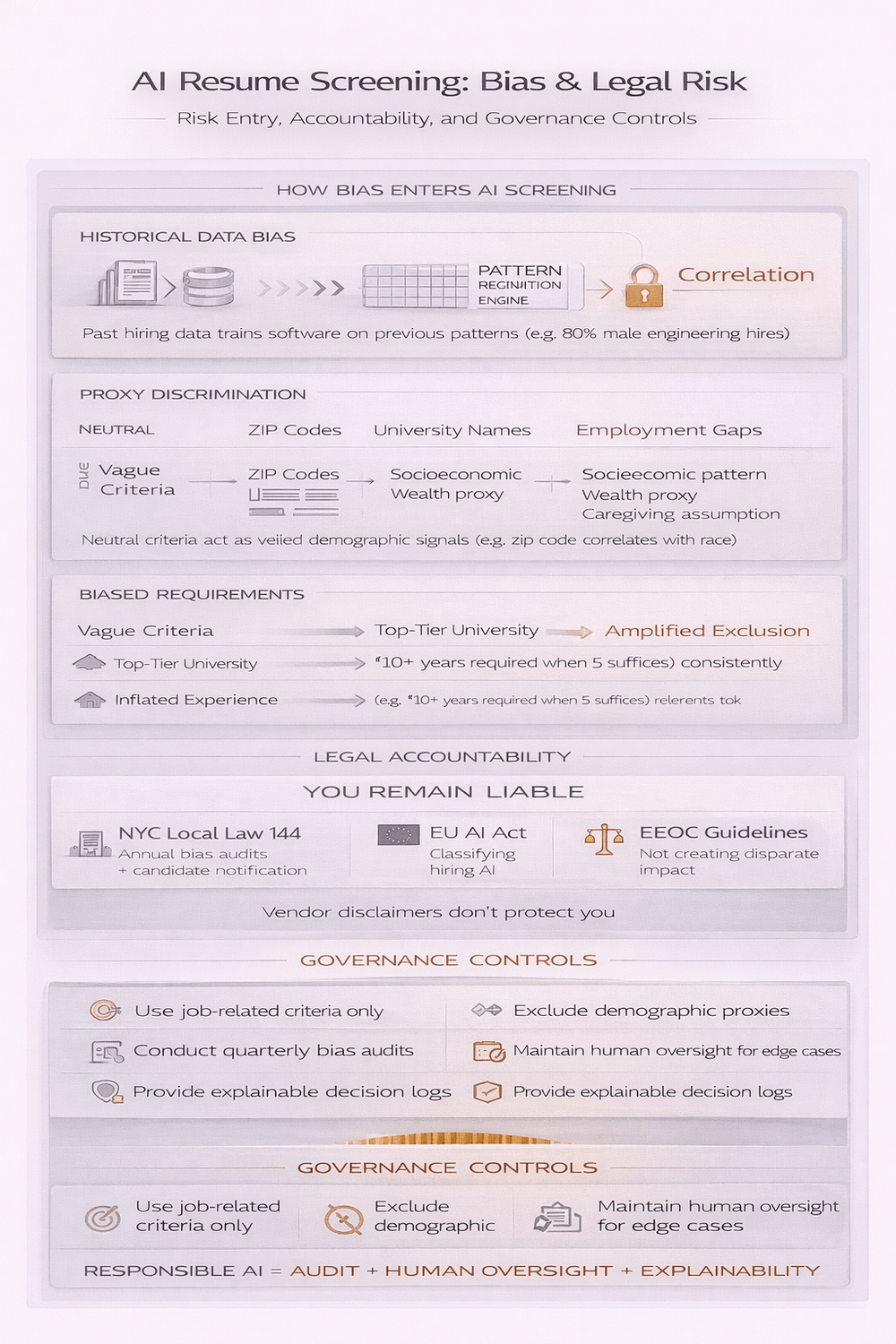
How Bias Enters AI Screening
Historical data bias: softwares trained on past hires learn patterns from that history. If 80% of historical engineering hires were male, AI may learn patterns correlating with gender.
Proxy discrimination: ZIP codes correlate with race and income. University names correlate with wealth. Employment gaps correlate with caregiving. These "neutral" criteria create discrimination.
Biased requirements: "Must attend top-tier university" or "10+ years experience" when 5 suffices creates bias that AI applies consistently.
Legal Liability in 2026
You remain liable for AI decisions. Vendor disclaimers don't protect you.
NYC Local Law 144: Requires annual bias audits and candidate notification.
EU AI Act: Classifies hiring AI as "high-risk," requires transparency and documentation. Fines reach 6% of global revenue.
EEOC guidelines: AI must not create disparate impact. If your software rejects 70% of women but 30% of men, you must prove criteria are job-related.
How to Reduce Bias Risk
Use job-related criteria only. Exclude demographic proxies. Conduct quarterly bias audits checking pass/fail rates by demographic group. Maintain human oversight for borderline cases. Provide explainable decisions showing why candidates were rejected.
Organizations using AI screening responsibly audit regularly, maintain human oversight, use job-related criteria, and can explain every decision.
How Does AI Resume Screening Compare to Manual Screening?
AI screening offers speed and consistency. Manual screening offers context and judgment.
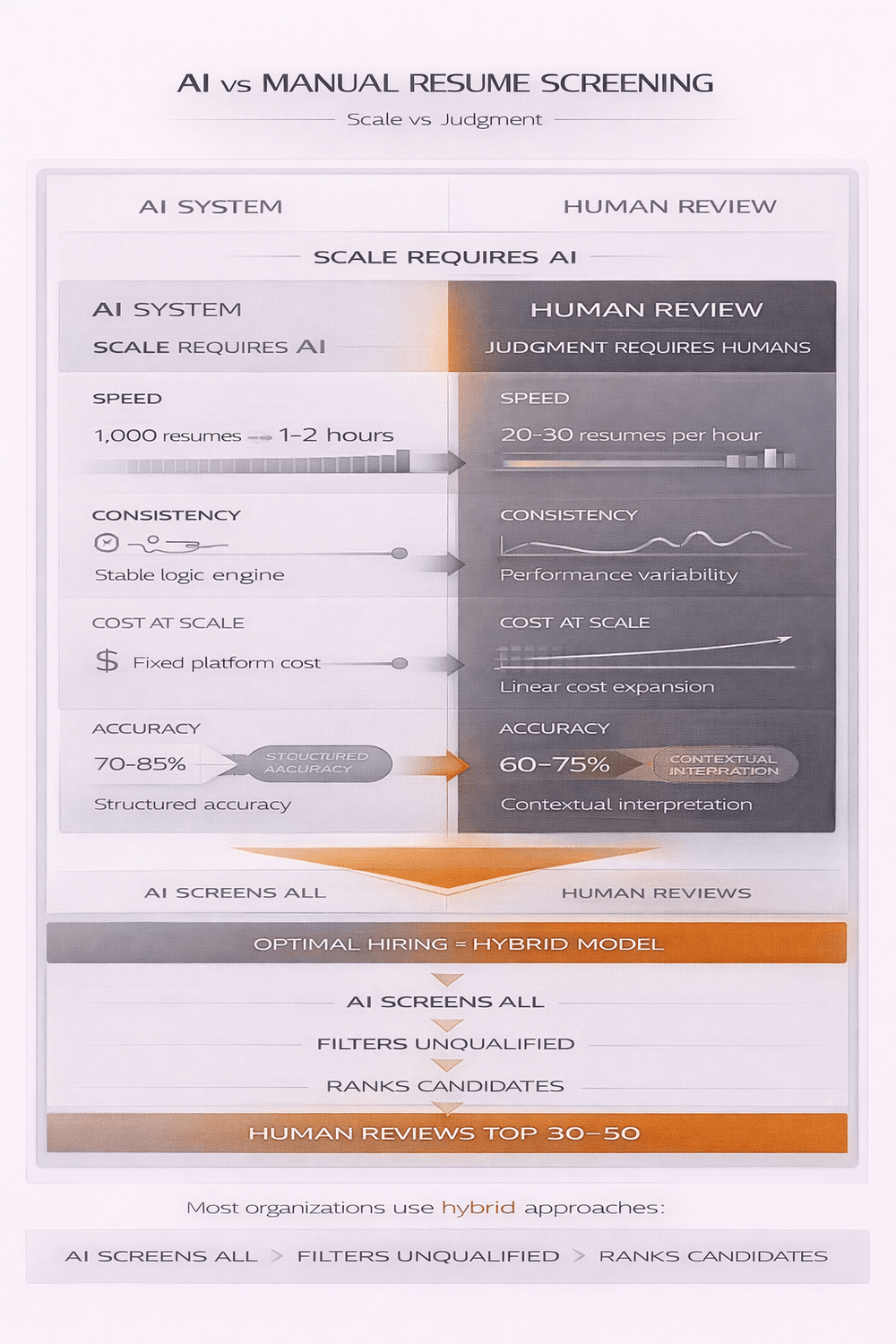
| Factor | AI Resume Screening | Manual Screening |
| Speed | 1,000 resumes in 1-2 hours | 20-30 resumes per hour |
| Consistency | Identical criteria every time | Varies by recruiter fatigue and mood |
| Cost at scale | Fixed platform cost $10k-$50k/year | Scales linearly with volume |
| Accuracy | 70-85% when configured well | 60-75% depending on experience |
| Context | Struggles with non-traditional paths | Recognizes transferable skills |
| Bias | Can amplify historical bias | Subject to unconscious bias |
| Scalability | Handles unlimited volume | Quality degrades after 50-100 resumes |
| Edge cases | Struggles with unusual backgrounds | Recognizes when rules should flex |
Most organizations use hybrid approaches: AI screens all applications, filters unqualified candidates, ranks remaining candidates, and recruiters review the top 30-50 for holistic evaluation.
Can AI Resume Screening Replace Recruiters?
No. AI resume screening handles specific tasks but cannot replace recruiter judgment, relationship building, or strategic functions.
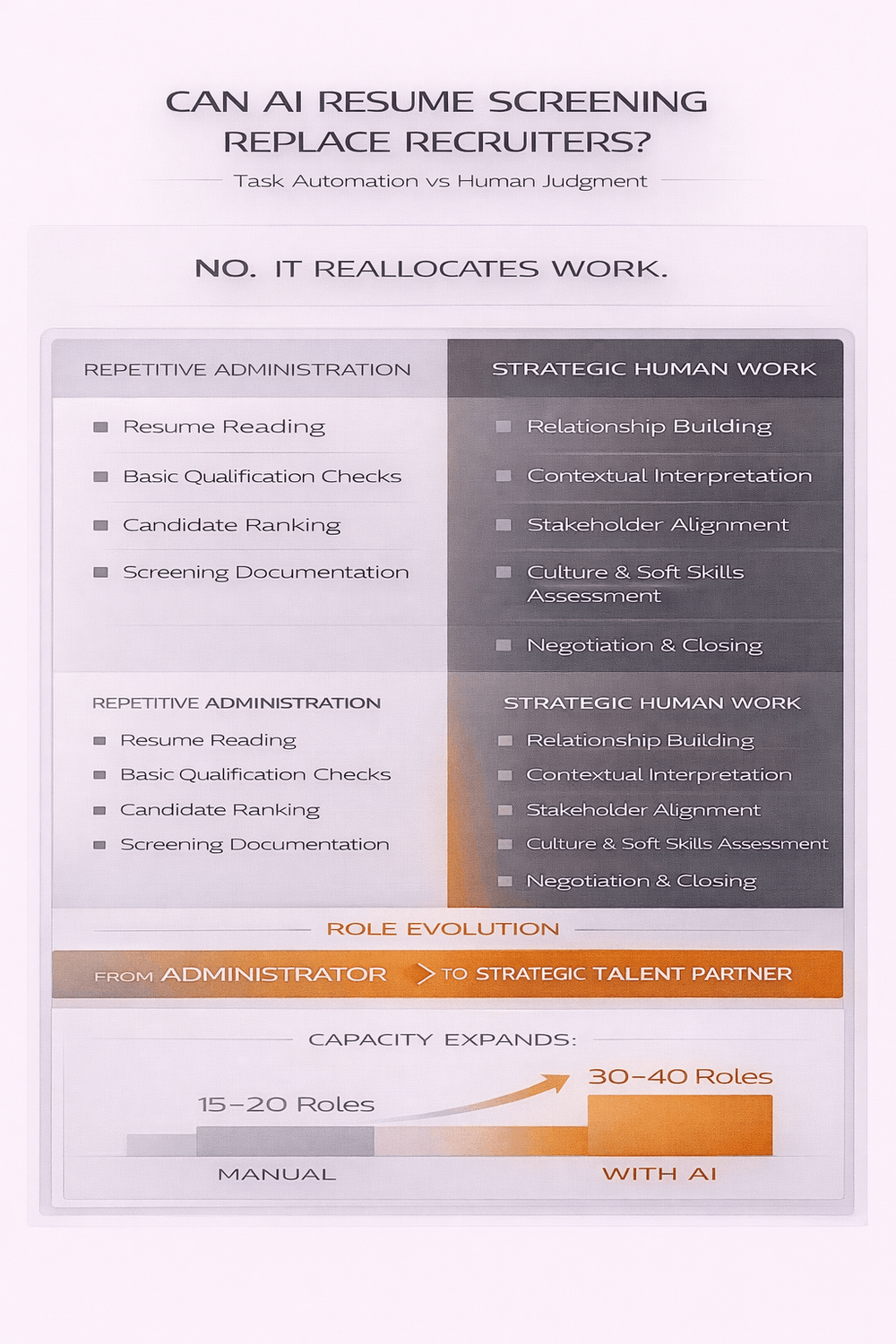
What AI Can Replace
- Resume reading time (40-60% of recruiter hours)
- Basic qualification checking
- Candidate prioritization and ranking
- Initial screening documentation
What AI Cannot Replace
- Relationship building with candidates
- Contextual evaluation (recognizing startup experience equals 2x traditional years)
- Stakeholder management with hiring managers
- Culture fit assessment
- Strategic sourcing and pipeline building
- Interviewing and soft skills evaluation
- Offer negotiation
AI shifts recruiters from administrative screening toward strategic relationship work. One recruiter managing 15-20 roles with manual screening can manage 30-40 roles with AI screening.
How Much Does AI Resume Screening Cost in 2026?
AI resume screening costs $200-$500/month for basic platforms to $50,000-$200,000/year for enterprise solutions.
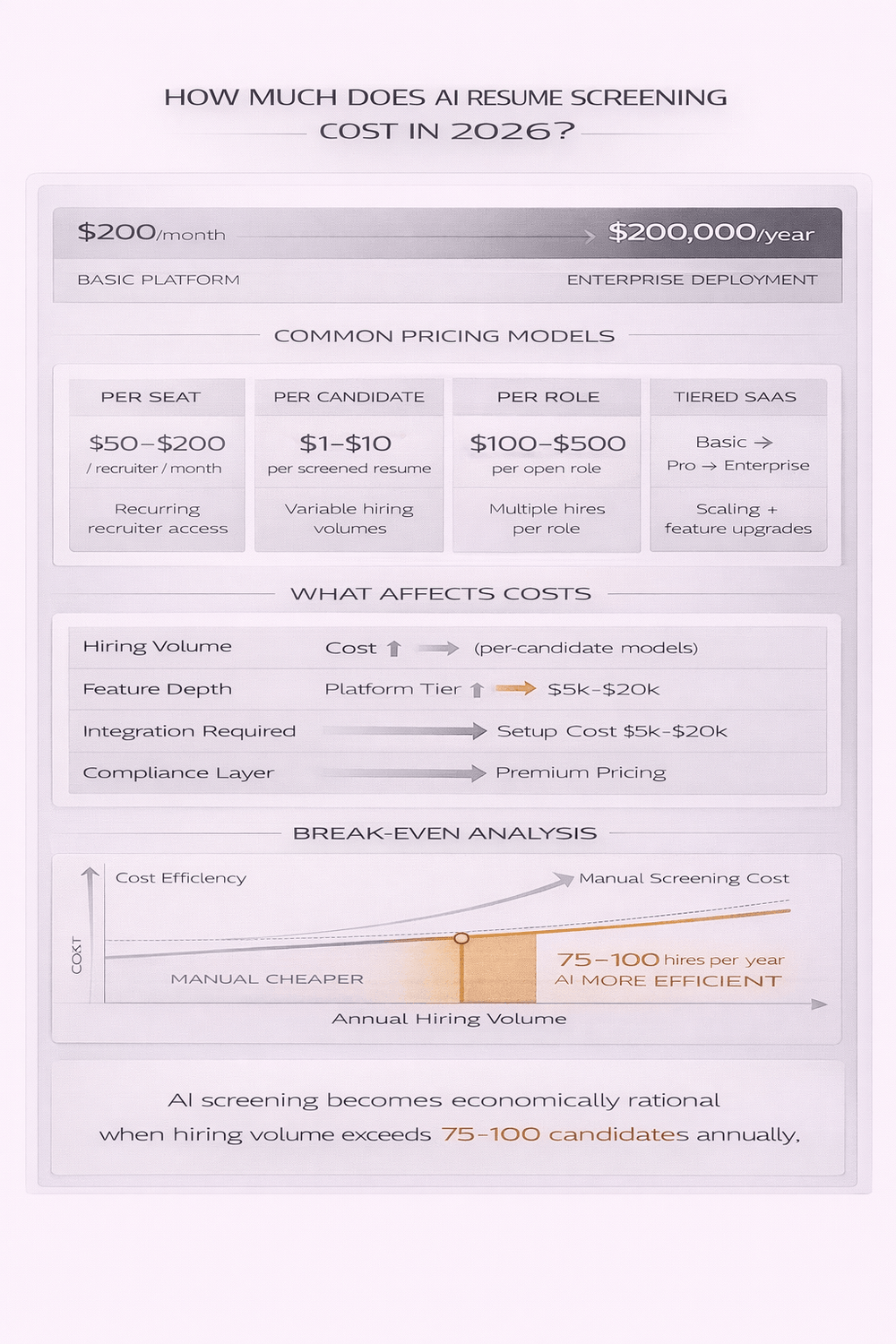
Common Pricing Models
Per-seat subscription: $50-$200 per recruiter per month
Per-candidate pricing: $1-$10 per screened candidate
Per-role pricing: $100-$500 per open role per month
Tiered SaaS:
- Basic: $200-$500/month (up to 50 hires/year)
- Professional: $1,000-$3,000/month (50-200 hires/year)
- Enterprise: $5,000-$15,000+/month (200+ hires/year)
What Affects Pricing
Hiring volume increases costs in per-candidate models. Feature complexity impacts pricing—basic parsing costs less than custom machine learning. Integration requirements add $5,000-$20,000 setup costs. Compliance features command premium rates.
Break-Even Analysis
AI screening makes financial sense when hiring volume exceeds 75-100 candidates per year. With fewer than 50 hires annually, platform costs exceed the time savings value.
How Do You Implement AI Resume Screening?
Implementation follows seven steps over 3-4 months:
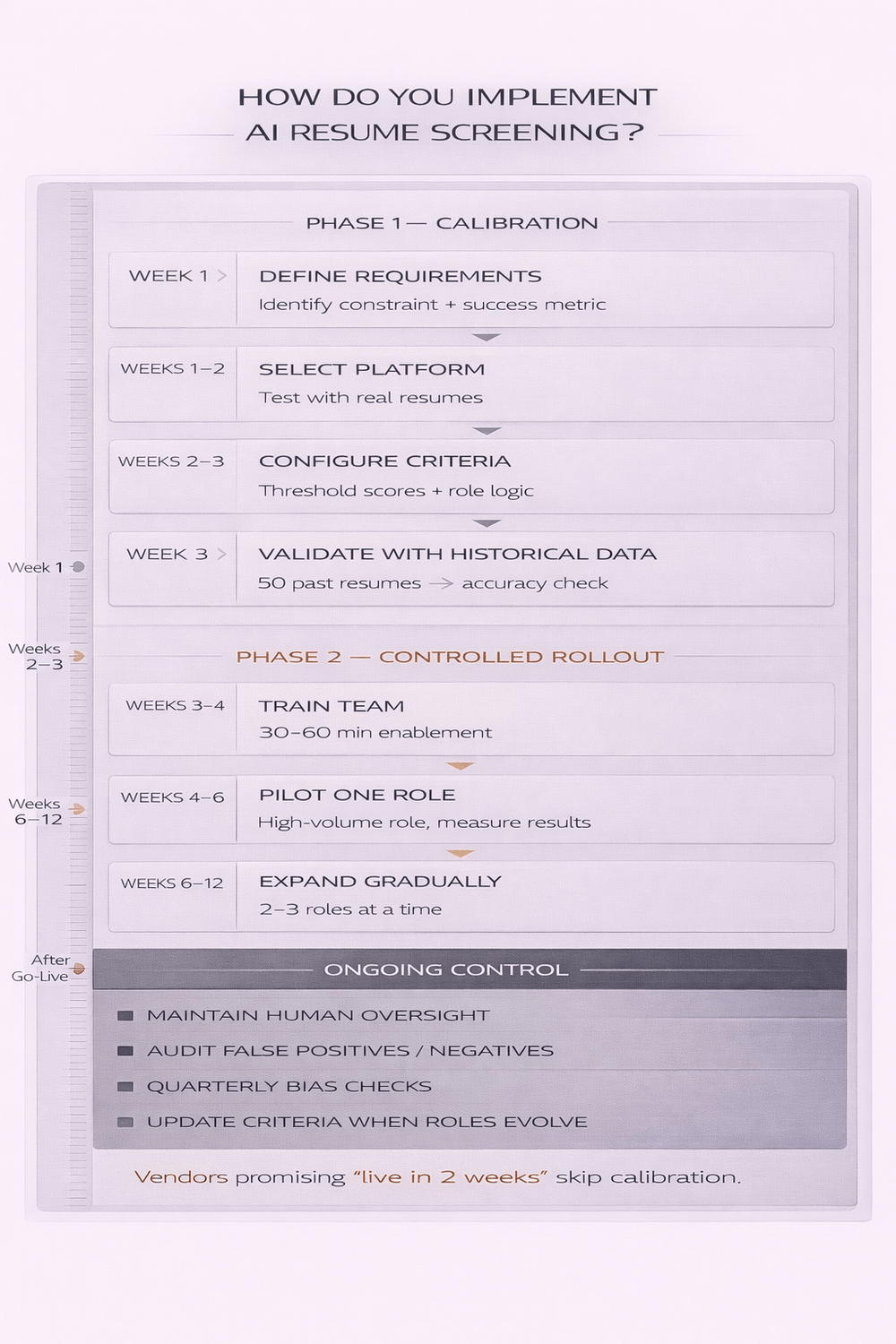
- Define requirements (Week 1) - Identify your constraints and success metrics
- Select platform (Week 1-2) - Test with real resumes, verify integrations
- Configure criteria (Week 2-3) - Define clear requirements and threshold scores
- Test with real data (Week 3) - Run 50 past resumes, check accuracy
- Train team (Week 3-4) - 30-60 minute session for recruiters and hiring managers
- Pilot one role (Week 4-6) - High-volume role, measure results
- Expand gradually (Week 6-12) - Add 2-3 roles at a time, monitor metrics
Critical Success Factors
Define clear, measurable requirements. Test accuracy before full deployment. Maintain human oversight for borderline cases. Audit quarterly for false positives and false negatives. Update criteria when requirements change.
Vendors promising "live in 2 weeks" skip critical testing and calibration.
Which Companies Should Use AI Resume Screening?
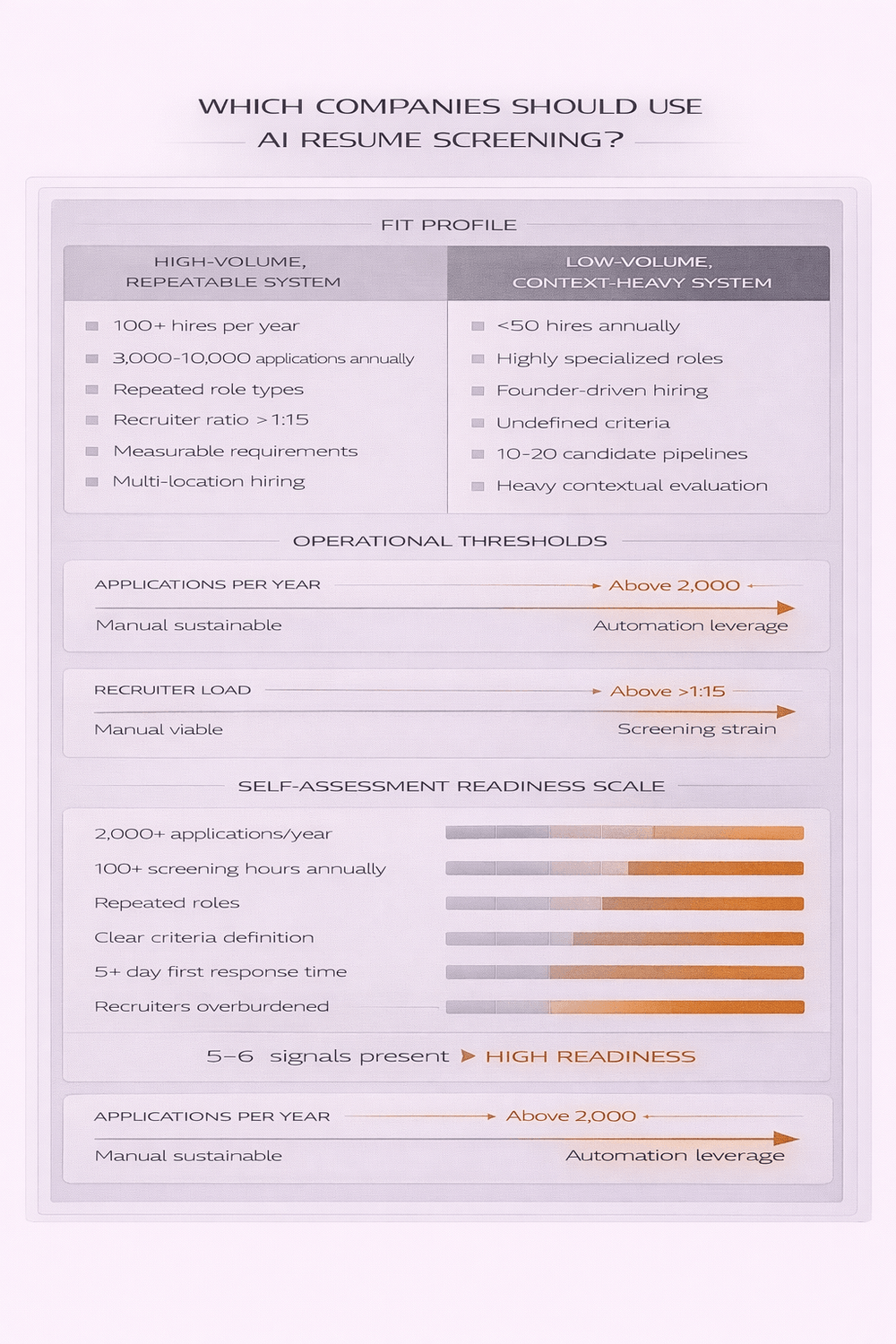
AI resume screening works for organizations with specific profiles:
Strong Candidates
- High-volume hiring: 100+ hires per year processing 3,000-10,000 applications
- Consistent role types: Repeatedly hiring for the same positions
- Recruiter constraints: Ratios exceeding 1:15 open roles per recruiter
- Objective requirements: Measurable criteria like years of experience and technical skills
- Geographic distribution: Hiring across multiple locations simultaneously
Poor Candidates
- Low volume: Under 50 hires per year
- Highly specialized roles: 10-20 qualified candidates don't need automation
- Significant context required: Non-traditional backgrounds are valuable
- Early-stage startups: First 10-20 hires need founder involvement
- Undefined requirements: Can't articulate clear criteria
Self-Assessment
If you answer yes to 5-6 questions, you're a strong candidate for AI screening:
- Process 2,000+ applications per year?
- Manual screening takes 100+ hours annually?
- Hire for same roles repeatedly?
- Can define clear, objective criteria?
- Time-to-first-response currently 5+ days?
- Have 2+ recruiters needing capacity increase?
Key Takeaways
AI resume screening automates initial candidate evaluation by parsing resumes, extracting qualifications, comparing them against requirements, and ranking applicants. Organizations use it to process high volumes faster than manual review while maintaining consistency.
Success requires clear criteria, regular accuracy audits, human oversight for borderline cases, and bias monitoring. Well-configured software achieves 70-85% accuracy and reduces screening time by 75-85%.
The technology works best for high-volume hiring with objective requirements. It struggles with subjective evaluation, non-traditional backgrounds, and nuanced context. Implementation takes 3-4 months and requires ongoing management.
Organizations hiring 100+ people annually typically achieve positive ROI. Those hiring fewer than 50 annually often don't justify platform costs. AI screening replaces resume reading time but cannot replace recruiter judgment, relationship building, or strategic sourcing.